
Why Adding Cooling Without Ductwork Options Compared Matters for Vintage Homes
Adding cooling without ductwork options compared is one of the most common challenges facing owners of older Columbus-area homes — and for good reason. Many vintage houses were built before central air conditioning existed, leaving homeowners with beautiful architecture but no practical way to run traditional duct systems without tearing into walls, ceilings, and original woodwork.
Here’s a quick look at the main no-duct cooling options so you can find your best fit fast:
| Option | Best For | Efficiency | Installation |
|---|---|---|---|
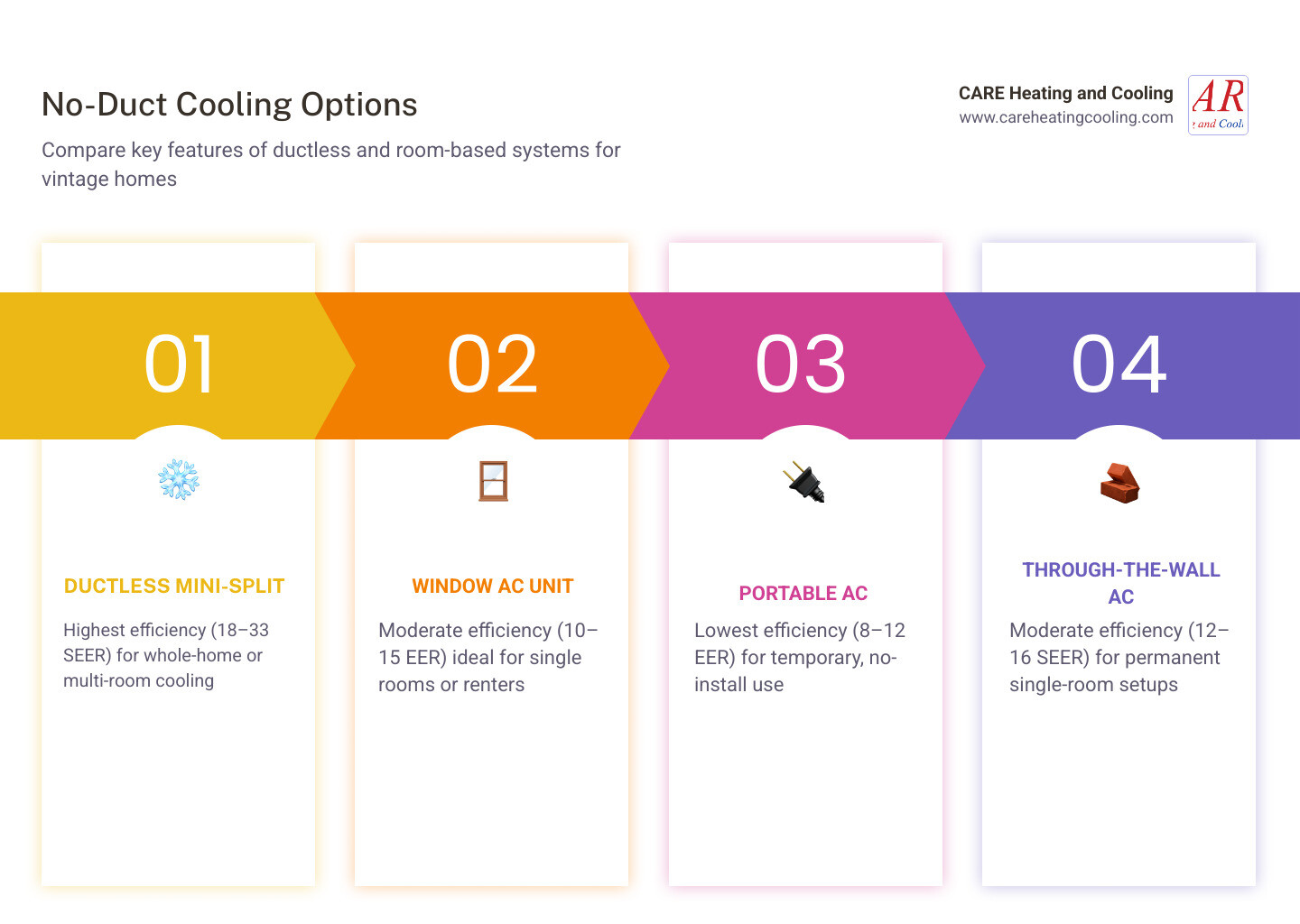
| Ductless mini-split | Whole-home or multi-room cooling | Highest (18–33 SEER) | Professional required |
| Window AC unit | Single rooms, renters, short-term use | Moderate (10–15 EER) | DIY-friendly |
| Portable AC | Temporary or flexible cooling | Lowest (8–12 EER) | No install needed |
| Through-the-wall AC | Permanent single-room solution | Moderate (12–16 SEER) | Moderate complexity |
| Ceiling cassette mini-split | Open-plan spaces, discreet look | High | Professional required |
The good news is that modern ductless technology has made staying cool — without touching a single original plaster wall — more practical and efficient than ever. Traditional ductwork can lose up to 30% of cooling energy through leaks and poor insulation, so skipping ducts entirely isn’t just a workaround — it can actually be the smarter long-term choice.
Whether you’re cooling one room or your entire home, understanding the real differences between these systems helps you spend money wisely and stay comfortable all summer long.
Adding cooling without ductwork options compared: Finding the Right Fit
When we look at adding cooling without ductwork options compared, we aren’t just looking for a machine that blows cold air. We are looking for a solution that respects the history of your home in areas like Clintonville or German Village while providing 21st-century comfort. As of April 2026, efficiency standards have reached new heights, making it easier to find a system that keeps your utility bills low while keeping your indoor air crisp.
The choice usually boils down to three main categories: portable units, window units, and ductless mini-split systems. Portable and window units are often the first thing people think of because they are available at big-box stores. However, they are often noisy, block your view, and struggle to keep up with the humid Ohio summers.
Ductless mini-splits have emerged as the gold standard for vintage homes. These systems consist of an outdoor condenser unit connected to one or more indoor air handlers via small refrigerant lines. This setup allows for incredible flexibility. You can choose a single-zone system to solve uneven cooling with ductless AC in a primary bedroom, or a multi-zone system to cool your entire house.
For homeowners in Dublin or Columbus, the ability to control rooms independently is a game-changer. One outdoor unit can typically support four to six indoor handlers, meaning you don’t need a separate machine for every window.
How mini-splits lead the adding cooling without ductwork options compared
The primary reason mini-splits dominate the conversation when adding cooling without ductwork options compared is their use of inverter-driven compressors. Traditional AC units are either “on” or “off,” which leads to uncomfortable temperature swings and high energy spikes. Inverter technology allows the system to speed up or slow down gradually, maintaining a perfectly steady temperature.
This technology contributes to a massive reduction in energy consumption—up to 40% compared to conventional ducted systems. When you consider that traditional ducts can lose 30% of their energy through leaks, the benefits of installing a mini split AC become very clear. You are paying for the cooling you actually feel, rather than cooling your attic or crawlspace.
Wall-mounted vs. ceiling cassette options
One concern we often hear from owners of historic homes is aesthetics. You’ve spent years preserving original trim and crown molding; you don’t want a “plastic box” ruining the vibe. This is where mini split zoning strategies for home comfort come into play.
- Wall-Mounted Units: The most common and cost-effective. They are sleek and high-performing, usually placed near the ceiling.
- Ceiling Cassettes: These sit flush with the ceiling, with only a decorative grille visible. They are perfect for open-concept areas and offer four-way airflow.
- Floor-Mounted Units: These resemble traditional radiators and are excellent for rooms with low knee walls, like finished attics or half-story bedrooms.
Why Ductless Mini-Splits Outperform Traditional Room Units
If you’ve ever tried to watch a movie in a room with a window AC unit, you know the struggle. Those units often operate at 50–60 decibels (dB), which is roughly the volume of a loud conversation. In contrast, ductless indoor units operate between 25–42 dB. To put that in perspective, 25 dB is quieter than a whisper.
Performance-wise, window and portable units are limited by their design. Portable ACs, especially single-hose models, actually pull warm air into your home through gaps in doors and windows to replace the air they exhaust. This makes them incredibly inefficient. Ductless systems deliver conditioned air directly into the room without creating negative pressure.
For our neighbors in Westerville, switching to ductless means more than just peace and quiet; it means a more secure home. Window units are a known security risk as they can be easily removed from the outside, and they block natural light all summer. A mini-split keeps your windows locked and your view clear.
Preserving Your Home’s Integrity with Non-Invasive Installation
Installing central air in a home built in 1920 usually requires “dropping” ceilings or building “soffits” (bulky boxes) to hide the ductwork. This can destroy the architectural soul of a vintage home. Ductless systems require only a small, 3-inch hole in the exterior wall to pass the refrigerant and electrical lines through.
This minimal disruption is why we frequently recommend these systems for New Albany and Worthington residents who want modern comfort without a major renovation. The installation is fast, often completed in just one or two days, and doesn’t require any major structural changes.
Evaluating adding cooling without ductwork options compared for historic preservation
When we evaluate adding cooling without ductwork options compared for historic preservation, we look at the structural limits of the building. Many older homes have thick masonry walls or intricate lath-and-plaster interiors. Running ducts through these materials is a nightmare.
By opting for a ductless solution in Delaware, you preserve the original plasterwork and avoid the dust and debris associated with a massive construction project. The lineset (the bundle of pipes connecting the units) can often be hidden behind downspouts or tucked away in a discreet “line hide” that matches your home’s exterior color.
Professional installation vs. DIY risks
While “DIY” mini-split kits exist, they come with significant risks. Proper sizing is the most critical step. If a unit is too small, it will run constantly and fail early. If it’s too large, it will “short cycle,” leaving your home feeling clammy and humid.
We use a “Manual J” calculation to determine the exact cooling load of your room based on its size, insulation, and window orientation. Furthermore, handling refrigerant requires specialized tools and EPA certification. In Powell, a professional installation ensures your warranty remains valid and your system operates at peak efficiency from day one.
Maximizing Efficiency and Year-Round Comfort
One of the most impressive features of modern mini-splits is their efficiency rating. While window units hover around 10–15 EER, ductless systems achieve SEER (Seasonal Energy Efficiency Ratio) ratings between 18 and 33. This leap in technology translates directly to lower monthly bills.
But it isn’t just about cooling. Most mini-splits are actually heat pumps. This means they can reverse the cooling process to provide highly efficient heat during the winter. Modern “cold climate” models can provide effective heating even when temperatures outside drop well below freezing.
For residents in Lewis Center, this provides a perfect year-round solution for those notoriously difficult-to-heat rooms, like a sunroom or a finished basement. Following a few temperature tips for ductless AC systems, such as setting a steady temperature rather than constantly adjusting it, will help you get the most out of your investment.
Frequently Asked Questions about Ductless Cooling
Can a mini-split system cool my entire house?
Absolutely. While many people start with a single-zone unit for a specific “hot spot,” multi-zone systems are designed for whole-home comfort. By placing indoor units in the main living areas and bedrooms, you can create a complete cooling network. This is often more efficient than central air because you aren’t wasting money cooling empty guest rooms or hallways.
What maintenance is required for ductless systems?
Maintenance is surprisingly simple. The most important task for homeowners is cleaning the filters inside the indoor units. These are usually washable and should be checked every month during heavy use. Keeping the filters clean ensures optimal airflow and protects the indoor air quality of your home. We also recommend a professional tune-up once a year to check refrigerant levels and clean the outdoor coils.
Are there federal tax credits available for these installations in 2026?
Yes! Under current federal programs, ENERGY STAR-certified ductless heat pumps may qualify for a federal tax credit of up to $2,000. Additionally, many local utility companies in the Columbus area offer rebates for upgrading to high-efficiency equipment. These incentives can significantly offset the initial investment, making the transition to ductless even more appealing.
Conclusion
Living in a vintage home shouldn’t mean suffering through a sweltering Ohio summer. When adding cooling without ductwork options compared, the ductless mini-split stands out as the clear winner for efficiency, quiet operation, and architectural preservation.
At CARE Heating and Cooling, we understand that your home is your sanctuary. Our technicians are paid to fix, not sell, ensuring you get an honest assessment of what your home actually needs. Whether you are in Columbus or any of our surrounding communities, we are here to help you find the perfect ductless solution.
Ready to experience a cooler, more comfortable home without the hassle of ductwork? Give us a call today and let’s talk about the best way to keep your vintage home chill.