
The Ducted vs. Ductless Dilemma: What Columbus Homeowners Need to Know First
A central ac vs ductless mini split comparison comes down to one core question: does your home already have ductwork, and how well is it actually working?
Here is a quick breakdown to help you decide:
| Factor | Central AC | Ductless Mini Split |
|---|---|---|
| Requires ductwork | Yes | No |
| Efficiency (SEER2) | 15-21+ | 18-38+ |
| Energy loss | Up to 30% via ducts | Near zero |
| Zoning control | Limited (costly to add) | Built-in, per room |
| Best for | Homes with existing ducts, larger spaces | No-duct homes, additions, problem rooms |
| Typical lifespan | ~15 years | 20-30 years |
| Installation disruption | High (if new ducts needed) | Minimal (3-inch wall hole) |
| Heating capability | Cooling only (needs furnace) | Most models heat and cool |
If you have good existing ductwork and want whole-home cooling with invisible vents, central AC is a strong choice. If you want room-by-room control, higher efficiency, or need to cool a space without tearing into walls, a ductless mini split is hard to beat.
Still, no system is the right fit for every home. The truth is that both have real strengths — and real trade-offs. Your layout, your habits, your home’s age, and even your local climate in Central Ohio all play a role in which system actually makes sense for you.
Search online and you will find plenty of strong opinions on both sides. One person swears mini splits are the future of home comfort. The next insists central air is the only serious option for a whole house. Somewhere in the middle is the honest answer — and that is exactly what this guide is here to give you.
Understanding the Central AC vs Ductless Mini Split Comparison
When we look at the mechanics of home comfort, both systems share a common goal: removing heat from your indoor air and moving it outside. However, the way they achieve this is fundamentally different.
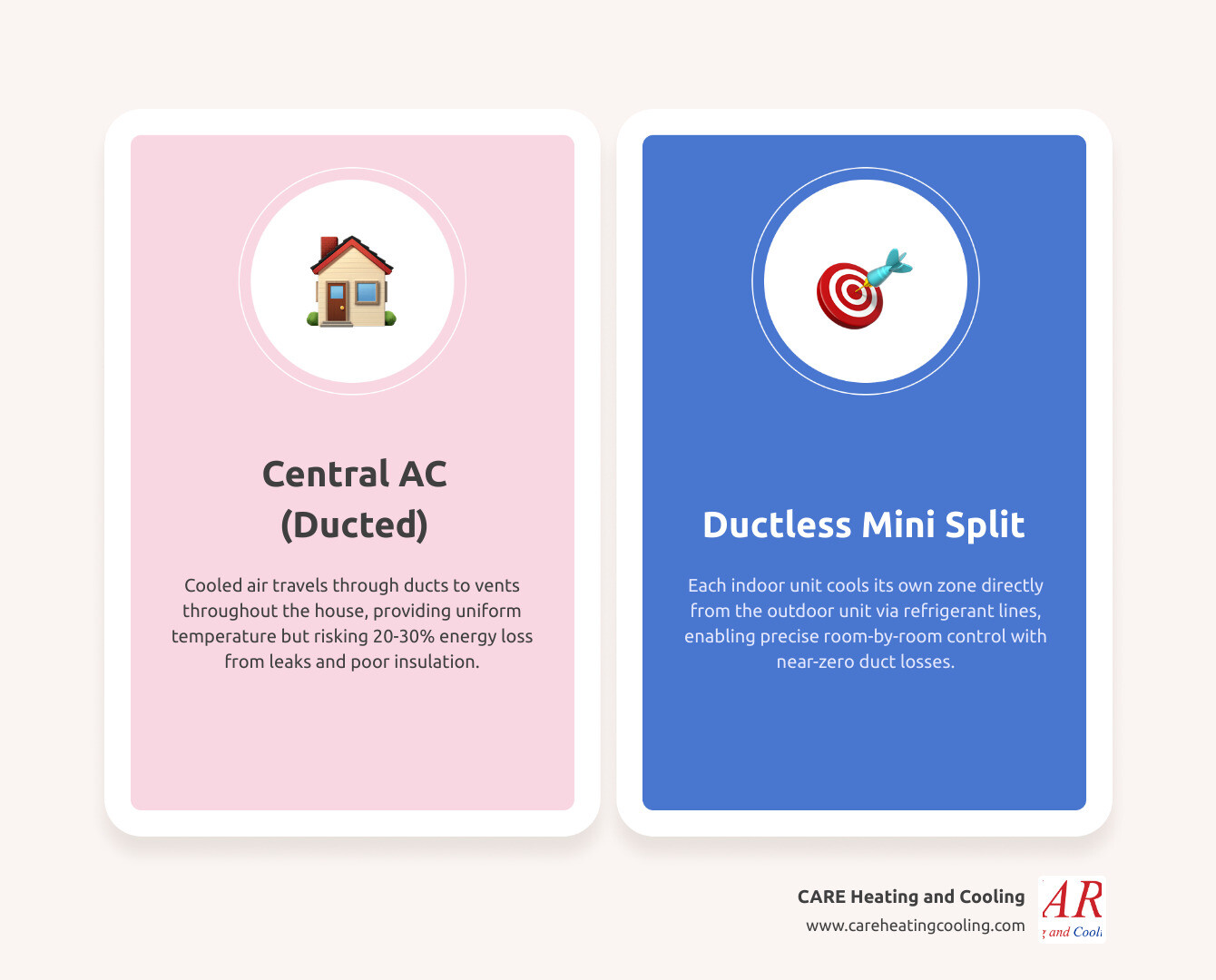
Air Conditioners that function as central systems are “forced-air” units. They use a large outdoor condenser and an indoor evaporator coil (usually sitting on top of your furnace) to chill the air. A powerful blower then pushes that air through a network of hidden ducts and out through floor or ceiling vents. It is a “blanket” approach—one thermostat tells the whole house to reach one temperature.
On the other hand, Ductless AC—often called a mini split—eliminates the middleman (the ducts). These systems consist of an outdoor unit connected to one or more indoor air handlers by small refrigerant lines and electrical wiring. Instead of cooling air in the basement and pushing it through 50 feet of metal pipe, the indoor unit sits right on your wall and cools the room directly.
Choosing The Right AC Installation for Home depends largely on your “bones.” If you live in a historic home in Clintonville or a slab-foundation house in Westerville where there is no room for bulky ducts, the mini split is often the only practical choice. If you have an existing 2,500-square-foot home in Dublin with functional ducts, central air remains a reliable standard.
Which system is more energy efficient for my Columbus home?
Efficiency is where the central ac vs ductless mini split comparison gets really interesting. In the HVAC world, we measure this using SEER2 (Seasonal Energy Efficiency Ratio 2). As of April 2026, standards have pushed equipment to be greener than ever, but ductless systems still hold the crown for raw efficiency.
| Efficiency Metric | Central AC (High-End) | Ductless Mini Split (High-End) |
|---|---|---|
| Max SEER2 Rating | ~26 SEER2 | 30-42 SEER2 |
| Duct Energy Loss | 25% to 30% | 0% |
| Compressor Type | Single/Two-Stage or Variable | Inverter-Driven Variable Speed |
The Department of Energy estimates that typical duct systems lose about 25% to 30% of cooling energy through leaks, poor insulation, or “thermal bypass” (where cool air escapes into an unconditioned attic or crawlspace). It’s like buying a gallon of milk but having 30% of it leak out of the bag before you get home. Ductless systems sidestep this entirely because they don’t use ducts.
Furthermore, many modern systems like the Daikin Fit Columbus homeowners often choose use inverter technology. Unlike traditional units that are either “all on” or “all off,” inverter-driven compressors act like a dimmer switch. They ramp up and down to maintain a steady temperature, using only the exact amount of electricity needed.
Why a central ac vs ductless mini split comparison favors zoning
Have you ever fought over the thermostat? Maybe the upstairs bedrooms in your Upper Arlington home are sweltering while the basement feels like a meat locker. This is where you can Solve Uneven Cooling with Ductless AC.
Mini splits offer native zoning. Each indoor head has its own thermostat. Using Mini Split Zoning Strategies for Home, you can cool your home office to 72°F during the day while leaving the guest rooms at 78°F. Central AC usually treats the whole house as one zone, meaning you waste money cooling rooms nobody is using.
Efficiency standards in a central ac vs ductless mini split comparison
Under the Inflation Reduction Act, many high-efficiency heat pump systems (which include most mini splits) qualify for significant federal tax credits. These incentives are designed to help homeowners move toward systems that meet higher SEER2 and HSPF2 (heating efficiency) benchmarks. Because mini splits are inherently more efficient, they frequently meet the highest tiers for these rebates.
How do installation and aesthetics differ for Westerville properties?
The installation process is a major factor in the central ac vs ductless mini split comparison. If we are performing an Air Conditioner Installation in a home that already has ducts, central air is a straightforward swap.
However, if you are adding AC to an older home or a new addition, AC Install for a central system can be invasive. It might involve tearing into drywall, losing closet space for duct runs, and weeks of construction mess. A mini split installation is much cleaner; we typically only need to drill a small 3-inch hole in the exterior wall to pass the refrigerant and power lines through.
Aesthetics in a central ac vs ductless mini split comparison
Aesthetics are subjective. Central air is virtually invisible—all you see are small floor or ceiling grilles. For many homeowners in areas like Bexley or Powell, this “hidden” look is preferred for interior design.
Ductless systems require an indoor unit in every room you want to cool. While modern designs are sleek, they are still visible. However, you have options beyond the standard wall-mount. Daikin Ductless Westerville installations can include:
- Ceiling Cassettes: These sit flush with the ceiling, showing only a grille.
- Floor-Standing Models: These look similar to a radiator and sit low on the wall.
- Slim-Duct Units: These are hidden behind a wall or in a soffit, giving you a ductless feel with a ducted look.
To keep the outside of your home looking sharp, we use “line hides.” These are decorative covers that match your siding, neatly tucking away the copper lines so they don’t look like messy “spaghetti” on the side of your house.
Noise levels in a central ac vs ductless mini split comparison
If you are sensitive to noise, the mini split is the clear winner. Most indoor mini split units operate between 19 and 26 decibels—that is quieter than a whisper or a library. Central AC involves the sound of a large blower motor and the “whoosh” of air moving through metal ducts, which can be quite noticeable when the system kicks on.
There are many Benefits of Installing a Mini Split AC, but the peace and quiet is often the one our customers in quiet neighborhoods like Galena appreciate the most.
Maintaining comfort and air quality in Central Ohio
Both systems require regular attention to stay efficient. For central air, Air Conditioning Service usually involves changing a large 1-inch to 5-inch pleated filter every 1 to 3 months. Central systems are excellent for air quality because they can use high-MERV filters that trap tiny allergens, smoke, and dust from the entire house.
Ductless systems use smaller, washable filters. These need to be rinsed out every 2 to 4 weeks, especially if you have pets. Because they don’t have ducts, they don’t circulate dust from the basement throughout the house, but they also don’t provide the same level of whole-home HEPA-style filtration that a central system can.
If you skip maintenance, you might run into Airflow Problems in Mini Splits. Over time, dust can build up on the internal fan wheel, requiring a professional deep cleaning. Additionally, in our humid Ohio summers, Humidity Problems with Ductless AC can occur if the system isn’t sized correctly, as mini splits are so efficient they may not run long enough to pull moisture from the air unless they are set properly.
Whether you need a routine check-up or an emergency AC Repair, keeping your system clean is the #1 way to ensure it hits that 15 to 20-year lifespan.
Frequently Asked Questions
Can a ductless system provide heating during Ohio winters?
Yes! Most ductless mini splits are actually “heat pumps.” They can reverse their operation to pull heat from the outdoor air and move it inside. Modern cold-climate models can provide efficient heat even when Columbus temperatures drop well below zero. They are much more efficient than electric baseboard heat and can serve as a primary heat source or supplemental warmth for a chilly basement.
Finding the right Temperature Settings for Mini Split AC units in winter is key to staying cozy without overworking the system.
Is a hybrid approach using both systems viable?
Absolutely. We often see this in homes in Lewis Center or Hilliard. A homeowner might have a perfectly good central AC for the main house but has a “bonus room” over the garage or a finished attic that never stays cool. Instead of trying to force more air through existing ducts, we install a Room Cooling Ductless AC Lewis Center unit just for that space. This gives you the best of both worlds: invisible cooling for the main areas and surgical precision for the problem spots.
How long do these systems typically last?
Central AC units typically last about 15 years in the Columbus area. Ductless mini splits, because they use inverter technology and experience less “mechanical stress” from frequent on/off cycling, can often last 20 to 30 years with proper care. The key to longevity for both is annual professional maintenance to check refrigerant levels and electrical connections.
Conclusion
At the end of the day, the central ac vs ductless mini split comparison isn’t about finding a “winner”—it’s about finding the right tool for your specific home. Whether you are looking for the whole-home uniformity of a central system or the high-efficiency zoning of a ductless unit, the decision should be based on your comfort and your budget.
At CARE Heating and Cooling, we take pride in being a different kind of HVAC company. As a BBB Torch Award for Ethics winner, our technicians are paid to fix your problems, not to hit sales quotas. We serve neighbors across Columbus, from Dublin to Pickerington and everywhere in between, with honest advice and expert service.
Ready to see which system fits your lifestyle? Schedule your Columbus mini-split consultation today and let us help you find the perfect chill for your home.