Why a Noisy Furnace is More Than Just an Annoyance
If your furnace making loud noise has you concerned, you’re right to take it seriously. Here’s what you need to know immediately:
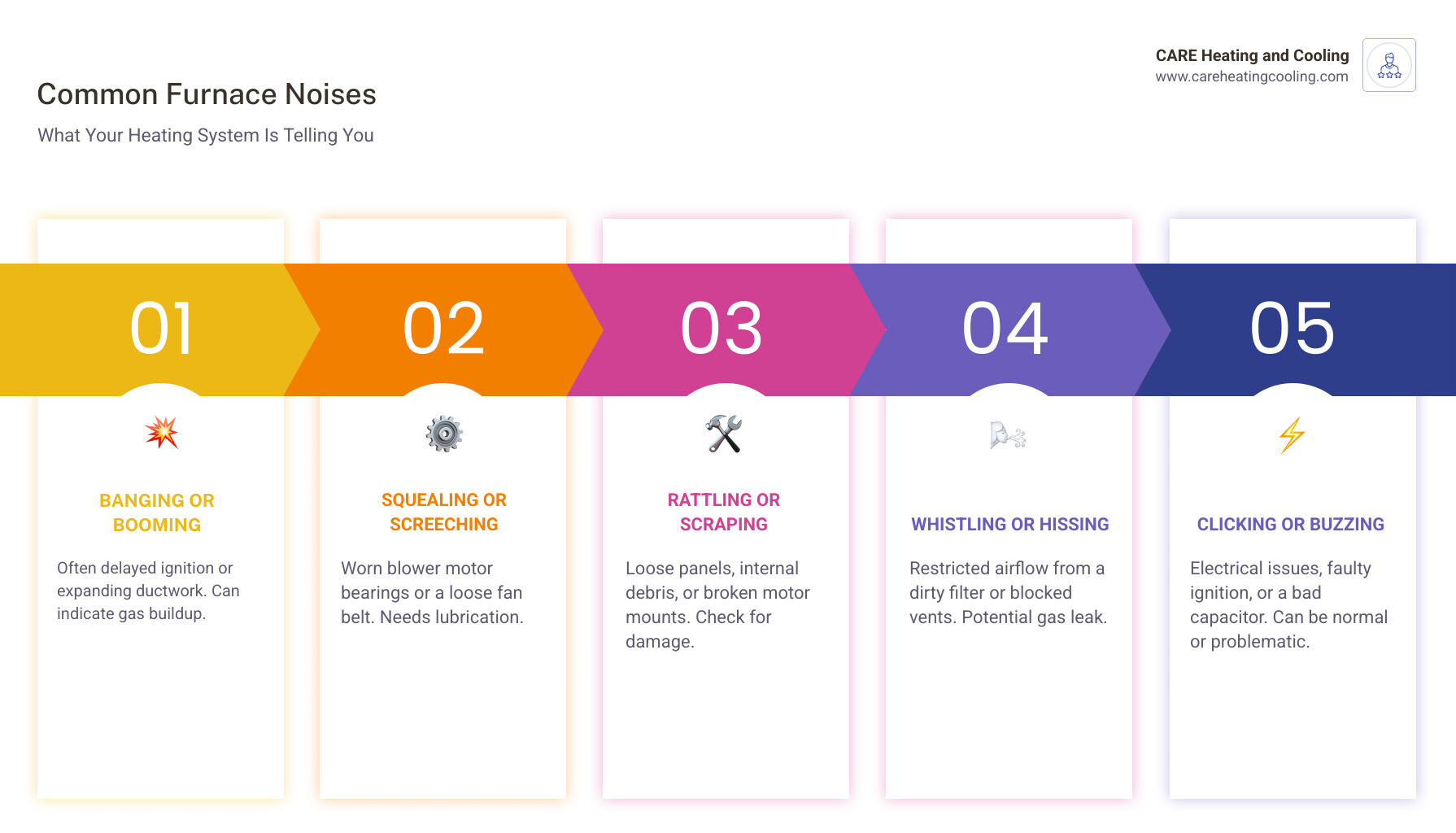
Common Furnace Noises and Their Meanings:
- Banging/Booming – Delayed ignition or ductwork expansion
- Squealing/Screeching – Blower motor or belt problems
- Rattling/Scraping – Loose parts or debris in the system
- Whistling/Hissing – Airflow restrictions or potential gas leaks
- Clicking/Buzzing – Electrical issues or ignition problems
Modern furnaces are designed to run quietly. When your heating system suddenly starts making strange sounds, it’s trying to tell you something important. These noises aren’t just annoying – they’re warning signs that could indicate anything from a simple maintenance issue to a serious safety hazard.
Don’t ignore these sounds. What starts as a minor rattling noise can quickly turn into a complete system breakdown, leaving you without heat when you need it most. Even worse, some furnace noises signal dangerous conditions like gas leaks or carbon monoxide risks.
The good news? Many furnace noise problems have straightforward solutions when caught early. This guide will help you identify what your furnace is trying to tell you and when to call for professional help.
A Symphony of Malfunction: Decoding Common Furnace Noises
When your furnace starts performing a new, loud “song,” it’s a clear signal that something within the system needs attention. Let’s break down the different sounds your furnace might make, what they typically mean, and the potential mechanical issues behind them. Understanding these can help us pinpoint the problem and decide on the best course of action.
Banging or Booming: The Sound of a Small Explosion
A loud bang or boom from your furnace can sound like a mini-explosion, and it’s always alarming. This noise is frequently caused by delayed ignition.
When gas builds up in the combustion chamber before igniting, it creates a small burst when the burners finally fire. This can happen if your gas burners are dirty, preventing them from igniting immediately. Over time, grime can accumulate on the burners, leading to this dangerous delay. Beyond the startling noise, this issue can put undue stress on your furnace’s components, including the heat exchanger, and can even pose a fire hazard.
Another common culprit for banging noises is your ductwork. As hot air rushes through thin metal ducts, they expand. When the furnace shuts off and the air cools, they contract. This expansion and contraction can create loud banging or popping sounds. While often less serious than delayed ignition, persistent duct noise can indicate issues with duct sizing or inadequate airflow.
What to do if you hear a loud bang: If you hear a loud bang or boom, especially right when the furnace turns on, we strongly recommend turning off your furnace immediately. Do not try to relight it. This is a safety concern that needs professional attention. For a comprehensive list of what to watch out for, check out our guide on Signs Your Furnace Needs Repair.
Squealing or Screeching: A Cry for Help from the Motor
A high-pitched squeal or screech from your furnace is a clear sign that your blower motor is in distress. The blower motor is the heart of your furnace’s air circulation system, responsible for pushing warm air through your home.
Over time, the bearings within the blower motor can wear out or lose their lubrication, creating friction and that tell-tale squealing sound. Similarly, if your furnace uses a fan belt (common in older models), it might be worn out or loose, causing it to slip and squeal. A screeching sound can also be a precursor to an entire system breakdown, indicating the motor is malfunctioning.
Ignoring these sounds can lead to the blower motor seizing up completely, leaving you without heat and facing a more expensive repair. Regular maintenance, including lubricating the motor, can often prevent these issues.
When to call an HVAC tech: If you hear persistent squealing or screeching, it’s time to call in the experts. Our trained technicians can diagnose whether it’s a lubrication issue, worn bearings, or a faulty belt. Learn more about common issues and solutions in our guide on Heating Repair Problems and Solutions.
Rattling or Scraping: When Parts are Out of Place
When your furnace sounds like a can full of nuts and bolts, it’s typically a sign that something is loose, broken, or has come detached inside the unit.
- Loose panels or debris: Sometimes, the simplest explanation is the right one. A rattling noise could be as straightforward as a loose access panel or small debris that has fallen into the blower assembly.
- Broken motor mounts: If the mounts holding your blower motor in place become worn or broken, the motor can vibrate excessively, leading to a loud rattling sound.
- Cracked heat exchanger: This is a much more serious concern. A rattling or cracking noise could indicate a crack in the heat exchanger. A cracked heat exchanger is dangerous because it can allow carbon monoxide (CO), a colorless and odorless toxic gas, to leak into your home. According to the U.S. Environmental Protection Agency (EPA), CO is a serious health risk.
- Blower wheel hitting casing: A harsh, metal-on-metal scraping sound often points directly to the blower wheel. If unbalanced or loose, the blower wheel can scrape against the furnace casing, causing significant damage if not addressed quickly.
A persistent rattling noise can indicate loose or damaged components. For more detailed insights, refer to our article on Common Furnace Problems Call for Repair.
Whistling or Hissing: A Sign of Airflow or Gas Issues
Some furnace noises might sound like a simple draft, but they can signal both common maintenance needs and critical safety hazards.
- Clogged air filter: This is the most common cause of whistling. When your air filter becomes clogged, airflow to the furnace is severely restricted. Air struggling to pass through the dense filter creates a whistling sound. A dirty filter also forces your furnace to work harder, reducing efficiency and potentially leading to overheating.
- Blocked vents or leaky ductwork: Similarly, blocked vents or leaks in your ductwork can cause air pressure imbalances, leading to whistling or hissing sounds.
- Gas leak danger: This is the most serious potential cause of a hissing sound. If you hear a distinct hissing sound accompanied by the smell of rotten eggs (the odor added to natural gas for detection), you might have a gas leak. This is not a situation to ignore.
What to do if you smell gas: If you suspect a gas leak, turn off your furnace immediately, evacuate your home, and call your gas company and emergency services from a safe location outside. For safety tips, consult our guide on What to do if you smell gas. Regular maintenance, including filter changes, can prevent many airflow issues. Find more tips in Furnace Maintenance Tips for Homeowners.
Clicking, Buzzing, or Humming: The Electrical Connection
Your furnace’s complex electrical system can sometimes be the source of noise.
- Normal startup clicking: A few clicks right after your thermostat kicks in is usually just the sound of your ignition system engaging. This is a perfectly normal operational sound.
- Repeated clicking: However, if you hear repeated clicking at startup and the furnace doesn’t ignite, it’s a sign of a problem. This often means the gas burners are failing to ignite, which can be a safety concern.
- Buzzing or humming: A persistent buzzing or humming sound often points to an electrical issue, such as a faulty capacitor or a problem with the transformer box.
- Electrical fire risks: Any unusual electrical noises should be taken seriously. A faulty electrical component can overheat and pose a fire risk. If you suspect an electrical issue, it’s best to turn off the furnace and contact a professional.
For solutions to these and other electrical concerns, see our article on Common HVAC Repair Issues and Solutions.
Your First Line of Defense: Simple Troubleshooting for a Furnace Making Loud Noise
When your furnace making loud noise has you worried, don’t panic. Sometimes the simplest solutions are the most effective. Before you call in the professionals, there are several straightforward troubleshooting steps you can try that might solve the problem.
Let’s start with the basics. Check your thermostat settings first. Make sure your thermostat is set to “Heat” and that the temperature setting is higher than your current room temperature. Sometimes a furnace will cycle on and off repeatedly when settings are incorrect, creating unusual sounds.
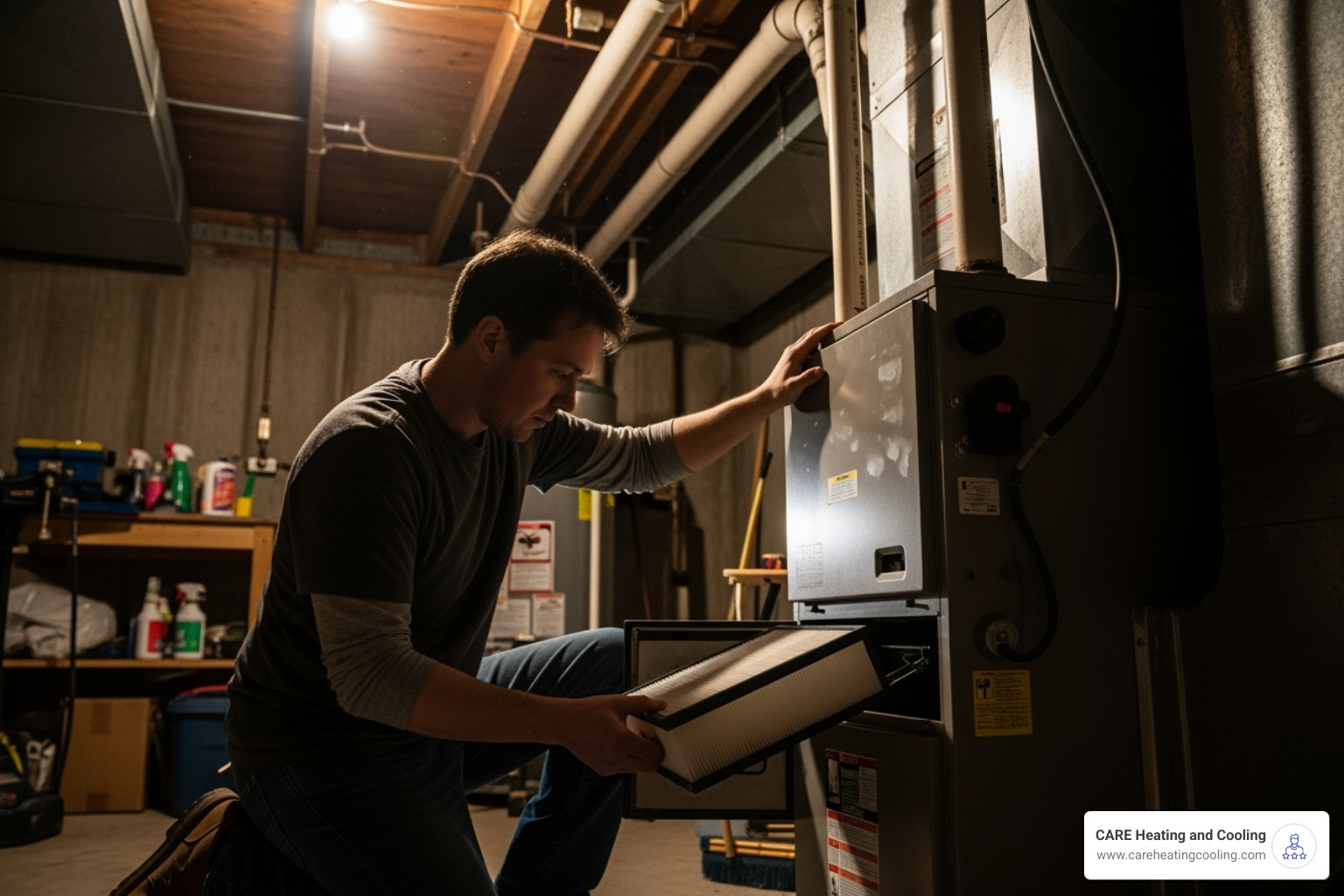
Next, take a look at your air filter. This component is often the culprit behind whistling or hissing sounds. A clogged filter forces your furnace to work much harder than it should, creating strain and noise throughout the system.
We recommend checking your filter every 30 days and changing it at least every three months. It’s better to run your furnace without a filter for a short time than with a severely clogged one. A dirty filter can damage your fan motor or heat exchanger, leading to much bigger problems. Keep a few backup filters on hand so you’re never caught without one!
Now, let’s look around your furnace itself. Clear the area around your unit of any clutter, especially anything flammable. Make sure nothing is blocking the intake or exhaust vents. Your furnace needs room to breathe, and blocked airflow creates strain that often shows up as noise.
Take a quick walk through your home and check all your vents and registers. Are they open and unblocked? Furniture or drapes can restrict airflow in your ductwork, leading to whistling or banging sounds. Opening blocked vents often provides immediate relief.
Finally, give your furnace a gentle visual inspection. Look for any loose access panels on the unit itself. Sometimes a rattling noise is nothing more than a panel that’s come loose and vibrates when the furnace runs. A few minutes with a screwdriver might be all you need to restore peace and quiet.
These simple maintenance steps can often resolve minor noise issues right away. They’re also great habits that will help keep your system running smoothly. For more helpful tips, check out our comprehensive guide on Furnace Maintenance Tips for Homeowners.
If these troubleshooting steps don’t solve your noisy furnace problem, don’t worry – that’s what we’re here for!
When to Call a Professional for Your Noisy Furnace
While some furnace noises can be resolved with simple DIY fixes, others are serious warning signs that demand immediate professional attention. Knowing the difference can save you from costly repairs, uncomfortable nights, and even dangerous situations.
Think of it this way: your furnace is trying to tell you something important. Sometimes it’s just clearing its throat (normal operational sounds), but other times it’s shouting for help. Let’s learn to recognize when your furnace is truly calling for backup.
Red Flags: Noises That Signal Immediate Danger
Some sounds signal immediate danger and require you to turn off the furnace and call for help right away.
Loud bangs, especially at startup, are never something to ignore. As we discussed earlier, this often points to delayed ignition and gas buildup. Each bang represents a small explosion that could become a bigger problem.
Hissing combined with that unmistakable rotten egg smell is your furnace’s way of screaming “gas leak!” If you smell it, don’t hesitate – evacuate your home immediately and call your gas company and emergency services from a safe location outside.
A persistent rumbling noise might sound harmless, but it can indicate a cracked heat exchanger. This is particularly dangerous because it can allow carbon monoxide to leak into your home. Carbon monoxide is invisible and odorless, making it a silent threat. This is why working carbon monoxide detectors are so important.
Metal-on-metal scraping sounds mean something inside your furnace is hitting something it shouldn’t be. Usually, this involves the blower wheel, and continuing to run your furnace in this condition can cause extensive damage.
When you hear any of these danger signals, your furnace making loud noise has crossed the line from annoying to hazardous. For immediate assistance, check out our guide on Signs You Need Immediate HVAC Repair.
Recognizing End-of-Life Sounds in an Old Furnace
Sometimes, a furnace making loud noise isn’t crying for repair – it’s saying goodbye. After about 18 years, even the best furnaces start showing their age with new and persistent noises.

An aging furnace often develops multiple new noises that seem to appear out of nowhere. What starts as occasional rattling might evolve into constant humming, with some squealing thrown in for good measure.
Frequent repair calls are another telltale sign. If you’re on a first-name basis with your HVAC technician, your furnace might be telling you it’s time to retire. Each repair fixes one problem, but new noises keep appearing because the overall system is wearing out.
Inconsistent heating performance often accompanies these end-of-life sounds. Your furnace might be working harder than ever (hence the noise) but delivering less consistent comfort.
We’re paid to fix your furnace, not sell you a new one. But sometimes, the most honest advice is that replacement makes more financial sense than continued repairs. A new, efficient furnace will run quietly and save you money on energy bills. To help you recognize when replacement might be your best option, take a look at our guide on Signs You Need New Furnace Installation.
Why ignoring a furnace making loud noise is a costly mistake
It’s tempting to live with the noise if your furnace is still producing heat, but this approach almost always backfires.
Small problems become big problems when left alone. A loose part rattling today could break off tomorrow and damage other components. A simple clogged filter, if ignored, can burn out your blower motor.
Your wallet will feel the impact through higher energy bills. A struggling furnace consumes more fuel to produce the same amount of heat.
The safety risks we’ve discussed – carbon monoxide leaks, gas buildup, electrical hazards – don’t improve with time. They get worse.
Perhaps most frustrating is complete system failure at the worst possible moment, like during the coldest weeks of winter, leaving you scrambling for emergency service when HVAC companies are busiest.
Regular maintenance helps prevent many of these issues by catching problems while they’re still small. Think of it as an investment in your comfort, safety, and financial well-being. Learn more in our article on the Importance of Regular Furnace Service.
Frequently Asked Questions About Loud Furnace Noises
We get calls about noisy furnaces daily in Columbus. Answering these questions often leads to simple solutions that save homeowners worry and money!
Can a dirty air filter really make my furnace so loud?
You bet it can! We’re always amazed at how many noise complaints we solve with a simple filter change. It’s like the furnace equivalent of clearing your throat.
When your air filter gets clogged with dust and pet hair, your furnace has to work overtime just to breathe. It’s like trying to drink a thick milkshake through a tiny straw – that’s what your furnace making loud noise is experiencing with a dirty filter.
Here’s what happens: restricted airflow forces air to squeeze through tiny spaces, creating whistling and hissing sounds. Meanwhile, your blower motor is straining, which can lead to humming, vibrating, or even squealing as parts wear out faster.
The real kicker? All this extra work means reduced efficiency and higher energy bills. In extreme cases, your furnace might even overheat and shut itself down as a safety measure.
We tell all our customers to check their filter monthly – it takes about 30 seconds and can save you from a lot of headaches.
What’s the difference between furnace noise and ductwork noise?
We get this one a lot, especially from homeowners who hear mysterious banging sounds. The trick is playing detective with your ears.
Furnace noise happens right at the unit itself. If you walk to your furnace and the sound is loudest when you’re standing next to it, then you’re dealing with a component inside the unit, like the blower motor or burners.
Ductwork noise, on the other hand, seems to come from everywhere at once. You’ll hear it through your walls or near vents. The most common duct noise is banging or popping that happens as thin metal ducts expand with hot air, then contract as they cool. It’s like a metal symphony playing throughout your house.
While duct noise is usually more annoying than dangerous, persistent banging can sometimes indicate airflow problems we can help address.
What should I do about a gas furnace making loud noise on startup?
This is a question that requires immediate action. If your gas furnace goes “BANG!” or “BOOM!” right when it starts up, we’re talking about potential delayed ignition – and that’s not something to mess around with.
Here’s what’s happening: gas is building up in the combustion chamber before it finally ignites, creating that scary explosive sound. This gas buildup is a real safety concern.
Turn off your furnace immediately – find the power switch (usually looks like a regular light switch on or near the unit) and flip it off. Don’t try to restart it – we can’t stress this enough.
This is definitely a “call the professionals” moment. The problem could be dirty burners, a faulty igniter, or gas pressure issues – all things that require trained eyes and proper tools to fix safely. Our technicians see this issue regularly and know exactly how to diagnose and resolve it without putting your family at risk. Your safety is worth more than the cost of a call for furnace repair.
Conclusion: Trust the Experts for a Quiet, Safe, and Warm Home
When your furnace making loud noise starts disrupting your peace of mind, those sounds are your heating system’s way of asking for help. Whether it’s a gentle squeal calling for a bit of lubrication or an alarming bang warning of a serious gas issue, each noise tells a story that shouldn’t be ignored.
Throughout this guide, we’ve walked through the most common furnace sounds and what they mean. The key takeaway? Don’t ignore loud furnace noises. What might seem like a minor annoyance today could turn into a major repair tomorrow, or worse, a safety hazard for your family.
Prioritizing safety and efficiency isn’t just about comfort – it’s about protecting your home and your loved ones. A whistling filter might just need changing, but a hissing sound with a gas smell requires immediate evacuation and professional help. Learning to distinguish between these sounds can make all the difference.
At CARE Heating and Cooling, we’ve built our reputation on doing right by our customers. We’re proud to have earned the BBB Torch Award for Ethics, which reflects our commitment to honest, transparent service. Here’s what makes us different: our technicians are paid to fix, not sell. This means when we come to your home, we’re focused on solving your problem, not pushing you toward an expensive replacement you might not need.
This approach has led to consistently high customer satisfaction because you can trust that our recommendations are genuinely in your best interest. We believe in giving you all the information you need to make the right decision for your home and budget.
If you’re dealing with a noisy furnace in the Columbus area, you don’t have to suffer through another sleepless night wondering if that sound is dangerous. Our experienced technicians can quickly diagnose the issue, explain what’s happening in plain English, and get your system running quietly and safely again.
Ready to restore peace and quiet to your home? Schedule your HVAC repair service in Columbus, OH with us today. We’re here to help you get back to enjoying a warm, comfortable, and blissfully quiet home.