
Why Gas Leak Warning Signs Every Homeowner Should Know Can Save Your Life
Gas leak warning signs every homeowner should know are more urgent than most people realize — and far easier to miss than you’d expect. Natural gas is colorless and odorless on its own. Without the added chemical that makes it smell, you could be living with a dangerous leak and never notice.
Here’s a quick summary of the most common warning signs:
- Rotten egg or sulfur smell indoors or near appliances
- Hissing or whistling sounds near gas lines, meters, or appliances
- Dead or dying patches of grass or plants above buried gas lines
- Bubbling in puddles or standing water in your yard
- Unexplained increases in your gas bill
- Physical symptoms like headaches, dizziness, nausea, or fatigue that improve when you leave the house
- Pet behavior changes such as lethargy or disorientation
Over 189 million Americans use natural gas in their homes. That’s a lot of households where a slow, silent leak could go undetected for weeks. And the stakes are high — gas becomes explosive at just 5 to 15 percent concentration in air.
The good news? These leaks leave clues. Knowing what to look, listen, and feel for puts you in a much stronger position to protect your family before a small problem becomes a serious emergency.
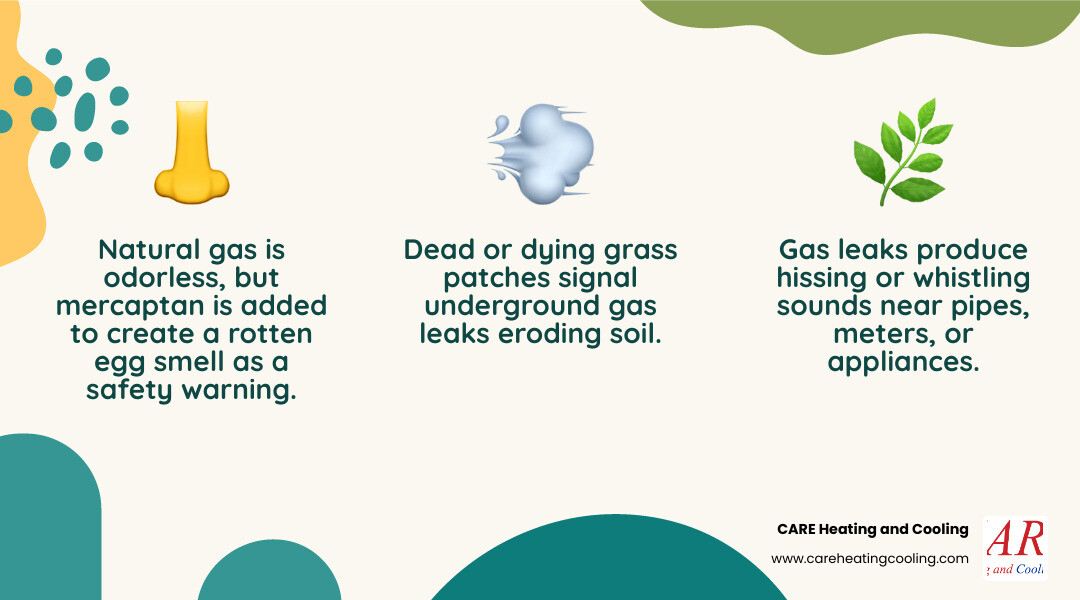
Sensory Gas Leak Warning Signs Every Homeowner Should Know
When we talk about natural gas, we are mostly talking about methane. In its natural state, methane is a bit of a ghost—you can’t see it, and you certainly can’t smell it. To fix this, utility companies add a chemical called mercaptan (also known as methanethiol). This is what gives gas its famous “rotten egg” or sulfurous stench.
As we head into April 2026, safety standards for residential gas systems have never been higher, yet human error and aging infrastructure remain risks. If you catch a whiff of something that smells like a dumpster in July or a carton of eggs that expired three weeks ago, don’t ignore it. Even a faint, intermittent odor can indicate a slow leak at a valve or connection.
However, there is a phenomenon known as “odor fade.” This happens when the mercaptan is filtered out of the gas by the soil (in the case of an underground leak) or absorbed by new steel piping or even moisture. This means you cannot rely on your nose alone. If you suspect something is off but the smell isn’t there, you must look for other How To Identify And Fix Gas Line Leaks indicators.

Visual Gas Leak Warning Signs Every Homeowner Should Know Outdoors
Sometimes, the best way to spot a gas leak is to look at your landscaping. If you live in a community like Westerville or Gahanna, you take pride in your lawn. If you notice a random, localized patch of yellow or brown grass in an otherwise lush green yard, it might not be a “dead spot” or a pest issue.
When a gas line buried underground leaks, the escaping methane displaces the oxygen in the soil. Roots need oxygen to “breathe,” and without it, the plants literally suffocate. This creates a very specific pattern: a circle or trail of dead vegetation that follows the path of your buried gas line.
Other visual clues include:
- Bubbling Puddles: If it has recently rained in Central Ohio and you see bubbles rising through a puddle or standing water in your yard where there is no wind, that’s gas escaping from the earth.
- Blowing Dust: A high-pressure leak underground can actually kick up dirt or create a “miniature dust storm” in a specific spot on the ground.
- Frozen Soil: In some cases, the rapid expansion of gas can cause a cooling effect, leading to a patch of frost or frozen ground even when the weather is mild.
We’ve seen cases of Gas Line Problems In Westerville Home where homeowners initially thought they just had a stubborn drainage issue, only to discover a significant line breach.
Auditory Gas Leak Warning Signs Every Homeowner Should Know Near Appliances
If your home is quiet, you might actually hear the leak before you smell it. Gas is kept under pressure so it can flow through your pipes and into your furnace or stove. When that pipe has a crack, puncture, or loose fitting, the pressure forces the gas out, creating a distinct sound.
- Hissing: This is common near appliance connectors, like the flexible hose behind your dryer or range.
- Whistling: A high-pitched whistle often indicates a smaller leak under high pressure.
- Roaring: If you hear a loud roaring sound near your gas meter or a main line, this is a major emergency. It indicates a significant rupture that requires immediate evacuation.
Over time, pipes can also suffer from Gas Line Corrosion Signs In Homes. Rust and pitting can weaken the metal until a pinhole leak develops. If you hear a faint “hiss” every time your furnace kicks on, it’s time to call in the pros for an inspection.
Physical Symptoms and Health Risks of Exposure
Natural gas isn’t just a fire hazard; it’s a health hazard. When gas leaks into an enclosed space, it displaces the oxygen you need to breathe. This leads to physical symptoms that can often be mistaken for the flu or a common headache—until you realize the symptoms vanish the moment you step outside for fresh air.
Common symptoms of natural gas exposure include:
- Dizziness and Lightheadedness: Because your brain isn’t getting enough oxygen.
- Nausea: A persistent “sick to your stomach” feeling.
- Fatigue: Feeling unusually tired or drowsy for no reason.
- Headaches: Often described as a dull, throbbing pain.
- Eye and Throat Irritation: Gas can cause a stinging sensation in the eyes or a scratchy throat.
It’s also crucial to watch your pets. Because animals are smaller and often closer to the floor (where some gases may settle, though natural gas typically rises), they often show symptoms first. If your normally energetic golden retriever is suddenly lethargic, or your cat is acting disoriented and losing its appetite, check your gas appliances.
Natural Gas vs. Carbon Monoxide
It is vital to distinguish between a natural gas leak and Carbon Monoxide Poisoning. Natural gas is the fuel itself leaking into the air. Carbon Monoxide (CO) is a byproduct of incomplete combustion—meaning your furnace or water heater is burning the gas, but not doing it correctly.
| Symptom/Feature | Natural Gas Leak | Carbon Monoxide (CO) |
|---|---|---|
| Odor | Rotten eggs (added mercaptan) | Completely odorless |
| Sound | Hissing or whistling often present | Silent |
| Main Danger | Explosion and suffocation | Internal poisoning (deadly) |
| Visual Signs | Dead plants, bubbles outside | Soot around appliances, yellow flames |
| Primary Symptom | Dizziness, nausea, headache | Confusion, “flu-like” without fever |
Immediate Safety Protocol: What to Do (and Not Do)
If you suspect a leak, your priority is safety, not investigation. Do not try to find the leak yourself. Do not try to “tighten” a valve. Simply follow these steps:
- Evacuate Immediately: Get every person and pet out of the house. Don’t stop to grab your wallet or change your shoes.
- Leave the Door Open: As you exit, leave the door wide open to help ventilate the area.
- Call for Help: Once you are at a safe distance (at least 300 feet away—roughly the length of a football field), call 911 and your local gas utility provider.
- Stay Out: Do not go back inside for any reason until a fire official or gas company representative tells you it is safe.
The “Do Not” List (Crucial for Preventing Sparks)
In a high-concentration gas environment, the smallest spark can trigger an explosion. While you are evacuating, follow these strict rules:
- DO NOT flip light switches: Turning a light on or off can create a tiny internal spark.
- DO NOT use your phone inside: Static electricity or the battery itself could be a trigger.
- DO NOT start your car: If your car is in an attached garage, leave it there. Starting the engine is a major ignition risk.
- DO NOT use matches or lighters: This seems obvious, but it’s worth repeating.
- DO NOT open or close windows: While ventilation is good, the friction of a window frame or the static from a screen can be dangerous if the concentration is high. Just leave the doors open as you run out.
Proactive Prevention and Maintenance for Columbus Homes
We believe in being proactive. You shouldn’t have to wait for a “rotten egg” smell to know your home is safe. In the greater Columbus area—from Pickerington to Dublin—there are several steps you can take to keep your family secure.
Call 811 Before You Dig
The leading cause of outdoor gas leaks is accidental damage to pipelines. Whether you are installing a new fence in Hilliard or planting a tree in Upper Arlington, you must call 811. This is a free service that marks the location of underground utility lines. In Ohio, this isn’t just a good idea; it’s the law.
Install the Right Detectors
Most people have smoke detectors, but do you have a combustible gas detector? Unlike a standard CO alarm, these are designed to “sniff” for methane or propane. We recommend installing them near gas-burning appliances and in sleeping areas. Furthermore, ensure you are getting a regular Carbon Monoxide Furnace Check to verify your heat exchanger is intact.
Annual Professional Inspections
At CARE Heating and Cooling, we recommend having your gas lines and appliances professionally inspected at least once a year. Our technicians are “Trust Certified,” meaning they’ve undergone rigorous background checks and drug testing. More importantly, they are paid to fix your equipment, not to pressure you into a sale. During an inspection, we look for:
- Corroded or rusted pipes.
- Worn-out flexible connectors.
- Proper pilot light color (a healthy flame should be a crisp blue with a tiny yellow tip; a solid yellow or orange flame indicates a problem).
- Correct venting of combustion gases.
If you are moving into a new home or renovating, Gas Line Installation Expert Handling is non-negotiable. Gas work is never a DIY project.
Frequently Asked Questions about Gas Leaks
Why is my gas bill suddenly higher?
If your gas usage has spiked but your habits haven’t changed (you aren’t taking longer showers or running the heat higher), you might have a slow leak. A small leak can waste enough gas to add $20 to $50 or more to your monthly bill. If you see a trend of rising costs, it’s worth having a technician perform a pressure test on your lines.
Where are gas leaks most likely to occur?
Leaks rarely happen in the middle of a solid pipe. They almost always occur at “points of connection.” This includes:
- Threaded joints: Where two pipes screw together.
- Shut-off valves: The handles used to turn gas on and off for a specific appliance.
- Appliance hoses: The flexible lines behind stoves and dryers that can crack if the appliance is moved too often.
- Corroded sections: Especially in older Columbus homes where moisture in a basement or crawlspace has caused the iron pipes to rust.
Can I use soapy water to find a leak?
The “bubble test” is a classic DIY method where you mix dish soap and water and brush it onto a fitting. If it bubbles up like a kid’s toy, you have a leak. While this works for very small, localized checks, we do not recommend it as a primary safety strategy. If you smell gas, do not stay inside to play with soap suds. Evacuate first. Professional technicians use electronic “sniffers” and calibrated pressure gauges that are far more accurate and safer.
Conclusion
Understanding the gas leak warning signs every homeowner should know is about more than just home maintenance—it’s about peace of mind. Whether it’s the smell of sulfur, the sight of a yellow patch on your lawn in Reynoldsburg, or a strange hissing sound in your basement, these signs are your home’s way of asking for help.
At CARE Heating and Cooling, we’ve built our reputation on being the most ethical and trustworthy HVAC company in the Columbus area. We’re proud winners of the BBB Torch Award for Ethics because we treat our customers like family. Our technicians are trained to find the root cause of your gas line issues and provide a safe, permanent fix without the high-pressure sales tactics you might find elsewhere.
If you have concerns about your gas lines, or if it’s simply been too long since your last safety check, don’t wait. Ensure Gas Line Installation For Safety by reaching out to us today. We serve the entire region, from New Albany to Grove City, ensuring that your home remains the safe haven it’s meant to be. Stay vigilant, stay safe, and remember: if you smell something, say something—and get out!