
How a New HVAC System Increases Home Value and Buyer Appeal
How a new HVAC system increases home value is one of the most practical questions a homeowner can ask before listing — and the answer matters more than most people expect.
Here’s the short version:
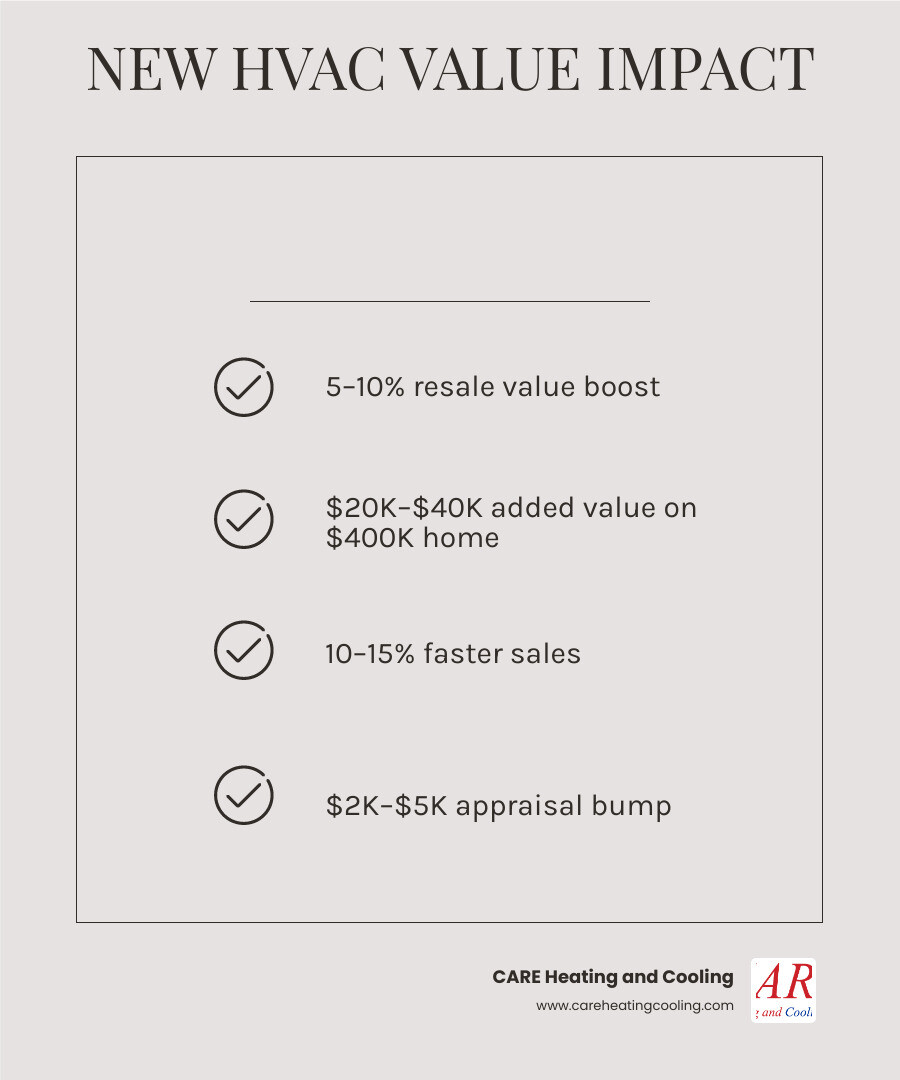
- Resale value boost: A new HVAC system typically adds 5–10% to a home’s resale value
- Dollar impact: On a $400,000 home, that’s roughly $20,000–$40,000 in added value
- ROI at resale: Most homeowners recover around 25–30% of the installation cost directly through a higher sale price
- Faster sales: Homes with new HVAC systems tend to sell 10–15% faster than comparable homes with aging systems
- Appraisal bump: Appraisers typically adjust valuations upward by $2,000–$5,000 for newer, efficient mechanical equipment
- Buyer confidence: A new system signals that the home is well-maintained, reducing buyer hesitation and lowering the risk of inspection-based concessions
But there’s more to the story than just numbers. Buyers in April 2026 are paying close attention to energy costs, indoor comfort, and long-term reliability. An outdated HVAC system — especially one nearing the end of its 15–20 year lifespan — can quietly kill a deal or hand buyers a negotiating chip worth thousands of dollars. A new system does the opposite: it removes doubt, signals move-in-ready status, and gives buyers one less thing to worry about.
Whether you’re planning to sell soon or just want to protect your investment over time, understanding how HVAC upgrades affect home value helps you make smarter decisions — without getting talked into anything you don’t need.
Why energy efficiency is the top priority for 2026 buyers
In the current real estate market of April 2026, buyers are more savvy than ever about “hidden” home costs. They aren’t just looking at the mortgage payment; they are looking at the monthly utility bills. This is why Energy Efficient HVAC systems have become a premier selling point.
The industry standard for measuring this efficiency is the SEER2 rating. If you haven’t brushed up on your acronyms lately, Understanding SEER2 Ratings and AC Efficiency is a great place to start. Essentially, a higher SEER2 rating means the system uses less electricity to cool your home. For a buyer, a high-efficiency unit with an Energy Star certification represents a guaranteed monthly “dividend” in the form of lower bills.
Furthermore, the modern buyer is increasingly conscious of their carbon footprint. A home that features high-efficiency mechanicals is seen as a forward-thinking, sustainable investment. When we install a system that cuts energy consumption by up to 40% compared to a unit from ten years ago, that’s a feature that realtors love to highlight in bold letters on a listing.
How a new HVAC system increases home value through modern technology
It isn’t just about the “box” outside; it’s about the brains of the operation. Modern HVAC technology has transformed from simple temperature control into a comprehensive home management experience.
For instance, Smart Thermostats Save Money by learning a family’s habits and adjusting temperatures automatically. When a prospective buyer walks through a home and sees a sleek, modern interface on the wall, it creates a powerful first impression of a “smart home.” The Benefits of Smart Thermostats extend beyond just cool gadgets; they offer zoned cooling and heating, allowing different areas of the house to be controlled independently.
We also see a huge demand for variable-speed motors. Unlike older systems that are either “all on” or “all off,” variable-speed systems ramp up and down gradually. This leads to quieter operation and much better humidity control—two things that significantly impact how “comfortable” a home feels during an open house. When a buyer enters a home that feels crisp, dry, and smells clean due to advanced indoor air quality filtration, they are much more likely to make a strong offer.
Comparing ROI: Which Systems Offer the Best Return?
When we look at the data for 2026, not all HVAC upgrades are created equal. Different systems offer different levels of return on investment (ROI) depending on their technology and how they fit into current electrification trends.
| System Type | Estimated Value Added | Typical ROI at Resale |
|---|---|---|
| High-Efficiency Heat Pump | $2,000 – $5,000+ | 30% – 50% |
| Central Air Conditioning | $1,500 – $3,500 | 25% – 30% |
| Geothermal System | $1,300 – $7,000+ | Variable |
| Ductless Mini-Split | $600 – $4,000 per zone | High for “problem” rooms |
Heat pumps are currently the “gold standard” for ROI. Because they provide both heating and cooling and align with federal electrification incentives, they are highly sought after. However, High Efficiency Furnaces remain a powerhouse for value in our local climate, where reliable winter heating is a non-negotiable necessity.
Maximizing ROI with high-efficiency installations
Simply buying a new unit isn’t enough to guarantee a 5–10% bump in home value. The quality of the installation is what actually secures that equity. A poorly installed system will underperform, lead to frequent repairs, and—worst of all—could fail a buyer’s home inspection.
One question we often hear is, Is a Higher SEER Rating Worth the Extra Cost? In terms of resale, the answer is usually yes. A premium system often comes with a transferable warranty. Imagine telling a buyer, “This system is brand new, and the warranty transfers to you for the next 10 years.” That provides incredible peace of mind and often prevents buyers from asking for price concessions. To see the potential savings for yourself, you can use our SEER Calculator to compare different efficiency levels.
What to expect during the upgrade process
If you decide to upgrade to boost your home’s marketability, it’s important to know What to Expect Furnace Installation (or AC installation) involves. We start with a proper system sizing—installing a unit that is too big or too small for the home is a common mistake that can lead to short-cycling and high energy bills.
We also perform a thorough ductwork inspection. Even the most efficient HVAC system in the world won’t add value if the air is leaking into the attic or crawlspace. Our process ensures permit compliance and performance optimization so that when the home inspector comes through, your HVAC system gets a glowing report.
Strategic Timing: Should You Replace Before Listing?

Timing is everything in real estate. If your system is under 10 years old and has been well-maintained, a full replacement right before selling might not be the best use of your renovation budget. However, if you notice Signs It’s Time for an AC Replacement, such as frequent repairs or rising bills, it’s better to address it on your terms rather than the buyer’s.
There are also regulatory reasons to consider an upgrade. The EPA AIM Act has pushed the industry toward newer, eco-friendly refrigerants like R-454B. Older systems using R-22 (which has been phased out) are now seen as a major liability. If a buyer sees an R-22 unit, they know that even a small leak could result in a massive repair bill because the refrigerant is so scarce. Addressing these Signs You Need New Furnace Installation before you list prevents a buyer from demanding a $10,000 credit at the closing table.
How a new HVAC system increases home value in the Columbus market
In the greater Columbus area, our weather is anything but predictable. We deal with humid, sweltering summers and bone-chilling winters. This makes the HVAC system the “engine” of the home.
In our local market, a home without reliable central air is often viewed as a “fixer-upper,” regardless of how nice the kitchen is. Conversely, a home with a brand-new, high-efficiency system stands out in a crowded listing field. Because we experience such seasonal extremes, Ohio buyers are conditioned to prioritize mechanical reliability. They want to know that when the first frost hits in October or the first heatwave arrives in June, they won’t be scrambling for an emergency repair.
Alternatives to Full Replacement for Sellers
If your HVAC system is in that “middle age” range (10–12 years old) and working well, you might not need a full replacement to impress buyers. You can still increase appeal through diligent maintenance and documentation.
The goal is to show the buyer that the system has been “loved.” Here is how we recommend preparing an existing system for sale:
- Professional Tune-Up: Have a technician perform a full safety and performance inspection. This gives you a “clean bill of health” to show prospective buyers.
- Document Service History: Keep a folder with all your receipts and maintenance records. A documented history of annual service is often just as impressive to a buyer as a new unit.
- Filter Replacement: It sounds simple, but a brand-new, high-quality filter shows the buyer that you care about the system’s longevity.
- System Cleaning: Ensure the outdoor condenser is free of debris and the indoor unit is dust-free.
- Upgrade the Thermostat: Even if the system is older, learning How to Save Money Using a Programmable Thermostat and installing a modern one can give the impression of an updated system.
Frequently Asked Questions About HVAC and Home Equity
Does a new HVAC system increase appraisal value?
Yes. While an appraiser might not give you a dollar-for-dollar credit for the installation cost, they do adjust for the “effective age” of the home’s mechanical systems. If the comparable homes in your neighborhood all have 20-year-old furnaces and yours is brand new, the appraiser will typically adjust your home’s value upward by several thousand dollars. Furthermore, a functional, modern HVAC system is often a requirement for certain types of traditional financing.
Are there tax incentives for upgrading my HVAC in 2026?
Absolutely. Under current 2026 guidelines, there are significant federal tax credits available for high-efficiency heat pumps and Energy Star-certified central air systems. There are also various local rebates for electrification. These incentives can significantly lower your net investment, meaning you recover a much higher percentage of the cost when you sell the home.
How much faster do homes with new HVAC systems sell?
Data from platforms like Zillow and the National Association of Realtors suggests that homes mentioning “New HVAC” or “High-Efficiency Heating” in the listing description sell 10–15% faster. In a competitive market, a new HVAC system often acts as the “tie-breaker” between two similar homes. It reduces post-closing anxiety for the buyer, making them more likely to submit a clean offer without asking for repair contingencies.
Conclusion
At the end of the day, how a new hvac system increases home value comes down to peace of mind. Whether it’s through the immediate “wow” factor of a smart thermostat or the long-term security of a 10-year warranty, a new system makes your home a safer, more attractive investment for the next family.
At CARE Heating and Cooling, we’ve spent years serving the Columbus community—from Dublin and Hilliard to Gahanna and Westerville. As a family-owned business and a recipient of the BBB Torch Award for Ethics, we believe in providing honest solutions. Our technicians are paid to fix your problems, not to hit sales quotas.
If you’re wondering if your system is ready for the market, or if you want to explore Energy Efficient HVAC options that will pay off for years to come, we’re here to help. We treat your home like our own, ensuring you get the comfort and value you deserve.