
Why High Summer Bills Might Have Nothing to Do With Your Thermostat
How dehumidifiers reduce summer cooling costs is one of the most searched — and most misunderstood — topics in home comfort. The short answer: when your air is too humid, your AC works harder than it needs to. A dehumidifier takes that moisture burden off your AC, so it runs less, uses less energy, and keeps you more comfortable.
Here’s a quick breakdown of how it works:
- High humidity makes air feel warmer than it actually is, so you crank the AC lower
- Your AC has to handle two jobs at once: cooling the air and removing moisture
- A dehumidifier offloads the moisture job, letting your AC focus on temperature alone
- Less AC runtime = lower energy bills
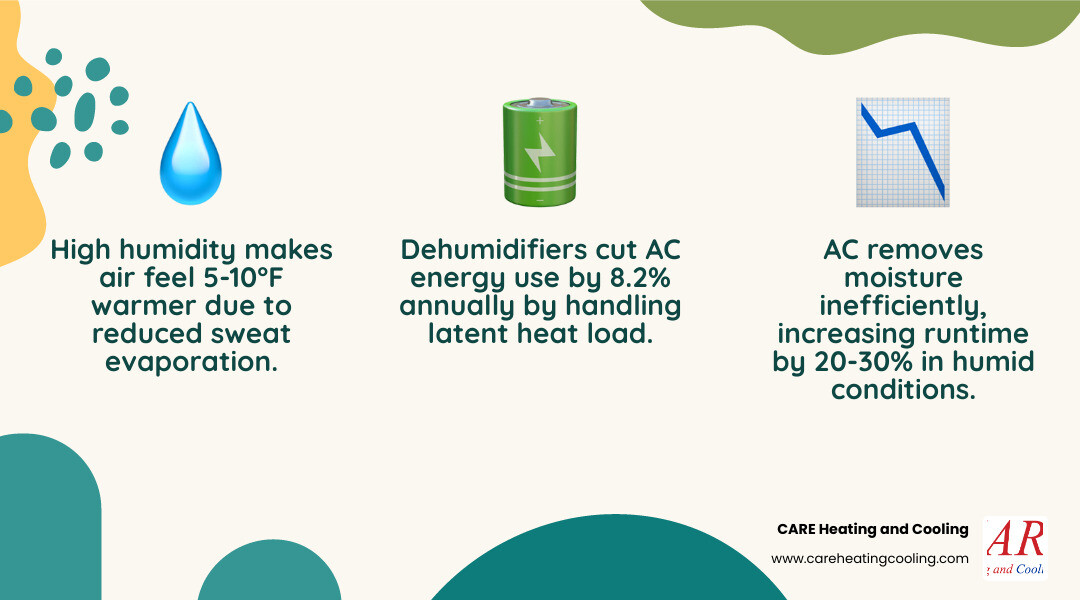
- Research shows pairing a whole-home dehumidifier with central AC can cut space-conditioning energy use by around 8.2% annually
- Some homeowners in humid climates have reported summer bills dropping by nearly 40%
If you live in Central Ohio, you know summer humidity is no joke. That sticky, heavy air doesn’t just feel uncomfortable — it quietly drives up your energy bills every single month from June through September. Your AC is running longer and working harder, not because it’s hot, but because the air is wet.
The good news? There’s a straightforward fix that most homeowners overlook entirely.
How Dehumidifiers Reduce Summer Cooling Costs for Homeowners in Central Ohio
In towns like Dublin, Powell, and Westerville, we experience that classic Ohio “sticky” heat. When the humidity climbs, your home starts to feel like a sauna. To combat this, most of us instinctively reach for the thermostat and nudge it down a few degrees. While this makes the air cooler, it doesn’t necessarily make it “drier” quickly enough to feel comfortable.
This is where the concept of Whole Home Dehumidifiers For Iaq comes into play. To understand the savings, we have to look at how your air conditioner actually works. It manages two distinct types of “loads”:
- Sensible Cooling: This is the actual lowering of the air temperature that you see on your thermometer.
- Latent Heat (Moisture Removal): This is the energy spent turning water vapor into liquid water to be drained away.
In a typical Central Ohio July, as much as 50% of your AC’s energy consumption can be dedicated just to that latent heat — the moisture. By installing an Energy Star-certified dehumidifier, you are essentially hiring a specialist to handle the moisture so your AC can focus on its primary job: cooling. Research indicates that a whole-house dehumidifier used alongside a central air conditioning unit can yield projected space-conditioning energy savings of about 8.2 percent over the course of a year.
How Dehumidifiers Reduce Summer Cooling Costs by Managing Latent Heat
The secret to why how dehumidifiers reduce summer cooling costs works so well lies in “perceived temperature.” Our bodies cool themselves through evaporative cooling — basically, sweat evaporating off our skin. When the air is saturated with moisture (high humidity), our sweat can’t evaporate. We feel hot, sticky, and miserable, even if the room is 72 degrees.
When you implement proper Humidity Control, you aim for an optimal relative humidity (RH) range of 30-50%. In this “sweet spot,” your sweat evaporates efficiently. Suddenly, 78 degrees with 40% humidity feels much cooler and more comfortable than 72 degrees with 70% humidity. Because you feel cooler, you stop “thermostat surfing” and leave the AC at a higher, more energy-efficient setting.
How Dehumidifiers Reduce Summer Cooling Costs and Extend HVAC Lifespan
We often talk about monthly bills, but the long-term savings are even more impressive. High humidity is a silent killer for HVAC machinery. Excessive moisture leads to:
- Mechanical Stress: Your AC compressor has to run longer cycles to try and “squeeze” the water out of the air.
- Component Corrosion: Moist environments accelerate the rusting of coils and electrical fittings.
- Biological Growth: Mold and algae can thrive on damp evaporator coils, clogging airflow and forcing the system to work harder.
By using systems like Ourproducts/Indoor Air Quality Systems/Healthy Climate Whole Home Dehimidifiers, you create a stable environment that reduces the “short cycling” and heavy lifting your AC usually performs. While a typical HVAC system in a high-stress, high-humidity environment might struggle to hit its 15-year mark, a system protected by a dehumidifier is much more likely to reach a full 15-20 year lifespan.
Why High Humidity Makes Your AC Work Overtime
In the greater Columbus area, the “dew point” is the number you really need to watch. When the dew point is high, your AC becomes a moisture-removal machine first and a cooling machine second. It won’t stop running until the temperature setpoint is hit, but if the humidity remains high, you’ll still feel warm, leading you to drop the temp even further. It’s a vicious, expensive cycle.
To put the energy drain in perspective, consider the power draw differences. A central AC unit is a heavy hitter, usually running on a 220V circuit with a massive compressor. A dedicated dehumidifier, however, is much more efficient at its specific task.
| Feature | Central AC Unit | Whole-Home Dehumidifier |
|---|---|---|
| Voltage | ~220 Volts | ~100-110 Volts |
| Primary Goal | Lowering Temperature | Removing Moisture |
| Efficiency | High for sensible heat | High for latent heat |
| Daily Savings Potential | N/A | Up to $20/day by reducing AC runtime |
If you are noticing that your home in Hilliard or Upper Arlington feels “clammy” even when the AC is running, your system is likely overwhelmed by the humidity. This is a common sign that you need a more robust solution like Hvac/Columbus Oh/Whole Home Dehumidifiers.
Solving Humidity Problems With Ductless AC Systems
Not every home uses a traditional central air system. Many residents in older neighborhoods like Clintonville or Marble Cliff use ductless mini-splits. While these are incredibly efficient at cooling, they can sometimes struggle with “short cycling.” This happens when the unit cools a small room so quickly that it shuts off before it has a chance to remove the humidity.
If you are experiencing Humidity Problems With Ductless Ac, adding a dehumidifier allows the mini-split to do what it does best — provide targeted cooling — without leaving you in a damp, cold room.
The Difference Between Portable and Whole-Home Efficiency
When people think of dehumidifiers, they often picture those noisy plastic boxes from big-box retailers that you have to empty every six hours. While portable units have their place, they aren’t the most efficient way to reduce cooling costs for an entire house.
A whole-home system is integrated directly into your return ductwork. It features:
- Automatic Drainage: No more carrying heavy buckets of water across the basement.
- Precision Control: Systems like the Ourproducts/Indoor Air Quality Systems/Humiditrol Whole Home Dehumidification System use advanced sensors to maintain exact RH levels.
- Superior Filtration: They often include higher-grade filters that clean the air while drying it.
In 2024, the average U.S. residential electricity bill was $173 per month in the summer. A significant portion of that was due to overworked AC units. By moving to a whole-home solution, you’re investing in a system that can pay for itself through lower monthly overhead.
Strategies for Maximizing Energy Savings This Summer
To really see how dehumidifiers reduce summer cooling costs, you need a strategy. You can’t just plug it in and hope for the best. Here is the CARE Heating and Cooling “Pro-Tip” list for maximum savings:
- The “78-Degree Rule”: Once your humidity is under 50%, try setting your thermostat to 78°F. Most people find this perfectly comfortable in a dry environment. Every degree you raise your thermostat can save you 3-5% on your cooling costs.
- Optimize Airflow: Use ceiling fans (rotating counter-clockwise) to create a wind-chill effect. This works in tandem with dry air to keep you cool.
- Seal the Envelope: Check for air leaks around windows and doors in your Grove City or Gahanna home. Humidity loves to seep in through cracks.
- Strategic Placement: Ensure your dehumidifier is placed where it can pull air effectively from the return plenum.
For a deeper dive into these strategies, check out our Indoor Air Quality Complete Guide and these Tips For Improving Indoor Air Quality.
Maintaining Your System for Peak Performance
A dehumidifier is a workhorse, but it needs a little love to stay efficient. If the coils get dusty or the filter gets clogged, it will draw more power and remove less water.
- Clean the Filters: Check them monthly during the peak of summer.
- Clear the Drain Line: Ensure the condensate line isn’t backed up with algae or debris.
- Annual Servicing: Just like your AC, your dehumidifier benefits from a professional “look-see” once a year.
Interestingly, managing humidity isn’t just a summer job. Understanding Humidity In Winter is also vital for home health, though the goals are usually the opposite (adding moisture rather than removing it).
Real-World Data: Lowering Bills in High-Humidity Climates
The numbers don’t lie. In real-world studies, the impact of dehumidification on energy bills is staggering. One homeowner in a high-humidity region reported their power bills dropping from the low $300s to an average of $190 in the summer after adding a whole-home dehumidifier. Another homeowner managed a July bill of just $87 for a 1,700 sq. ft. house by running their dehumidifier and cycling their AC strategically.
While Ohio isn’t Florida, our “latent load” during a humid July is comparable. By offloading that moisture, you reduce the AC runtime, which is the single biggest contributor to your electric bill.
Frequently Asked Questions About Dehumidifiers and Cooling
Can I raise my thermostat if I use a dehumidifier?
Absolutely! This is the primary way you save money. Because dry air allows your sweat to evaporate faster, you feel cooler at higher temperatures. Many of our customers in New Albany and Pickerington find that 77 or 78 degrees feels like 72 degrees once the “mugginess” is gone.
Does a dehumidifier add heat to my home?
Technically, yes. Dehumidifiers give off a small amount of heat (usually a 1-2 degree increase in the air passing through them) as a byproduct of the refrigeration process. However, the “net comfort gain” is vastly positive. The slight increase in temperature is far outweighed by the massive drop in humidity, making the air feel significantly cooler to your skin.
Is a whole-home dehumidifier better than a portable unit?
For a small apartment or a single damp closet, a portable unit is fine. But for a home in Delaware or Marysville, a whole-home unit is superior. It’s quieter, more energy-efficient, treats every room simultaneously, and doesn’t require you to empty buckets of water every day.
Conclusion
At CARE Heating and Cooling, we’ve spent years helping our neighbors in the greater Columbus area stay comfortable without breaking the bank. We are proud recipients of the BBB Torch Award for Ethics, a testament to our philosophy: our technicians are paid to fix your problems, not to hit sales quotas.
If you’re tired of that sticky summer feeling and skyrocketing electric bills, it’s time to look at how dehumidifiers reduce summer cooling costs for your specific home. Whether you’re in Bexley, Reynoldsburg, or Sunbury, we are here to provide honest, transparent advice on the best moisture-control solutions for your family.
Ready to take the “swamp” out of your living room? Learn more about energy-efficient HVAC solutions or contact us today to discuss Hvac/Westerville Oh/Whole Home Dehumidifiers. We’ll help you turn your dehumidifier into the secret weapon your wallet has been waiting for.