
How Old Is Too Old for an HVAC System — and What to Do About It
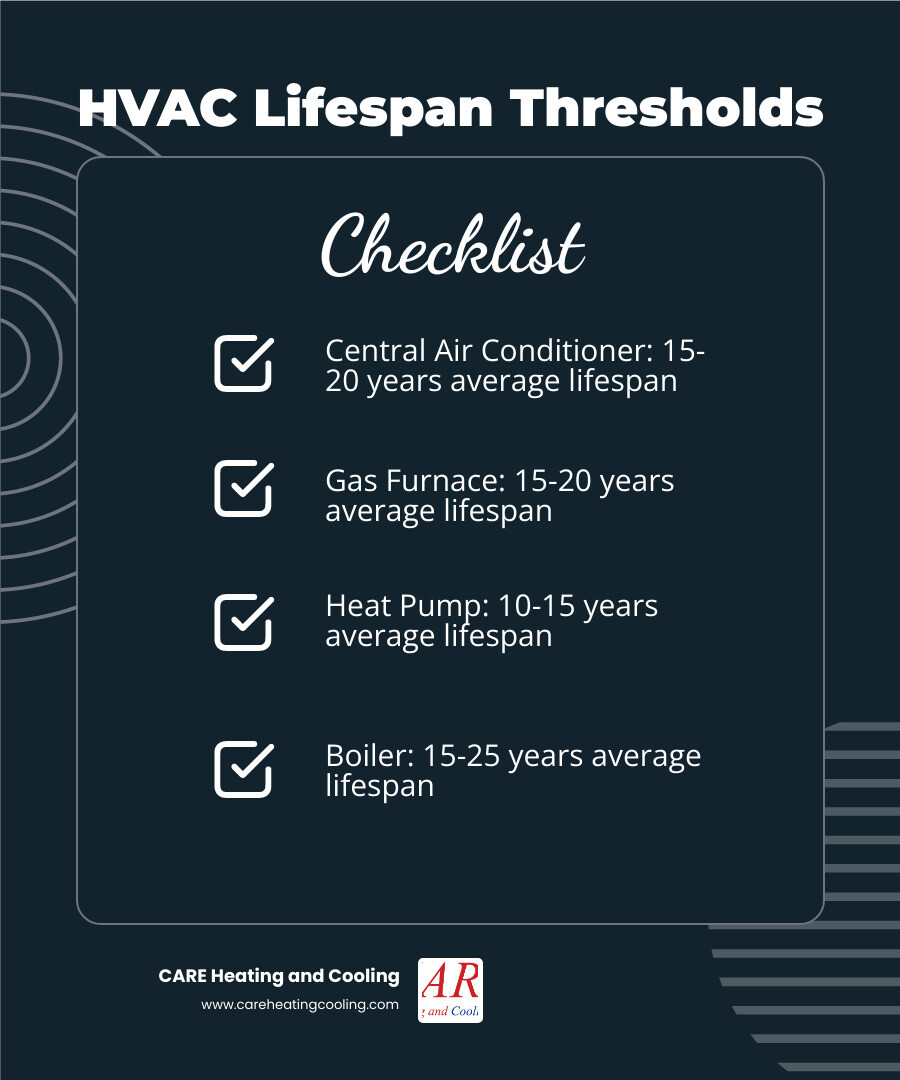
How old is too old for an HVAC system depends on the type of equipment you have, but here are the general thresholds most HVAC professionals and energy experts agree on:
| System Type | Average Lifespan | Consider Replacement At |
|---|---|---|
| Central Air Conditioner | 15-20 years | 10-15 years if issues arise |
| Gas Furnace | 15-20 years | 15+ years |
| Heat Pump | 10-15 years | 10+ years if issues arise |
| Boiler | 15-25 years | 15+ years |
| Ductless Mini-Split | 15-20 years | 15+ years |
Most systems don’t fail overnight. They slow down, cost more to run, and break down more often — long before they stop working completely. By the time a 15 or 20-year-old system finally quits, many homeowners have already spent years paying the price in higher energy bills and repair visits.
If your system is approaching or past these age ranges, it’s worth understanding what that actually means for your home’s comfort, safety, and budget — especially here in Ohio, where both hot summers and cold winters put real stress on heating and cooling equipment year-round.
Understanding the Average Lifespan of Heating and Cooling Units
When we talk about how long an HVAC system lasts, we are really talking about “service life.” This is the period during which the unit can maintain its rated output at an acceptable efficiency without the cost of repairs becoming a burden. In our experience serving the Greater Columbus area, we see a wide range of lifespans. Some systems are ready for the scrap heap at year 12, while others (usually the ones that were pampered with annual maintenance) are still humming along at year 22.
Here is a deeper dive into the typical lifespans for the systems we see in Ohio homes:
- Central Air Conditioners: These typically last 15 to 20 years. However, because the outdoor unit is exposed to the elements — including those unpredictable Ohio spring storms and humid summer heat — they can show signs of wear closer to the 12-year mark.
- Gas Furnaces: These are the workhorses of the Midwest. A well-maintained furnace can last 15 to 20 years, though some cast-iron models or exceptionally well-cared-for units can push toward 30 years. The primary limiting factor is often the integrity of the heat exchanger.
- Heat Pumps: Because a heat pump provides both heating and cooling, it essentially works double-time compared to a dedicated AC unit. Consequently, their lifespan is slightly shorter, usually ranging from 10 to 15 years.
- Boilers: Boilers are known for their durability. Cast-iron boilers can last 20 to 35 years, while modern high-efficiency steel boilers typically fall in the 15 to 25-year range.
- Ductless Mini-Splits: These systems generally offer a reliable 15 to 20 years of service, provided the filters and coils are kept clean.
Before you decide that your unit has reached its expiration date, it is important to perform a thorough evaluation. You can learn more about what to check in our guide on Before You Replace Your Ac.
How to determine the exact age of your system
If you didn’t install the system yourself, you might have no idea how old it is. Thankfully, your HVAC unit carries its “birth certificate” right on its sleeve — or rather, its nameplate.
To find the age, head to the outdoor condenser unit (for AC/heat pumps) or the indoor cabinet (for furnaces). Look for a metal plate or sticker containing the model and serial number.
- Check for a Manufacture Date: Many modern units (post-2010) explicitly state the manufacture date in a “MM/YYYY” format.
- Decode the Serial Number: If there is no date, the serial number is your best friend. For many brands, the first four digits represent the week and year. For example, a serial number starting with “4214” often means the unit was manufactured in the 42nd week of 2014.
- Use Online Resources: You can enter your brand and serial number into a search engine or the manufacturer’s website to find the exact production date.
- Check Installation Records: Sometimes, the original installer will leave a sticker on the unit with the installation date.
Factors that influence equipment longevity in Ohio
In places like Delaware, Powell, and Westerville, our weather plays a massive role in how fast a system ages.
- The “Ohio Swing”: We experience extreme temperature fluctuations. A system that has to cycle from heating in the morning to cooling in the afternoon undergoes significant thermal stress.
- Humidity Levels: High summer humidity in the Columbus area forces air conditioners to work harder to dehumidify the air. If a system is oversized, it might “short cycle,” which wears out the compressor prematurely.
- Installation Quality: A system is only as good as its installation. Poorly sized ductwork or incorrect refrigerant charges can shave five years off a system’s life from day one. This is why we emphasize the importance of looking for Signs Old Ac Needs Replacement Delaware specifically for our local climate.
- Usage Patterns: If you keep your thermostat at 68 degrees in July, your system is logging significantly more hours than a neighbor who keeps theirs at 78.
How Old is Too Old for an HVAC System?
The question of how old is too old for an hvac system usually hits home when that first triple-digit repair bill arrives. As we move through April 2026, we are seeing more homeowners opt for replacement once their systems cross the 15-year threshold.
At 15 years, most mechanical systems have entered the “wear-out” phase of the reliability curve. Components like blower motors, capacitors, and contactors are reaching the end of their engineered life. While you can keep replacing these parts, you are essentially “patching a sinking ship.”
If you are noticing your furnace is struggling to keep up during a cold snap in Dublin or Hilliard, it might be time to review the Signs You Need New Furnace Installation.
Evaluating milestones: how old is too old for an hvac system at 10 or 15 years?
Is a 10-year-old system “too old”? Usually, no — but it is the age where you should start a “replacement fund.” According to ENERGY STAR, if your heat pump or AC is more than 10 years old, replacing it with a high-efficiency unit can save you up to 20% on heating and cooling costs.
By year 12, most central air systems are operating at only 80–85% of their original efficiency. By year 15, the technology gap becomes significant. A system installed in 2011 likely has a SEER (Seasonal Energy Efficiency Ratio) of 13. In 2026, modern entry-level units start at SEER2 15, and high-end models can exceed SEER2 20. The electricity savings alone often make the 15-year mark the “sweet spot” for proactive replacement.
When a 20-year-old system becomes a liability
Once a system hits 20 years, it is no longer just an efficiency concern; it is a liability.
- Safety Risks: For gas furnaces, the biggest danger is a cracked heat exchanger. As metal expands and contracts over two decades, stress cracks can develop, allowing carbon monoxide (CO) to leak into your home’s air supply.
- Emergency Failures: Systems rarely fail on a mild Tuesday afternoon. They fail during the hottest week of July or the coldest night in January when HVAC companies are booked solid.
- Part Obsolescence: For many 20-year-old units, manufacturers have stopped producing replacement parts. If your proprietary control board fries, you might be forced into an emergency replacement whether you’re ready or not.
Key Signs Your Aging System Needs Professional Attention
Age is a number, but performance is a reality. If you aren’t sure if your system is “too old,” look for these red flags that indicate the end is near. Many of these are common Signs Its Time For An Ac Replacement that we see across Central Ohio.
Rising utility bills and efficiency loss
Have you noticed your electric or gas bills creeping up, even though the rates haven’t changed much? As systems age, they lose efficiency. Coils become fouled, motors work harder to achieve the same RPM, and refrigerant may have slowly leaked out. A 12-year-old AC system can lose 20–30% of its efficiency. If you are paying $300 a month to cool your home in Upper Arlington, and $60-$90 of that is simply due to “age-related drag,” that money is better spent on a new unit. When evaluating a new system, it helps to know What To Look For When Researching A New Furnace or AC to ensure you’re getting the best ROI.
Safety risks and the “repair frequency” problem
If you feel like you have your HVAC technician on speed dial, your system is trying to tell you something. We call this the “repair frequency problem.”
- The “One-Two Punch”: You fix a capacitor in June, then the fan motor goes in August.
- Strange Noises: Squealing, banging, or grinding noises are the sounds of mechanical failure.
- Short Cycling: If your unit turns on and off every few minutes, it is putting massive strain on the compressor.
- Humidity and Dust: An old system struggles to remove moisture and filter air. If your home in Gahanna feels clammy or you see dust buildup shortly after cleaning, your system’s performance is likely degraded.
For heat pump owners, the decision can be even trickier. Check out our guide on When To Replace Vs Repair Heat Pump for more specific advice.
The Decision Framework: Repair vs. Replacement Rules
To take the emotion out of the decision, we recommend using two industry-standard “rules of thumb” to determine if your HVAC is too old to save.
| Feature | Repair | Replacement |
|---|---|---|
| Upfront Cost | Lower | Higher |
| Efficiency | Remains the same (low) | Significant increase (SEER2 16+) |
| Warranty | Usually 30-90 days on part | 10-year parts / Labor options |
| Reliability | High risk of next failure | Peace of mind for 10+ years |
| Monthly Bills | Likely to continue rising | Immediate 20-40% reduction |
The $5,000 Rule
Multiply the age of the system by the cost of the repair. If the result is more than $5,000, you should strongly consider replacement.
- Example: A 12-year-old system needs an $800 repair. (12 x 800 = 9,600). Since 9,600 is greater than 5,000, replacement is the smarter financial move.
- Example: A 5-year-old system needs a $400 repair. (5 x 400 = 2,000). This is well below the threshold; fix it!
The 50% Rule
If the cost of a single repair is 50% or more of the cost of a brand-new system, it is time to say goodbye to the old unit.
Why refrigerant phase-outs determine how old is too old for an hvac system
This is a critical factor in 2026.
- R-22 (Freon): Production of R-22 was banned in 2020. If your system was built before 2010, it likely uses R-22. A simple refrigerant leak in an R-22 system can now cost over $1,000 just to “top off,” making these systems effectively “too old” the moment they leak.
- R-410A Phasedown: As of April 2026, the industry is well into the phasedown of R-410A (the refrigerant that replaced R-22). Quotas are tightening, and prices are rising. Modern systems are moving toward newer, more environmentally friendly refrigerants. Investing heavily in an aging R-410A system is becoming a “false economy.”
The impact of maintenance on system life expectancy
We can’t talk about age without talking about care. A neglected 10-year-old system can be “older” mechanically than a well-maintained 20-year-old system. Annual tune-ups include cleaning the coils (which reduces head pressure and compressor wear), checking electrical connections (to prevent fire hazards), and ensuring proper airflow. This preventive care is the only way to ensure your system reaches the upper end of that 15-20 year lifespan.
Benefits of Upgrading to Modern, Energy-Efficient Technology
If you decide your system is indeed too old, the good news is that the technology available in 2026 is lightyears ahead of what was available even 10 years ago.
Improved comfort and advanced features
- Variable-Speed Compressors: Unlike old units that were either “100% on” or “off,” variable-speed systems ramp up and down like a dimmer switch. This provides incredibly consistent temperatures and superior humidity control.
- Two-Stage Heating: Your furnace can run on a “low” setting for most days, only kicking into “high” during those brutal Ohio polar vortexes.
- Zoning: You can finally stop the “downstairs is freezing, upstairs is sweltering” battle by cooling or heating specific areas of your home.
- Quiet Operation: Modern units are engineered with sound-dampening blankets and swept-wing fan blades, making them whisper-quiet.
Long-term savings and warranty protection
The financial case for replacement is stronger than ever:
- Federal Incentives: Under current 2026 standards (following the Inflation Reduction Act), homeowners can claim significant tax credits for qualifying high-efficiency equipment. Heat pumps often qualify for up to $2,000 in credits, while high-efficiency central ACs and furnaces can net up to $600.
- Warranties: Most new systems come with a 10-year parts warranty. This eliminates the “repair-of-the-month” anxiety.
- Energy Waste: A new ENERGY STAR-rated furnace is 15% more efficient than a standard new model and significantly more efficient than a 20-year-old unit.
Frequently Asked Questions
What is the average lifespan of a heat pump compared to a furnace?
A furnace typically lasts longer (15–20+ years) because it only runs during the heating season. A heat pump usually lasts 10–15 years because it operates year-round for both heating and cooling. In the Columbus area, where we use both systems heavily, this gap is very common.
Should I replace my indoor and outdoor units at the same time?
Yes. HVAC systems are designed as “matched pairs.” If you put a brand-new, high-efficiency outdoor condenser on a 15-year-old indoor evaporator coil, the system will not reach its rated efficiency, and the old coil is likely to leak or fail soon anyway, costing you more in labor to fix it later.
How does the Ohio climate specifically affect my AC unit’s lifespan?
Ohio’s high humidity and heavy pollen (especially in the spring) can “clog” outdoor coils quickly. If these aren’t cleaned, the system runs at higher temperatures and pressures, which shortens the life of the compressor. Additionally, our snowy winters mean the outdoor unit is sitting in moisture for months, which can lead to base pan corrosion if not properly elevated.
Conclusion
Deciding how old is too old for an hvac system is a big decision, but you don’t have to make it alone. At CARE Heating and Cooling, we pride ourselves on being the ethical choice for homeowners in Columbus, Marysville, New Albany, and beyond. As a winner of the BBB Torch Award for Ethics, our philosophy is simple: our technicians are paid to fix your system, not to hit a sales quota for new ones.
If your system is nearing that 15-year mark or your utility bills are making you do a double-take, we are here to provide an honest, transparent assessment. We will tell you if a simple repair can get you another few seasons, or if it’s truly time to invest in your home’s future comfort.
Schedule your professional system assessment with CARE Heating and Cooling today