The Simple Answer to How Often You Should Service Your HVAC System
How often should you service your HVAC system is one of the most common questions homeowners ask — and the answer is simpler than most people expect.
Quick answer:
| System Type | Recommended Service Frequency |
|---|---|
| Central Air Conditioner | Once per year (spring) |
| Gas Furnace | Once per year (fall) |
| Heat Pump | Twice per year (spring and fall) |
| Any system 10+ years old | Twice per year minimum |
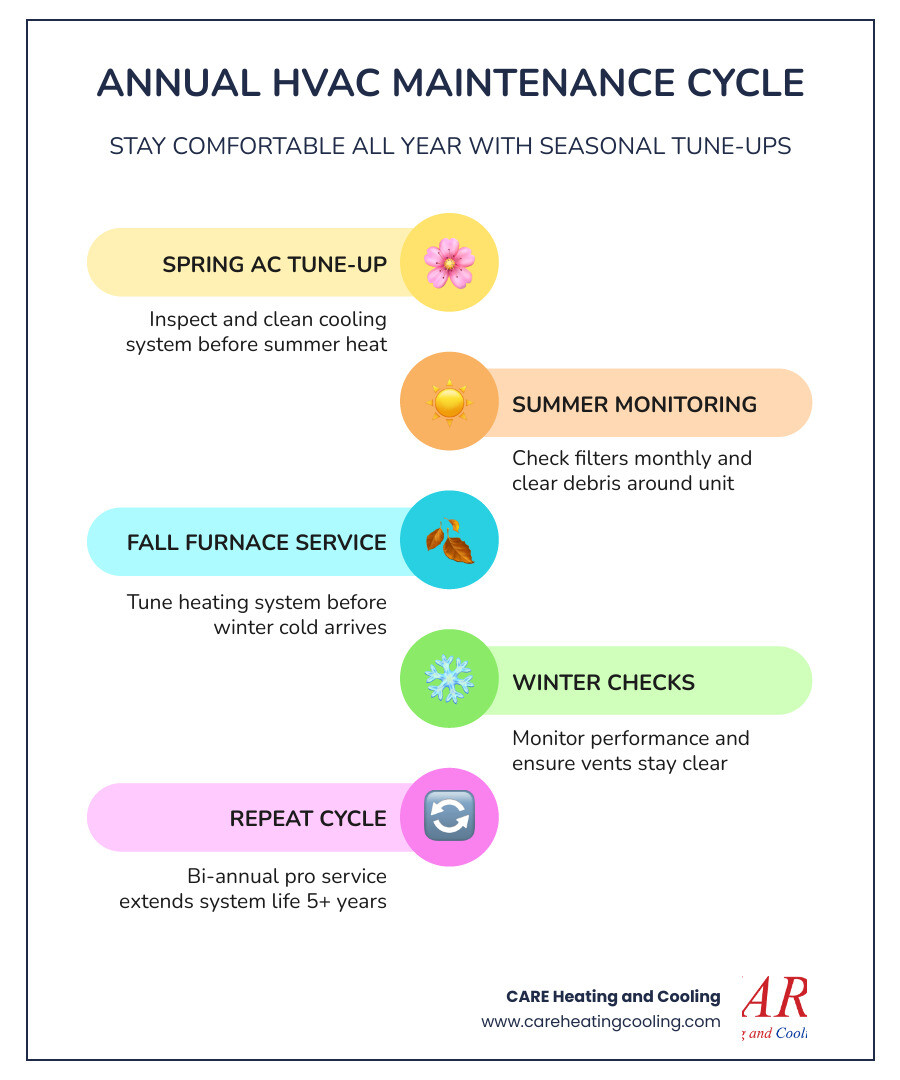
For most homes, that means two professional tune-ups per year — one in spring before cooling season, and one in fall before heating season. If you have a heat pump or an older system, twice-yearly service isn’t optional, it’s essential.
Here’s the thing most homeowners don’t realize: your HVAC system is quietly working in the background every single day. When it’s running well, you don’t think about it. But the moment it stops — in the middle of a July heat wave or a January cold snap — you’ll wish you had.
Research consistently shows that 85% of HVAC repairs are linked to a lack of proper maintenance. Systems that get regular tune-ups last 15 to 20 years. Neglected systems often fail after just 10 to 12 years. That’s a significant difference in both comfort and cost — and it all comes down to staying on schedule.
At CARE Heating and Cooling, we believe maintaining your system shouldn’t feel like guesswork. This guide walks you through exactly how often to schedule service, what those visits should include, and what you can do yourself to keep things running smoothly in between.
How Often Should You Service Your HVAC System?

When we talk about the frequency of HVAC care, we aren’t just trying to fill up our calendar. There is a mechanical “why” behind the bi-annual recommendation. Your heating and cooling systems are comprised of moving parts, electrical connections, and chemical refrigerants that all degrade or shift with use.
For the average homeowner, the “gold standard” is a professional visit twice a year. We recommend scheduling your air conditioning tune-up in the spring (March through May) and your furnace tune-up in the fall (September through November). This proactive approach ensures that your system is prepared for the heavy lifting it will do during the extreme temperatures of summer and winter.
Knowing When To Schedule Hvac Services allows you to beat the “peak season rush.” If you wait until the first 90-degree day in June to realize your AC isn’t blowing cold, you’ll likely be joining a very long waiting list. By scheduling in the “shoulder seasons” of spring and fall, you ensure your home stays comfortable year-round.
How often should you service your HVAC system in Central Ohio?
In Central Ohio, our climate doesn’t do anything halfway. We experience humid, scorching summers and bone-chilling winters with plenty of frost and snow. As of April 2026, we are seeing even more variable weather patterns in areas like Columbus, Dublin, and Westerville. This seasonal volatility puts an immense strain on HVAC equipment.
Because our systems in towns like Upper Arlington or Gahanna often switch from heating to cooling within the same week during the spring, the components never truly get a “vacation.” This high usage intensity makes the twice-yearly check-up even more vital. A furnace that has sat dormant all summer can accumulate dust and debris that poses a fire or carbon monoxide risk if not cleaned before that first cold night. That is why understanding When To Schedule Furnace Service is a matter of both comfort and home safety.
Factors that change how often should you service your HVAC system
While the twice-a-year rule applies to most, several factors might mean you need to see us a bit more frequently:
- System Age: If your unit is over 10 to 12 years old, it is entering its “senior years.” Older systems have worn bearings, aging capacitors, and more fragile seals. More frequent monitoring can catch a failing part before it causes a “cascading failure” that destroys the entire unit.
- Pet Dander: We love our furry friends in Hilliard and Worthington, but their hair and dander are the natural enemies of your HVAC system. If you have multiple pets, your filters and coils will clog much faster than a pet-free home.
- Allergy and Health Needs: If anyone in your household suffers from severe asthma or allergies, more frequent servicing and filter changes are necessary to maintain high indoor air quality.
- Usage Intensity: Do you keep your home at a crisp 68 degrees all summer? High demand means more wear and tear, necessitating more frequent professional oversight.
The Ideal Maintenance Schedule for Different Systems
Different types of equipment have different needs. A gas furnace has combustion components that an electric AC unit does not, and a heat pump works twice as hard because it handles both jobs.
| System Component | Service Frequency | Primary Goal |
|---|---|---|
| Central AC | Annual (Spring) | Efficiency, Coil Cleaning, Refrigerant Check |
| Gas Furnace | Annual (Fall) | Safety, Heat Exchanger Integrity, Burner Cleaning |
| Heat Pump | Bi-Annual (Spring & Fall) | Reversing Valve Check, Year-Round Reliability |
| Ductwork | Every 3–5 Years | Leak Sealing, Dust Removal, Airflow Optimization |
If you are looking for Service/Furnace Maintenance Central Ohio, it is important to remember that these schedules are designed to keep your factory efficiency ratings intact. A system that isn’t regularly maintained can use up to 25% more energy than a well-tuned one.
Professional maintenance visit checklist
When a CARE Heating and Cooling technician arrives at your home in Pickerington or New Albany, they aren’t just there to poke around. A comprehensive Ac Tune Up Services visit includes a rigorous multi-point inspection. Here is what a professional tune-up typically entails:
- Coil Cleaning: Dirty coils can reduce cooling efficiency by up to 40%. We remove the grime that prevents heat transfer.
- Refrigerant Levels: Low refrigerant reduces efficiency by 10-20% and puts massive strain on the compressor.
- Electrical Connections: We tighten all connections and measure voltage/current on motors. Loose connections are a leading cause of part failure.
- Lubrication: We lubricate all moving parts to reduce friction and energy consumption.
- Thermostat Calibration: We ensure your thermostat is communicating correctly with your system so you aren’t paying for cooling you aren’t actually getting.
- Safety Inspections: For furnaces, this includes checking the heat exchanger for cracks which could leak dangerous carbon monoxide.
Homeowner maintenance: What to do between professional visits
While we handle the heavy lifting and technical calibrations, you play a vital role in the “daily health” of your system. Following these Furnace Maintenance Tips For Homeowners can prevent emergency calls:
- Change Air Filters: This is the single most important task. Clogged filters can raise your energy bills by 5-15% and are the #1 cause of system “suffocation” and freezing.
- Clear the Area: Ensure there is at least two feet of clearance around your outdoor condenser unit. Trim back shrubs and remove leaves or “cottonwood” fluff that can choke the system.
- Check Vents: Make sure furniture or curtains aren’t blocking supply or return vents. This maintains proper airflow and prevents the system from short-cycling.
- Monitor Noises: If you hear something new — a whistle, a bang, or a grind — don’t wait for your scheduled visit.
Why Regular Maintenance is a Smart Investment
Many homeowners view HVAC service as an “optional” expense, but the data tells a different story. Regular maintenance isn’t a cost; it’s an investment with a massive ROI.
Consider this: A well-tuned HVAC system can use 10-30% less energy than a neglected one. In the heat of a Columbus summer, that 30% savings adds up quickly on your utility bill. Furthermore, fixing duct leaks can improve your efficiency by about 20%. When you look at the big picture, the energy savings alone often pay for the cost of the tune-up.
Understanding Why Furnace Maintenance Is Important goes beyond just the monthly bill. It is about protecting the largest mechanical investment in your home. A new HVAC system can be a major expense; extending its life by 5 to 8 years through regular care saves you thousands in the long run.
Benefits of a professional tune-up
Beyond the raw numbers, there are several “hidden” benefits to scheduling your Benefits Of A Regular Ac Tune Up:
- Warranty Protection: Did you know that most manufacturers require documented professional maintenance to keep your warranty valid? If your compressor fails in year seven but you have no service records, the manufacturer may deny your claim.
- Indoor Air Quality: Maintenance includes cleaning the components that your air passes through. This reduces the amount of dust, mold, and allergens circulating in your home.
- Safety: Especially with gas furnaces, annual checks are critical to ensure there are no gas leaks or combustion issues.
- Peace of Mind: There is a certain stress that comes with wondering if your AC will survive the next heatwave. Regular service eliminates that anxiety.
The ROI of preventative care
The Importance Of Regular Furnace Service is best illustrated by the “85% rule.” Since 85% of repairs are preventable, a tune-up is essentially “breakdown insurance.”
Emergency repairs typically cost 3 to 5 times more than a scheduled maintenance visit. When a part fails on a Sunday night, you are often looking at after-hours fees and expedited shipping for parts. By catching a worn capacitor or a frayed belt during a Tuesday morning tune-up in April, you avoid the “emergency” altogether.
Signs You Need an HVAC Tune-Up Sooner Than Planned
Even with the best schedule, sometimes your system will send up a flare indicating it needs help. Being aware of the Importance Of Ac Tuneups means knowing when to call us before a total breakdown occurs.
Warning signs to watch for
Keep an eye (and an ear) out for these red flags:
- Unusual Noises: Squealing, banging, or grinding. These often indicate a belt that is about to snap or a motor bearing that is failing.
- Weak Airflow: If the air coming out of your vents feels like a light breeze instead of a strong flow, you likely have a clogged filter, a failing blower motor, or ductwork issues.
- Short Cycling: This is when your system turns on and off rapidly without ever completing a full cooling or heating cycle. This puts immense strain on the compressor and heat exchanger.
- Foul Odors: A “dirty sock” smell often indicates mold or bacteria on the evaporator coils. A burning smell could indicate electrical issues or a motor overheating.
- Ice Buildup: If you see ice on your outdoor refrigerant lines or indoor coil — even in the middle of summer — you have an airflow or refrigerant issue that needs immediate attention.
By following these Top Tips For Effective Ac Maintenance, you can often spot these issues early. If your energy bills have spiked suddenly without a change in the weather, your system is likely working much harder than it should be to compensate for a mechanical problem.
When to call a professional
If you experience a total system failure, smell gas, or see smoke, shut the system off at the breaker and call us immediately. For homeowners in the Columbus area, we know that When You Need A Company You Can Trust, you want technicians who are focused on the solution, not a sales pitch.
At CARE Heating and Cooling, our technicians are paid to fix your unit, not to pressure you into a replacement you don’t need. This ethical approach is why we were awarded the BBB Torch Award for Ethics. We treat your home in Lewis Center or Canal Winchester like it’s our own.
Frequently Asked Questions
Is an HVAC maintenance plan worth it?
Absolutely. Our Hvac Service Plans take the “remembering” out of the equation. We help you stay on schedule by reaching out when it’s time for your spring or fall visit.
A Hvac Service Agreement often includes added perks like priority scheduling and discounts on repairs. It’s the most cost-effective way to ensure your system reaches that 20-year lifespan. Think of it like a gym membership for your furnace — it keeps the heart of your home in peak condition.
How often should I change my air filters?
The standard answer is every 1 to 3 months, but it depends on your home. If you live in a dusty area of Pataskala or have three Golden Retrievers in Dublin, you might need to change it every 30 days.
During your Spring Hvac Maintenance For Homes visit, we can check your filter’s MERV rating. High-efficiency filters (MERV 11-13) are great for air quality but can restrict airflow if they get even slightly dirty. A simple rule: hold your filter up to a light. If you can’t see the light through it, it’s time for a new one.
What happens if I neglect my HVAC system?
Neglect is the fastest path to a “red-tagged” system. Without maintenance:
- Efficiency plummets: You’ll pay more for less comfort.
- Warranties are voided: You lose your financial safety net.
- Lifespan is halved: You’ll be buying a new system in 10 years instead of 20.
- Safety risks increase: Unchecked gas connections or cracked heat exchangers are serious hazards.
Conclusion
How often should you service your HVAC system? The answer is clear: twice a year is the key to a long-lasting, efficient, and safe home environment. Whether you are in Bexley, Powell, or Reynoldsburg, your comfort depends on the health of your heating and cooling equipment.
At CARE Heating and Cooling, we are proud to be the trusted choice for families across the greater Columbus area. As a family-owned business, we value honesty above all else. Our technicians are highly skilled professionals who are dedicated to fixing your system and ensuring it runs at peak performance. We don’t believe in high-pressure sales; we believe in providing the service your home actually needs.
If it has been more than six months since your last tune-up, don’t wait for the weather to turn. Contact us today to learn more about our Service/Maintenance Agreements and let us help you protect your home’s comfort for years to come. At CARE, we’re not just servicing machines — we’re taking care of people.