
The mini split vs central ac cost comparison comes down to more than just sticker price — it depends on your home’s existing setup, how you use your space, and what you’re paying every month to stay comfortable.
Here’s a quick-reference breakdown to answer the most common questions upfront:
| Factor | Mini Split | Central AC |
|---|---|---|
| Best for | Homes without ductwork, room additions, zoned comfort | Homes with existing ductwork, whole-home uniform cooling |
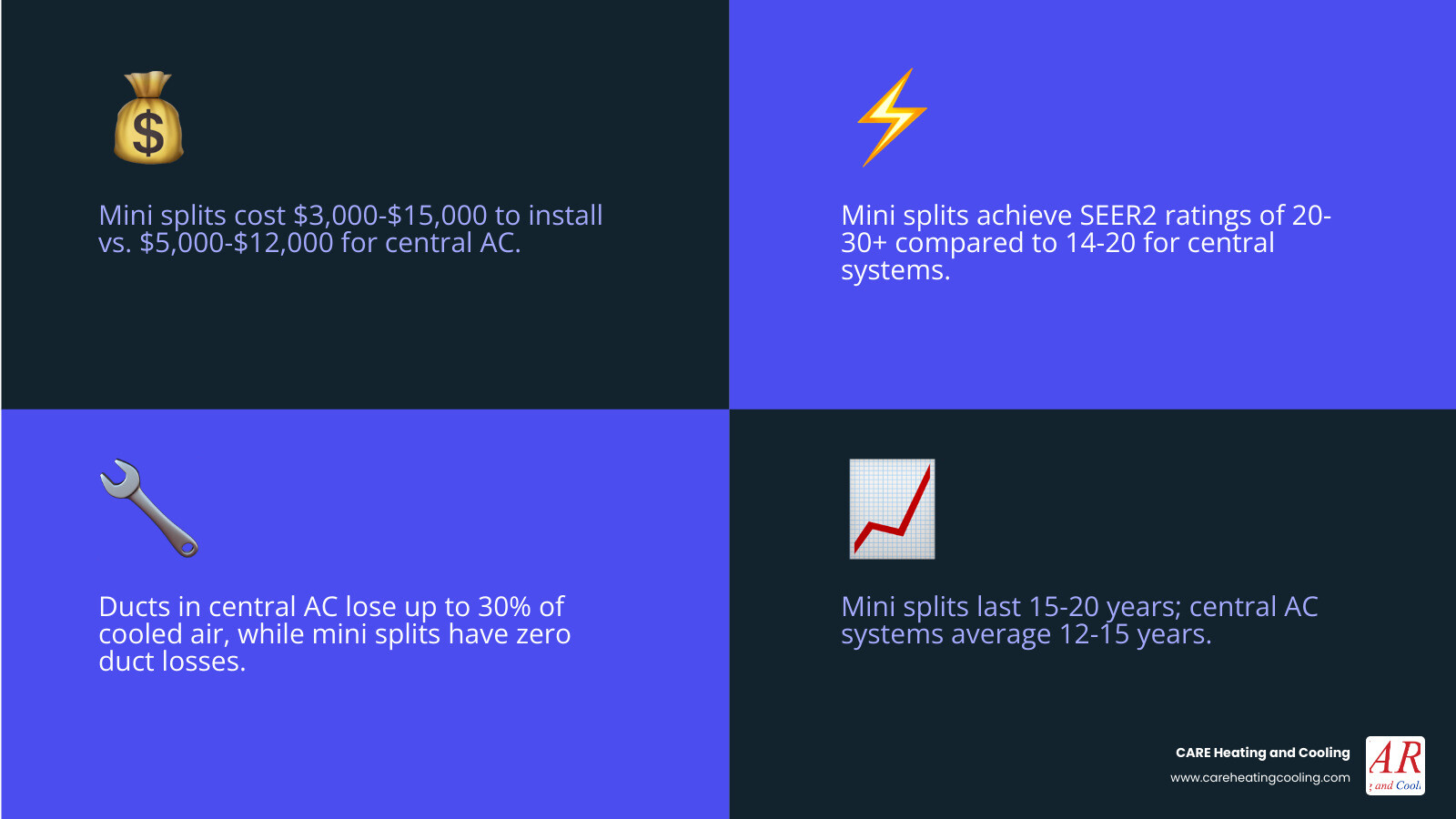
| SEER2 efficiency range | 20-30+ | 14-20 |
| Energy loss from ducts | None | Up to 30% |
| Lifespan | 15-20 years | 12-15 years |
| Installation disruption | Low (small wall penetration) | Higher (ductwork required if none exists) |
| Heating capability | Yes (heat pump) | Cooling only (separate furnace needed) |
| Zoning | Built-in, room by room | Limited without add-ons |
Most homeowners start this conversation focused on the purchase price. But that’s only part of the picture. The system that costs less to install isn’t always the one that costs less to own. Duct losses, monthly energy bills, maintenance needs, and system lifespan all shift the math — sometimes dramatically.
For Columbus-area homeowners, the question is especially relevant. Ohio’s climate means you need reliable performance in both summer heat and winter cold, and the wrong system for your home can mean years of overpaying on utilities or dealing with comfort problems that never quite get fixed.
This guide walks through every layer of the cost comparison — from installation and efficiency to long-term ownership — so you can make a confident, informed decision for your home.
Evaluating the Upfront Investment: Mini Split vs Central AC Cost Comparison Factors
When we sit down with a family in Dublin or Westerville to discuss a new cooling system, the first thing we look at isn’t the equipment — it’s the house itself. The “upfront investment” is heavily dictated by what’s already behind your walls.
The Ductwork Dilemma
The biggest “hidden monster” in any mini split vs central ac cost comparison is ductwork. If your home in Clintonville was built in the early 1900s and relies on a boiler for heat, you likely don’t have ducts. Installing a full Air Conditioners system in a home like that requires more than just a unit; it requires a major renovation. We’re talking about cutting into ceilings, losing closet space for returns, and days of labor-intensive construction.
In this scenario, a ductless system is almost always the more budget-friendly installation. Because Mini Split Installers Near Me only need to drill a small three-inch hole for refrigerant lines, the labor intensity is significantly lower. However, if you already have a well-maintained duct system from a previous forced-air furnace, central AC often wins the upfront price battle because the infrastructure is already there.
Electrical Capacity and Panel Upgrades
Modern HVAC systems are sophisticated, and they need the power to match. Many older homes in the Columbus area still operate on 60-amp or 100-amp electrical panels. When we transition a home to high-efficiency cooling, we often find that the existing panel can’t handle the new load. Whether you choose a multi-zone mini split or a high-SEER2 central unit, you may need an electrical service upgrade to 200 amps. This is a crucial factor that affects the initial investment regardless of which system you choose.
Home Size and Layout Constraints
A single-zone mini split is a fantastic, cost-effective solution for a sunroom in Gahanna or a finished basement in Hilliard. But as you add “zones” (indoor heads) to cover a whole 2,500-square-foot home, the equipment costs for a mini split system can climb. Conversely, a central AC unit handles large, open floor plans with ease using a single outdoor condenser and one indoor air handler. We always tell our neighbors that the “right” system is the one that fits the way you actually live in your home.
Efficiency and Monthly Savings: How SEER2 Ratings Impact Your Budget
By April 2026, the industry has fully embraced SEER2 (Seasonal Energy Efficiency Ratio 2) as the standard for measuring how much cooling you get for every dollar spent on electricity. When comparing these systems, it’s like comparing a hybrid car to a traditional sedan; both get you there, but one uses significantly less fuel.
The Inverter Advantage
One reason mini splits often boast higher SEER2 ratings (frequently reaching 25 to 30+) is inverter technology. Traditional central AC units are often “single-stage,” meaning they are either 100% on or 100% off. Imagine trying to keep your car at exactly 65 mph by only flooring the gas or hitting the brakes — it’s inefficient and wears out the parts.
Mini splits and premium central AC units use variable-speed compressors. These act more like a dimmer switch, ramping up and down to maintain a perfectly steady temperature. This precision is one of the biggest Benefits of Installing a Mini Split AC. You can use our SEER Calculator to see how moving from an old 10-SEER unit to a modern 20-SEER2 system can slash your monthly utility bills.
The “Duct Tax”
Even the most efficient central AC unit in the world has a handicap: the ducts. According to the Department of Energy, the average home loses 20% to 30% of its conditioned air through leaks, holes, and poorly connected ducts. This is essentially a “tax” you pay every month. Since mini splits deliver air directly into the room, they have 0% duct loss. This makes them inherently more efficient in a real-world setting, even if the SEER2 ratings on the box look similar.
| Feature | High-Efficiency Mini Split | Standard Central AC |
|---|---|---|
| SEER2 Rating | 22-30 | 14-16 |
| Compressor Type | Variable-speed (Inverter) | Single-stage or Two-stage |
| Energy Loss | 0% (Ductless) | 20-30% (Duct leaks) |
| Monthly Bill Impact | Lowest | Moderate |
Understanding the mini split vs central ac cost comparison in monthly utilities
In a typical Columbus summer, your operational efficiency depends on your cooling habits. Central air is designed to cool the entire house to one temperature. If you have a guest room in New Albany that stays empty most of the month, you’re still paying to cool it.
Mini Split Zoning Strategies for Home allow you to turn off the cooling in unused areas or keep the master bedroom at a crisp 68 degrees while the rest of the house stays at 74. This targeted cooling can lead to substantial savings that aren’t always reflected in the base SEER2 rating. Proper Temperature Settings for Mini Split AC are key to maximizing these savings without overworking the compressor.
Long-Term Ownership: Maintenance, Lifespan, and Reliability
A new HVAC system is a 15-to-20-year commitment. When we look at the total cost of ownership, we have to account for how often a technician needs to visit and how long the system will last before it needs replacement.
System Longevity
Generally, a well-maintained mini split can last 15 to 20 years. Central AC units typically have a slightly shorter lifespan, averaging 12 to 15 years. Part of this is because central units often work harder to push air through restrictive ductwork, which puts more strain on the blower motor and compressor over time.
However, mini splits are more sensitive to neglect. Because they use complex electronics and “heads” inside the living space, they require a bit more “TLC” from the homeowner. At CARE Heating and Cooling, our Air Conditioning Service focuses on preventative care to ensure you get every possible year out of your investment.
Filtration and Air Quality
Central AC systems offer a major advantage in filtration: you can install high-end HEPA filters or UV light purifiers directly into the ductwork to clean the air for the whole house. Mini splits have smaller, individual filters in each head. While they are great at catching dust in a specific room, they don’t provide the same “whole-home” scrubbing power as a ducted system.
Maintenance requirements in a mini split vs central ac cost comparison
The maintenance routine for these two systems is quite different. For central AC, you’re looking at changing a central filter every 1–3 months and having an annual professional tune-up to check refrigerant levels and clean the outdoor coils.
For mini splits, the homeowner needs to be a bit more hands-on. You should clean the filters in each indoor head every 2–4 weeks, especially if you have pets or live in a high-pollen area like Delaware or Powell. If you neglect this, you’ll start seeing Airflow Problems in Mini Splits or even find your Ductless AC Leaking Water Westerville.
Water leaks in mini splits are almost always caused by a clogged condensate drain line — a simple fix, but one that can cause a headache if not caught early. We also see Electrical Issues with Ductless AC occasionally, often due to the sensitive circuit boards being affected by power surges. We always recommend surge protection for these high-tech systems.
If you ever see a blinking light on your unit, don’t panic! You can often Troubleshoot Mini Split AC Error Codes using your manual, or give us a call. Sometimes it’s as simple as Ductless AC Remote Control Malfunctions—a dead battery can make it seem like the whole system is down!
Choosing the Right System for Your Columbus Home Layout
The “best” system often depends on the “problem” you’re trying to solve. Every neighborhood in Columbus has its own architectural quirks that favor one system over the other.
Older Homes and Historic Districts
In places like Bexley or German Village, preserving the aesthetic of the home is paramount. Installing ductwork in a 100-year-old home can be a nightmare. Mini splits are the gold standard here. They allow us to provide modern comfort without destroying the historic plaster walls or original woodwork.
Room Additions and Finished Attics
If you’ve just finished an attic in Upper Arlington or added a “four-season” sunroom in Pickerington, your existing central AC might not have the capacity to handle the extra square footage. Instead of replacing your entire central system with a larger one (and trying to run new ducts to a hard-to-reach attic), a single-zone mini split is the perfect “supplemental” solution. It can Solve Uneven Cooling with Ductless AC in those “nuisance rooms” that never seem to stay the right temperature.
Aesthetics and Noise
Some homeowners find the “white box on the wall” of a mini split to be an eyesore. If you prefer the “invisible” look of central air where only small vents are visible, then a ducted system is for you. However, when it comes to noise, mini splits win hands down. The indoor units are whisper-quiet, often operating at decibel levels lower than a library. Central AC systems, while much quieter than they used to be, still have the audible “whoosh” of air moving through the vents.
Humidity and Comfort
Ohio summers are famously humid. If you find Why Ductless AC Isn’t Cooling Properly, it might actually be a humidity issue. Mini splits are excellent at dehumidification because their variable-speed compressors run longer, lower-intensity cycles, which pulls more moisture out of the air. If you’re experiencing Humidity Problems with Ductless AC, it’s often because the unit is oversized and “short-cycling,” turning off before it has a chance to dehumidify.
Frequently Asked Questions about HVAC Comparisons
Which system is better for heating in Ohio winters?
In 2026, the answer has changed! Modern mini split heat pumps are now “cold-climate” rated, meaning they can provide efficient heat even when the temperature in Canal Winchester or Marysville drops well below zero.
Central AC units are strictly for cooling. To get heat, you need a separate furnace (usually gas). However, many Columbus homeowners are now opting for “Dual Fuel” systems — a central heat pump for most of the year, with a gas furnace that kicks in only during the absolute coldest nights. This provides the best of both worlds.
Does adding a mini split increase my home’s resale value?
Absolutely. Modern buyers are very energy-conscious. Seeing a high-efficiency zoned system is a major selling point, especially in homes where the upstairs is traditionally much hotter than the downstairs. It shows that the home has been upgraded with modern technology. The Benefits of Installing a Mini Split AC extend beyond your own comfort to the eventual appraisal of your property.
Are there incentives available for high-efficiency systems in 2026?
Yes! Under current federal guidelines, high-efficiency heat pumps (which include most mini splits) qualify for significant tax credits. Many local utility providers in the Columbus area also offer rebates for installing Energy Star-rated equipment. When you combine these incentives with the monthly savings shown on a SEER Calculator, the “premium” for a high-efficiency system often pays for itself in just a few years.
Conclusion
Choosing between a mini split and central AC isn’t about finding the “cheaper” system — it’s about finding the best value for your specific Columbus home. Whether you’re cooling a historic home in Worthington or a new build in Pataskala, the goal is reliable, efficient comfort that fits your budget.
At CARE Heating and Cooling, we pride ourselves on being the ethical choice for your family. Our technicians aren’t salesmen; they are skilled professionals paid to find the right solution for you, not to hit a sales quota. We believe in transparency, honesty, and treating your home with the same respect we give our own.
If you’re still weighing your options in the mini split vs central ac cost comparison, we’re here to help. We can perform a full home assessment to see which system will provide the most comfort for the lowest long-term cost. From Bexley to Sunbury, we are your local experts in keeping Ohio homes cool and comfortable.
Ready to find the perfect fit for your home? Contact us today to speak with a technician who cares about your comfort as much as you do.