
What SEER2 Rating Should I Buy in Ohio? Here’s What You Need to Know
What SEER2 rating should I buy in Ohio depends on your home, your budget, and how much you use your AC — but here’s a fast answer most Ohio homeowners can act on right now:
| Your Situation | Recommended SEER2 Rating |
|---|---|
| Budget-conscious, minimal AC use | 13.4 SEER2 (legal minimum) |
| Most Central Ohio homes | 16-18 SEER2 (sweet spot) |
| Long-term owners, heavy AC use | 19-24 SEER2 (premium) |
| Heat pump in Ohio (North Region) | 14.3 SEER2 minimum required |
Ohio sits in what the Department of Energy calls the North Region — and as of January 1, 2023, every new split-system air conditioner installed here must meet at least a 13.4 SEER2 rating. That’s the law. But meeting the minimum and making a smart choice are two very different things.
Ohio summers are no joke. Columbus and the surrounding areas see hot, humid stretches that push cooling systems hard for months at a time. One Columbus-area homeowner who upgraded from an old 8 SEER unit to a 16 SEER system cut their annual cooling costs by nearly 50%. That kind of savings is real — and it starts with picking the right efficiency rating before you buy.
SEER2 is simply the updated way the government measures how efficiently your AC runs. Think of it like a car’s fuel economy rating — except this one is tested under conditions that actually reflect what happens inside a real home with real ductwork, not a lab with perfect airflow. The new standard uses five times the external static pressure of the old test, which means the number you see on the label is a much more honest picture of what you’ll actually get.
This guide walks you through exactly what those numbers mean for your Ohio home, which rating makes sense for your situation, and how to avoid the most common mistake homeowners make — buying a high-efficiency system and never seeing the savings because of a poor installation.
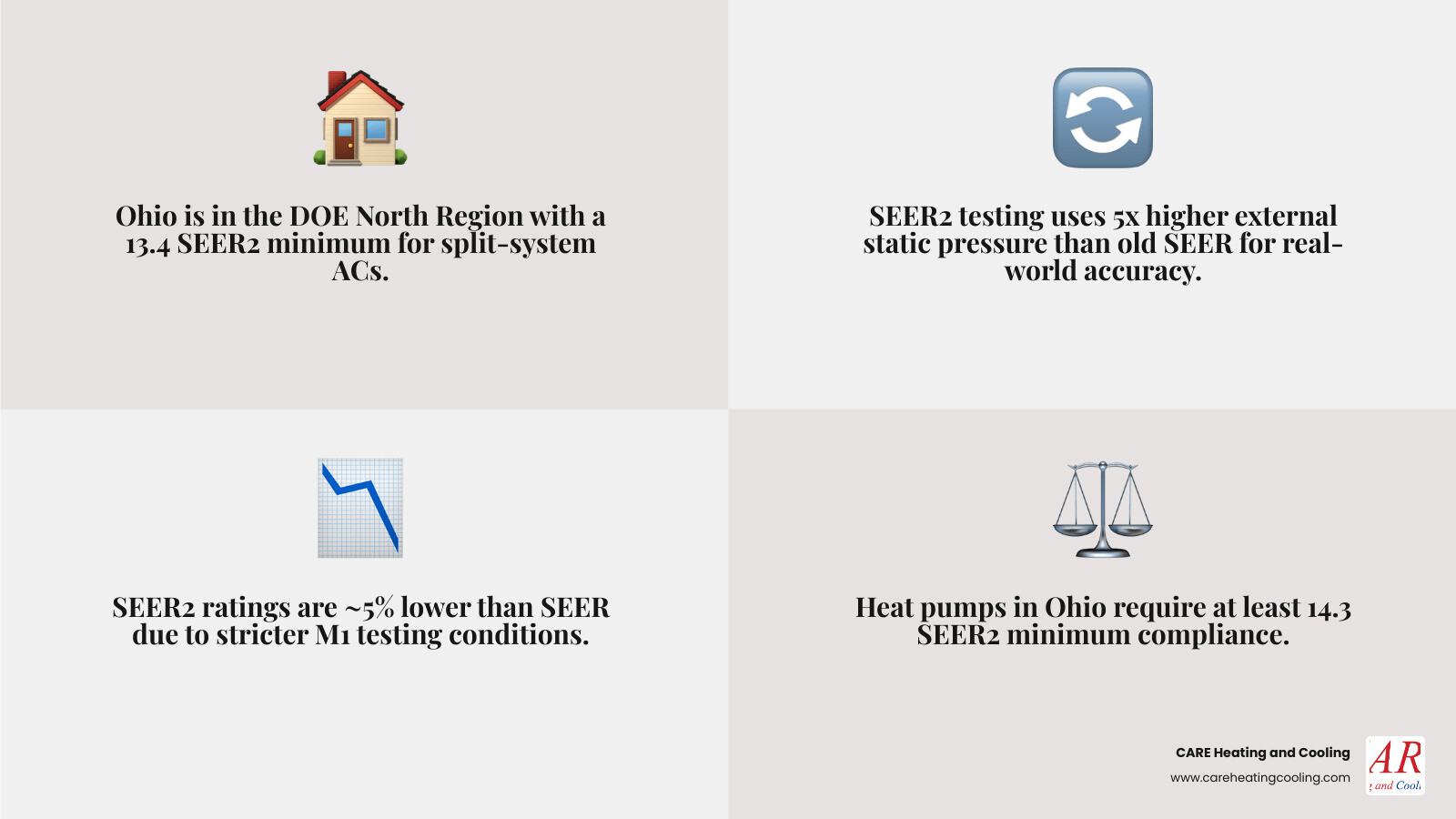
Understanding the Shift from SEER to SEER2 in Ohio
If you’ve lived in the Columbus area for a while, you probably remember the old SEER (Seasonal Energy Efficiency Ratio) ratings. It was the standard for decades. However, as of April 2026, we are well into the SEER2 era. The Department of Energy (DOE) realized that the old testing methods didn’t exactly match the “real world.”
In the old SEER testing, units were tested with very little resistance to airflow (static pressure). It was like testing a car’s fuel efficiency while it was on a perfectly flat, indoor treadmill with no wind resistance. But your home isn’t a lab. You have filters, twists and turns in your ductwork, and vents that create resistance.
SEER2 uses the “M1” testing procedure. This update increases the external static pressure used during testing by five times—from 0.1 inches of water column to 0.5 inches. This makes the rating much more accurate for a typical Ohio home in places like Dublin or Westerville. Because the testing is harder, the numerical ratings for SEER2 are usually about 4.5% to 5% lower than the old SEER numbers. For example, a 14 SEER unit is roughly equivalent to a 13.4 SEER2 unit.
In Ohio, which is part of the North Region, the regulations are based on the manufacturing date. This is a bit different than the South, where regulations are based on the installation date. In our neck of the woods, if a unit was manufactured before January 1, 2023, it can still be legally installed even if it only meets the old 13 SEER standard. However, any unit manufactured after that date must meet the 13.4 SEER2 minimum.
When you see a yellow Energy Guide label on a new unit, you’ll now see the SEER2 rating clearly displayed. If your current unit is pushing 15 years old and struggling to keep up with a humid July in Hilliard, it’s likely a 10 or 12 SEER unit. Upgrading to even the modern minimum will feel like a massive leap in technology. If you aren’t sure if your system is ready for the scrap heap, check out our guide on Signs It’s Time for an AC Replacement.
What SEER2 rating should i buy in Ohio for maximum comfort?
When homeowners in Powell or Upper Arlington ask us, “what seer2 rating should i buy in ohio?”, we usually point them toward the “sweet spot.” While the legal minimum is 13.4 SEER2, that doesn’t always provide the best value over the 15 to 20-year lifespan of the equipment.
For most Central Ohio homes, a 16 to 18 SEER2 rating is the ideal balance between the upfront cost of the machine and the monthly savings on your AEP or Columbia Gas bill. In our humid climate, a higher SEER2 rating often comes with better humidity removal capabilities. In Ohio, it’s often not the heat that makes you miserable—it’s that “thick” air that makes your living room feel like a sauna. High-efficiency units run longer, lower-speed cycles that pull more moisture out of the air.
Let’s look at the efficiency gains you can expect when comparing different Air Conditioners:
| SEER2 Rating | Efficiency Gain (Compared to 13.4 SEER2) | Estimated Monthly Cooling Cost (2,000 sq ft home) |
|---|---|---|
| 13.4 SEER2 | Baseline | ~$120 |
| 16 SEER2 | ~12% more efficient | ~$105 |
| 18 SEER2 | ~20% more efficient | ~$90 |
| 24 SEER2 | ~43% more efficient | ~$75 |
As you can see, jumping from the minimum to an 18 SEER2 unit can save you roughly $30 a month during the peak cooling season. Over 15 years, that adds up to thousands of dollars in savings. Plus, these units are generally much quieter, so you won’t have to turn up the TV every time the AC kicks on.
Deciding what SEER2 rating should i buy in Ohio based on home size
Your home’s physical footprint plays a huge role in this decision. A 1,200-square-foot ranch in Whitehall has very different needs than a 4,000-square-foot multi-story home in New Albany.
For larger homes, especially those with two or three stories, we almost always recommend a higher SEER2 rating (18+). Why? Because heat rises. Your upstairs bedrooms will always be harder to cool than your basement or first floor. A high-efficiency system with variable-speed technology can “sip” energy and run almost constantly at a low level to keep those upstairs rooms comfortable without freezing out the people downstairs.
We always perform a Manual J Load Calculation before recommending a specific unit. This looks at your square footage, insulation levels, window orientation, and even how many people live in the house. If you have an older home in Delaware with original windows, you might need a different approach than a brand-new build in Lewis Center. If you’re noticing uneven cooling or your unit is constantly cycling on and off, it might be one of the Signs Old AC Needs Replacement Delaware.
How usage patterns dictate what SEER2 rating should i buy in Ohio
Are you a “set it and forget it” person, or do you keep your thermostat at 68 degrees all summer long? Your personal habits change the math on what seer2 rating should i buy in ohio.
- The “Eco-Warrior”: If you keep the windows open as much as possible and only turn the AC on when it hits 85 degrees, a 13.4 or 14.3 SEER2 unit is likely fine. The “payback period” for a high-end unit would take too long because you aren’t using enough electricity to justify the extra cost.
- The “Comfort Seeker”: If you want your home to be a crisp 70 degrees from May through September, an 18-20 SEER2 unit is a much better investment. You are using the system enough that the energy savings will pay for the equipment upgrade much faster.
- The “Remote Worker”: With more people working from home in places like Gahanna and Pickerington, AC units are running during the hottest parts of the day when they used to be set to “away” mode. This increased usage makes high-efficiency SEER2 ratings even more valuable.
Comparing Single-Stage, Two-Stage, and Variable-Speed Technology
The SEER2 rating tells you how efficient the unit is, but the technology inside tells you how it will actually feel.
- Single-Stage (The “Light Switch”): These are usually your 13.4 to 15 SEER2 units. They are either 100% on or 100% off. It’s like a car that only goes 0 or 60 MPH. These are the most affordable upfront but lead to more temperature swings and higher humidity.
- Two-Stage (The “Middle Ground”): These typically fall in the 16-17 SEER2 range. They have a “low” setting (usually about 65-70% capacity) for mild days and a “high” setting for those 95-degree Columbus afternoons. They are much better at dehumidifying and are quieter than single-stage units.
- Variable-Speed (The “Cruise Control”): These are the premium units, often hitting 19-24 SEER2. The compressor can adjust its speed in tiny increments—sometimes as low as 25% capacity. They run for long periods at very low energy levels. This is the gold standard for comfort. It eliminates hot spots, kills humidity, and is so quiet you might have to walk up to it to see if it’s running.
When we talk about High Efficiency Furnaces, we often pair them with these variable-speed AC units to create a complete home comfort system that communicates and optimizes energy use across both heating and cooling seasons.
Heat Pump Requirements and Federal Incentives
In Ohio, heat pumps are becoming incredibly popular, especially as “dual-fuel” or hybrid systems. In these setups, a heat pump handles the cooling and moderate heating, while a gas furnace takes over when the temperatures drop below freezing.
The rules for heat pumps are stricter than for standard AC units. In the North Region, a split-system heat pump must meet a minimum of 14.3 SEER2 and 7.5 HSPF2 (Heating Seasonal Performance Factor).
The good news? The federal government really wants you to buy these. Under the Inflation Reduction Act (25C Tax Credit), homeowners can often claim a tax credit of up to 30% of the project cost (capped at $2,000 per year) for high-efficiency heat pumps. To qualify for these top-tier incentives, the heat pump usually needs to be at least 16 SEER2.
If you are looking at a new system in Grove City or Reynoldsburg, a 16+ SEER2 heat pump often ends up being cheaper than a mid-range AC unit once you factor in the federal tax credits and local utility rebates. It’s a win-win: higher efficiency, better comfort, and a lower net price.
Why Commissioning is Critical for Real-World Performance
Here is a secret the big-box retailers won’t tell you: The SEER2 rating on the box is just a potential.
You could buy the most expensive, 24 SEER2 variable-speed unit on the market, but if it’s installed poorly, it might only perform like a 13 SEER2 unit. This is why “commissioning” is the most important part of the process.
Commissioning is more than just “hooking it up.” It involves:
- Airflow Calibration: Ensuring your ductwork can actually handle the air the new unit is pushing.
- Refrigerant Charge: Using digital gauges to ensure the refrigerant level is precise to the ounce. Being off by just a little bit can drop your efficiency by 20%.
- Static Pressure Testing: Measuring the resistance in your ducts to ensure the fan motor isn’t working harder than it has to.
- Thermostat Communication: Ensuring your smart thermostat is actually talking to the variable-speed motor correctly.
At CARE Heating and Cooling, our technicians are paid to fix and install things correctly, not to chase sales commissions. This means we take the extra hour or two to “dial in” your system. We’ve seen many homes in Canal Winchester and Pataskala where a perfectly good high-efficiency unit was failing simply because the installer skipped the commissioning phase. Don’t let your investment go to waste by choosing an installer who takes shortcuts.
Frequently Asked Questions About Ohio HVAC Efficiency
What is the minimum SEER2 for air conditioners in Ohio?
As of 2026, the minimum for a standard split-system air conditioner in Ohio (North Region) is 13.4 SEER2. For heat pumps, the minimum is 14.3 SEER2. If you are buying a “packaged unit” (where the whole system sits outside), the minimum is 13.4 SEER2.
Does a higher SEER2 rating always mean lower utility bills?
Generally, yes, but only if the system is sized and installed correctly. A 20 SEER2 unit that is “oversized” for your home will “short cycle” (turn on and off too quickly). This uses a massive amount of electricity and fails to remove humidity, leaving you with a high bill and a clammy house. Proper sizing is just as important as the rating itself.
Can I still install a SEER-rated unit manufactured before 2023?
Yes. In Ohio, the law allows for “inventory depletion.” If a local warehouse still has a brand-new 13 SEER unit that was manufactured in 2022, it is perfectly legal to install it in 2026. However, these units are becoming very rare as the industry has fully transitioned to SEER2-compliant equipment.
Conclusion
Choosing what seer2 rating should i buy in ohio doesn’t have to be a headache. For most of our neighbors in the Greater Columbus area—from the historic streets of Clintonville to the growing suburbs of Sunbury—the 16 to 18 SEER2 range offers the best “bang for your buck.” It provides significant energy savings, excellent humidity control, and qualifies for many of the best rebates and tax credits.
At CARE Heating and Cooling, we take pride in being the ethical choice for HVAC in Central Ohio. We were honored with the BBB Torch Award for Ethics because we believe in transparency. Our technicians aren’t sales reps; they are experts who want to find the right solution for your specific home and budget. Whether you’re in Plain City, Blacklick, or anywhere in between, we’re here to make sure you stay cool without overpaying.
Ready to see how much you could save by upgrading? Use our SEER Calculator to compare different ratings and see the real-world impact on your wallet. When you’re ready for an honest assessment of your home’s needs, give us a call—we’re here to help you stay comfortable, Ohio style.