
Do I Need a Humidifier or Dehumidifier? Here’s the Quick Answer
If you’re wondering do i need a humidifier or dehumidifier, the short answer comes down to one thing: your current indoor humidity level.
- Humidity below 30%? You need a humidifier — it adds moisture to dry air.
- Humidity above 50%? You need a dehumidifier — it removes excess moisture.
- Humidity between 30–50%? You’re in the healthy range. No device needed right now.
The EPA recommends keeping indoor humidity between 30% and 50% year-round for comfort, health, and home protection. A simple, inexpensive device called a hygrometer can tell you exactly where your home stands.
Most homeowners don’t think much about the moisture in their air — until something feels off. Maybe your skin is cracking and dry every winter, or your basement smells musty every summer. Maybe you wake up with a scratchy throat, or you notice condensation building up on your windows.
These aren’t random annoyances. They’re your home telling you its humidity is out of balance.
Too little moisture in the air — common during Ohio winters when heating systems run nonstop — can dry out your skin, irritate your sinuses, and even damage wood furniture and flooring. Too much moisture, which hits hard during Columbus summers, creates the perfect conditions for mold, dust mites, and allergens that make breathing harder for everyone in the house.
The good news is that once you know which direction your humidity is off, the fix is straightforward.
Understanding the Ideal Indoor Humidity Level for Your Health
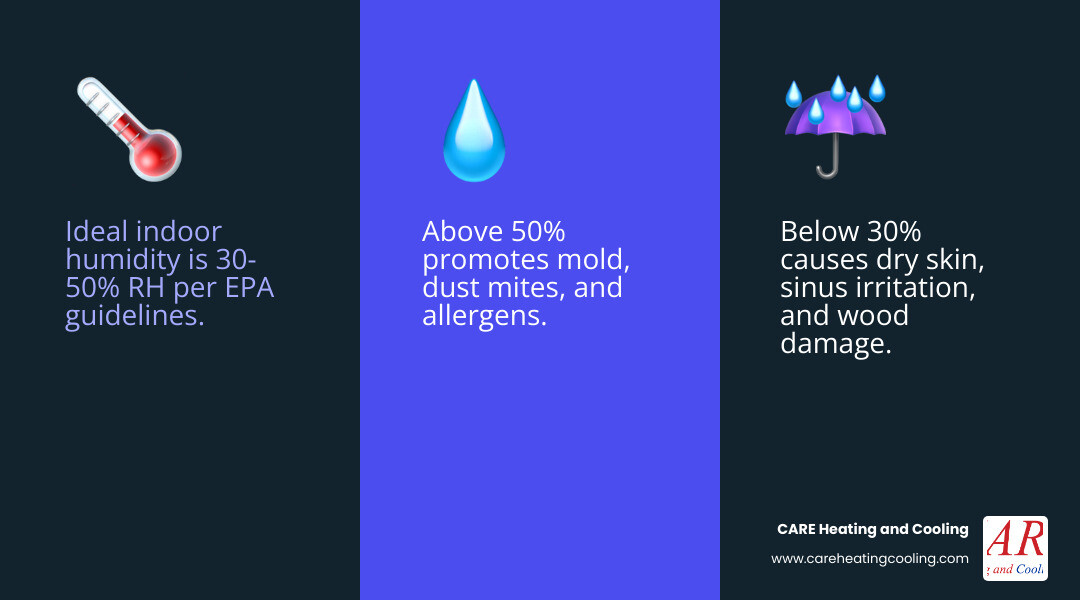
In April 2026, as we look at modern home comfort, the science remains clear: balance is everything. The Environmental Protection Agency (EPA) and various health experts consistently recommend maintaining indoor relative humidity (RH) between 30% and 50%.
Why this specific window? It’s the “Goldilocks zone” for your health and your home’s structure. When humidity drops below 30%, the air becomes predatory—it literally pulls moisture out of your skin, your nasal passages, and even your wooden furniture. Conversely, once humidity climbs above 50%, you invite biological pollutants. This includes mold, bacteria, and dust mites, all of which thrive in damp environments.
To manage this, we recommend every homeowner in the Columbus area invest in a hygrometer. This small, inexpensive digital device acts like a thermometer for moisture, giving you a real-time percentage of your indoor humidity. Without one, you’re just guessing. By keeping your home in that 30-50% range, you support your respiratory system and protect your property from the silent damage of humidity control issues.
Determining Your Home’s Needs: Do I Need a Humidifier or Dehumidifier?
In Central Ohio, we experience the full spectrum of weather. From the bone-dry, freezing winters in Dublin and Westerville to the muggy, heavy summers in Grove City and Hilliard, your home’s needs will likely shift with the seasons.
The question of do i need a humidifier or dehumidifier often depends on the time of year and your specific living situation. Here is a quick breakdown of how these two systems compare:
| Feature | Humidifier | Dehumidifier |
|---|---|---|
| Primary Function | Adds moisture to the air | Removes moisture from the air |
| Best Used When | Humidity is below 30% | Humidity is above 50% |
| Common Season | Winter (Heating season) | Summer (Cooling season) |
| Physical Signs | Static shocks, dry skin, nosebleeds | Musty smells, mold, window sweat |
| Health Goal | Relieve dry sinuses and itchy skin | Reduce allergens and mold triggers |
Because our climate is so variable, many residents find that whole home humidifiers indoor comfort is essential from November through March, while dehumidification becomes the priority from June through September.
Signs Your Home Needs a Humidifier During Dry Winters
As we move through the winter of 2026, you might notice your home becoming a “static electricity factory.” This is one of the first signs of dry indoor winter air. When cold air from outside is brought in and heated by your furnace, its capacity to hold moisture drops significantly. It’s not uncommon for an average American home to drop to 20-25% humidity during a cold snap—drier than the Sahara Desert!
Watch for these red flags:
- Health Symptoms: Frequent nosebleeds, “sandpaper” throat in the morning, and itchy, flaky skin.
- Physical Property Damage: Gaps appearing between hardwood floorboards, cracking in wooden musical instruments (like pianos or guitars), and peeling wallpaper.
- Static Electricity: Constant shocks when touching doorknobs or petting the cat.
Managing humidity in winter isn’t just about comfort; it’s about preservation. Dry air pulls moisture out of the very “bones” of your house, leading to expensive structural repairs over time.
How do I know if I need a humidifier or dehumidifier for seasonal allergies?
This is a common point of confusion. For many in the Columbus area, allergies are a year-round battle. If your allergies are triggered by dry, inflamed sinuses, a humidifier is your best friend. It keeps the protective mucus in your respiratory tract moist, allowing your body to naturally filter out dust and pollen. We’ve seen how whole home humidifiers improve IAQ (Indoor Air Quality) by preventing the airborne “dust travel” that happens in overly dry environments.
However, if your allergies are triggered by mold or dust mites, a humidifier might actually make things worse if overused. This is why measuring with a hygrometer is so critical—you want to soothe your sinuses without crossing the 50% threshold where mold begins to grow.
Humidifier types and maintenance
If you decide a humidifier is the right choice, you’ll encounter several types:
- Ultrasonic: Uses high-frequency vibrations to create a fine mist. They are quiet but require distilled water to avoid “white dust” from minerals.
- Evaporative: Uses a fan to blow air through a wet wick or filter. These are self-regulating because as the air gets more humid, it becomes harder for water to evaporate.
- Steam Vaporizers: These boil water to create steam. While great for killing bacteria, they can be a burn risk around children and pets.
Regardless of the type, you must keep whole home humidifiers in condition through regular cleaning. For portable units, this means daily water changes and weekly scrubbing. For whole-home systems, it involves an annual filter or pad change, which our technicians can handle during your routine maintenance visit.
Signs Your Home Needs a Dehumidifier in Humid Summers
When July hits in Central Ohio, the air can feel like a warm, wet blanket. High humidity doesn’t just make you feel “sticky”—it can cause serious issues for your home’s health. Many homeowners find that whole home dehumidifiers for IAQ are the only way to stay truly comfortable during the peak of summer.
Signs you need to remove moisture include:
- The “Smell”: A persistent musty or earthy odor, especially in lower levels or closets.
- Window Sweat: Condensation or fogging on the glass inside your home.
- Visible Growth: Small black or green spots on walls, especially in bathrooms or corners of the ceiling.
- Sticky Floors: Hardwood or tile floors that feel tacky or damp to the touch.
Should I choose a humidifier or dehumidifier for my Columbus basement?
In almost every case, a basement in Columbus, Delaware, or Marysville will need a dehumidifier rather than a humidifier. Basements are naturally cooler and more prone to dampness from the surrounding soil. High basement humidity is a magnet for dust mites and can lead to structural rot.
Installing HVAC/Columbus OH/whole home dehumidifiers is often the most effective way to protect your foundation and prevent that “basement smell” from traveling upstairs to the rest of the house.
Dehumidifier types and operation
Most modern dehumidifiers work via refrigeration. They pull in warm, moist air and pass it over cold coils. The moisture condenses into water droplets (just like a cold soda can on a hot day) and drips into a reservoir or down a drain.
- Capacity: Dehumidifiers are rated by “pints,” which refers to how many pints of water they can pull from the air in 24 hours.
- Desiccant Dehumidifiers: These use a moisture-absorbing material (like silica gel) and are often used in very cold areas where traditional refrigerant coils might freeze.
If you live in areas like Westerville, you might consider HVAC/Westerville OH/whole home dehumidifiers which integrate directly with your cooling system to manage the entire home’s moisture levels automatically.
Whole-Home Systems vs. Portable Units: Which Is Better?
When addressing the question of do i need a humidifier or dehumidifier, the next step is deciding between a portable “plug-in” unit and a whole-home system.
While portable units are great for a single small bedroom or a specific “problem” closet, they have several downsides:
- Maintenance: You have to manually fill or empty them every single day.
- Noise: They can be loud, especially in a bedroom.
- Efficiency: They only treat the air in their immediate vicinity, leaving the rest of the house unbalanced.
A whole-home system, such as those we install at HVAC/Columbus OH/whole home humidifiers, is integrated directly into your existing ductwork. This means:
- Set It and Forget It: Your thermostat or a dedicated humidistat controls the level automatically.
- Better HVAC Efficiency: Properly humidified air feels warmer, meaning you can turn your thermostat down a few degrees in the winter without feeling cold. Conversely, dehumidified air feels cooler in the summer, reducing the load on your AC.
- Lower Energy Bills: By helping your HVAC system work more effectively, these systems can actually pay for themselves over time through reduced energy consumption.
For residents in suburban areas like Powell or New Albany, HVAC/Westerville OH/whole home humidifiers provide a seamless way to protect high-end finishes and hardwood floors throughout the entire property.
Frequently Asked Questions about Humidity Control
Can I use both a humidifier and a dehumidifier in the same home?
Absolutely—just usually not at the same time! In the Columbus area, our seasons are distinct. You might run a whole-home humidifier in January to stop the static shocks and then switch to a dehumidifier in July to prevent mold. Using both seasonally is the best way to maintain that 30-50% range year-round.
How do I accurately measure the humidity levels in my house?
The most accurate way is with a digital hygrometer. You can find these at most hardware stores in places like Gahanna or Hilliard. For the best reading, place it in a room where you spend a lot of time (like the living room) and keep it away from direct sunlight, heat vents, or humid bathrooms.
How does humidity impact my HVAC system’s efficiency?
Water vapor holds heat. If your air is too dry in the winter, heat escapes your body faster, making you feel cold even if the furnace is set to 72°F. By adding moisture, you feel warmer at 68°F. In the summer, your AC’s primary job is actually removing humidity. If you have a dedicated dehumidifier helping out, the AC doesn’t have to work nearly as hard, extending the life of your equipment.
Conclusion
Finding the right balance for your home’s air doesn’t have to be a guessing game. Whether you are struggling with the parched air of an Ohio winter or the swampy humidity of a Columbus summer, there is a solution that fits your specific needs.
At CARE Heating and Cooling, we specialize in helping homeowners throughout the greater Columbus area—from Pickerington to Dublin and everywhere in between—achieve perfect indoor air quality. Our technicians are unique in the industry; they are paid to fix your problems, not to sell you equipment you don’t need. This ethical approach ensures that if we recommend a whole-home system, it’s because it truly is the best solution for your comfort and health.
Don’t let poor air quality impact your family’s well-being or your home’s integrity. If you’re still asking “do I need a humidifier or dehumidifier?” let us provide a professional assessment. We treat every home like our own, ensuring you get the honest, reliable service you deserve.
For more info about humidity control services, reach out to our team today and breathe easier tomorrow.