
Why Ductless Heating and Cooling for Homes Without Ductwork Is the Smartest Fix for Older Columbus Homes
Ductless heating and cooling for homes without ductwork is the most practical way to get year-round comfort in an older home — without tearing open walls or laying hundreds of feet of new ductwork. If your home runs on baseboard heaters, radiators, or a patchwork of window units, you already know the frustration: uneven temperatures, high energy bills, and a system that was never really designed for the Ohio climate.
Here’s a quick look at what makes ductless systems the go-to solution:
- No ductwork needed — a small 3- to 4-inch hole in the wall connects the indoor and outdoor units
- Heats and cools — ductless heat pumps handle both, unlike window ACs
- Up to 40% more efficient than traditional ducted systems by eliminating duct energy loss
- Whisper-quiet — indoor units operate as low as 21 decibels
- Zoned comfort — control temperatures room by room, not whole-house
- Works in cold climates — modern cold-climate units deliver full heating capacity down to 5°F
- Long lifespan — 12 to 20 years with proper maintenance
Older homes in the Columbus area were built for charm, not HVAC convenience. Thick plaster walls, no attic clearance, and tight floor cavities make adding traditional ducts a costly and invasive project — and sometimes, it simply isn’t possible without damaging the home’s character. For decades, homeowners in this situation were stuck choosing between noisy window units in summer and expensive electric baseboard heat in winter. That combination is neither comfortable nor efficient.
Modern ductless mini-split systems change that equation entirely. They move heat rather than generate it, which is the core reason they’re so much more efficient than older electric heating methods. ENERGY STAR certified mini-splits use up to 60% less energy than standard electric radiators — a meaningful difference on a monthly utility bill.
Understanding Ductless Heating and Cooling for Homes Without Ductwork

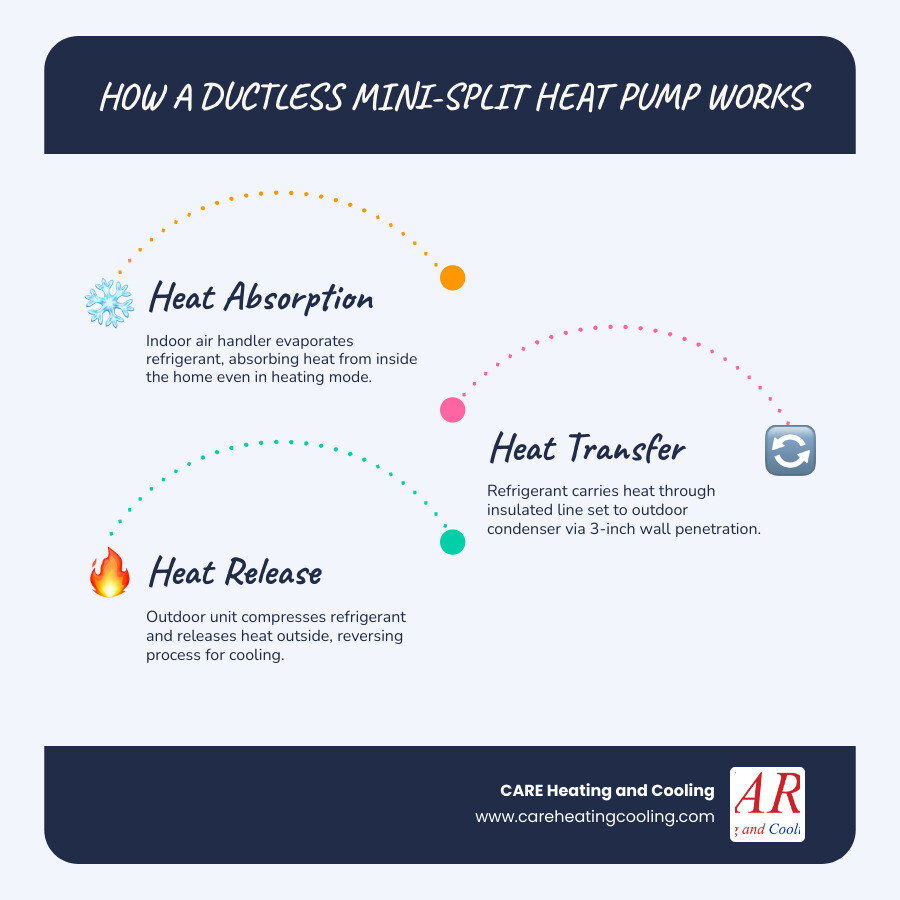
To understand why these systems are so effective, it helps to know what is a ductless mini-split system? and how it differs from the furnace or central air conditioner you might be used to. A ductless system, often called a mini-split, consists of two primary components: an outdoor condenser unit and one or more indoor air handlers.
Unlike central HVAC systems that force air through a maze of metal channels, ductless systems use a refrigerant line set to move thermal energy directly to the room that needs it. In the summer, the indoor unit absorbs heat from your room and sends it outside. In the winter, the process reverses: the outdoor unit extracts heat from the air (even in cold May 2026 temperatures!) and moves it inside.
The installation is remarkably non-invasive. We only need to make a small 3-inch wall penetration to connect the indoor and outdoor units via refrigerant lines, suction lines, and power cables. This makes it a “game-changer” for historic homes in areas like Clintonville or German Village, where preserving the original plaster and woodwork is a top priority.
Furthermore, these systems utilize inverter technology. Think of a traditional furnace like a light switch—it’s either 100% on or completely off. An inverter-driven compressor is more like a dimmer switch. It scales its speed up or down to meet the exact demand of the room, preventing those annoying temperature swings and saving a massive amount of energy in the process.
Why Older Homes and Additions Benefit from Ductless Systems
If you are currently relying on window units to survive a Columbus summer, you are likely dealing with high noise levels and even higher utility bills. When adding cooling without ductwork, options compared show that ductless systems win on almost every metric.
| Feature | Window Units | Central HVAC (New Ducts) | Ductless Mini-Split |
|---|---|---|---|
| Efficiency | Low (6-12 SEER) | Moderate (13-20 SEER) | High (Up to 38 SEER2) |
| Noise | High (Jet engine) | Moderate (Air movement) | Whisper (21-30 dB) |
| Installation | DIY / Temporary | Highly Invasive | Low Impact / Permanent |
| Energy Loss | High (Air leaks) | Up to 40% (Duct loss) | Less than 5% |
One of the biggest benefits of installing a mini-split AC is the elimination of “duct loss.” In a traditional home, leaky or uninsulated ductwork can account for up to 40% of energy waste. Because ductless systems deliver conditioned air directly into the living space, that waste is virtually eliminated.
Indoor air quality is another major advantage. Traditional ducts can become a “dust highway,” circulating allergens and pollutants throughout the house. Ductless units feature multi-stage filtration systems that trap microscopic particles and allergens right at the source, providing cleaner air for your family. Plus, the units are incredibly quiet. At 21 to 30 decibels, they are literally as soft as a whisper—a far cry from the “pinging” of metal ducts or the roar of a window shaker.
Strategic Zoning and System Configurations
One of the most powerful features of ductless heating and cooling for homes without ductwork is the ability to create personalized comfort zones. In a central HVAC setup, one thermostat usually controls the whole house. This often leads to “hot and cold spots,” where the upstairs is sweltering while the basement is freezing.
By using mini-split zoning strategies for home, you can solve uneven cooling with ductless AC by placing an air handler in each major room. A single outdoor unit can support up to 8 separate indoor zones. This means you can keep your master bedroom at a crisp 68 degrees for sleeping while keeping the guest room or home office at a higher setting to save energy.
This flexibility is perfect for:
- Home Additions: If you are thinking, “I’m looking for ductwork contractors in Westerville for a home addition project,” you might find that a ductless system is actually more cost-effective than trying to extend your existing, possibly undersized, central system.
- Garage Conversions: Turning a garage into a gym or workshop? A single-zone mini-split provides perfect climate control without needing to connect to the main house.
- Finished Basements: Basement air is often damp and chilly. Ductless units are excellent at dehumidifying and providing targeted warmth.
Versatile Options for Ductless Heating and Cooling for Homes Without Ductwork
Ductless doesn’t just mean a white box on the wall. In 2026, homeowners have several aesthetic choices to match their decor:
- Wall-Mounted Units: The most common and cost-effective option, mounted high to stay out of the way.
- Floor-Mounted Consoles: Great for replacing old radiators or for rooms with limited wall space or slanted ceilings.
- Ceiling Cassettes: These mount flush with the ceiling, offering a discreet look and 360-degree airflow.
- Concealed Ducted: For those who want the efficiency of ductless but want the units completely hidden, these can be tucked into a small attic or crawlspace with only small grilles visible.
Whether you need room cooling with ductless AC in Lewis Center or a whole-home solution in Dublin, there is a configuration that fits your home’s unique layout.
Performance in Extreme Climates and Long-Term Reliability
A common myth is that heat pumps can’t handle Ohio winters. While that may have been true 20 years ago, modern cold-climate heat pumps are designed for our environment. Many ENERGY STAR certified units can provide 100% heating capacity at 5°F and continue operating efficiently down to -13°F.
To get the most out of your system, following proper temperature settings for mini-split AC is key. Unlike a furnace, heat pumps work most efficiently when you “set it and forget it.” Trying to drop the temperature 10 degrees at night actually uses more energy than keeping it at a steady, comfortable level.
With professional installation and care, these systems are a long-term investment, typically lasting between 12 and 20 years. They are also environmentally friendly; a whole-house ductless system can avoid more than 4,500 lbs of greenhouse gas emissions over its lifespan. To help with the transition, federal tax credits for air-source heat pumps can reach up to $2,000, making now an excellent time to upgrade. For more advice on maximizing your system, check out our temperature tips for ductless AC systems.
Performance of Ductless Heating and Cooling for Homes Without Ductwork
Maintenance for a ductless system is straightforward but essential. The most important task for a homeowner is cleaning the washable filters every 2 to 4 weeks. Clogged filters are the number one cause of airflow problems in mini-splits.
Beyond DIY filter cleaning, we recommend a professional inspection once a year to check refrigerant levels and clean the coils. Neglecting maintenance can lead to issues like ductless AC leaking water in Westerville or the system throwing cryptic messages. If your unit stops acting right, you can often troubleshoot mini-split AC error codes using your manual, but major repairs should always be handled by a pro.
Frequently Asked Questions about Ductless HVAC
Can a ductless system heat an entire home in Ohio winters?
Yes! By using a multi-zone configuration with air handlers in every major living space, a ductless heat pump can serve as your primary heating source. For the coldest days in Central Ohio, modern “Hyper-Heat” or cold-climate models are specifically engineered to keep you warm even when temperatures drop well below zero.
How many indoor units can connect to one outdoor condenser?
Most residential multi-zone outdoor units can support between 2 and 5 indoor units, though some advanced systems can handle up to 8. This allows you to cover every bedroom, the living room, and even a finished basement with a single outdoor footprint.
Are ductless systems better for people with allergies?
Absolutely. Because there are no ducts for dust, pet dander, or mold to settle in, the air stays much cleaner. Most units also feature advanced filtration that traps allergens and can be easily washed, ensuring your indoor air quality remains high year-round.
Conclusion
Finding the right solution for ductless heating and cooling for homes without ductwork doesn’t have to be a headache. At CARE Heating and Cooling, we understand the unique challenges of Columbus-area homes, from the historic bungalows of Bexley to the modern additions in Hilliard.
We are proud to be a family-owned company that puts ethics first. As a winner of the BBB Torch Award for Ethics, our philosophy is simple: our technicians are paid to fix your system, not to hit sales quotas. When we visit your home, we provide honest, transparent recommendations tailored to your specific needs and budget. Whether you need a simple repair or a full system installation, we treat your home with the same care we’d give our own.
Ready to ditch the window units and experience true zoned comfort? If you’re looking for ductless AC in Westerville or anywhere in the greater Columbus area, give us a call. We’re here to help you stay comfortable, no matter what the Ohio weather throws your way.