
Why Dirty Air Ducts Are Quietly Draining Your HVAC System
How dirty ducts affect your HVAC efficiency is something most homeowners never think about — until their energy bills climb for no obvious reason, or certain rooms just never feel comfortable.
Here’s the short answer:
How Dirty Ducts Affect HVAC Efficiency
| Effect | What It Means for You |
|---|---|
| Restricted airflow | Your system works harder to push air through clogged passages |
| Longer run cycles | The system runs more often to reach your thermostat setting |
| Higher energy use | Dirty ducts can increase energy consumption by 20–40% |
| Uneven temperatures | Some rooms get too hot or cold due to blocked airflow |
| Premature wear | Key components like the blower motor strain and fail sooner |
| Poor indoor air quality | Dust, mold, and allergens recirculate through your living spaces |
Think of your ductwork like a highway. When that highway is clear, air moves fast and efficiently to every room. When it’s packed with dust, debris, pet dander, and grime, everything slows down. Your HVAC system has to work harder, run longer, and burn more energy — just to deliver less comfort.
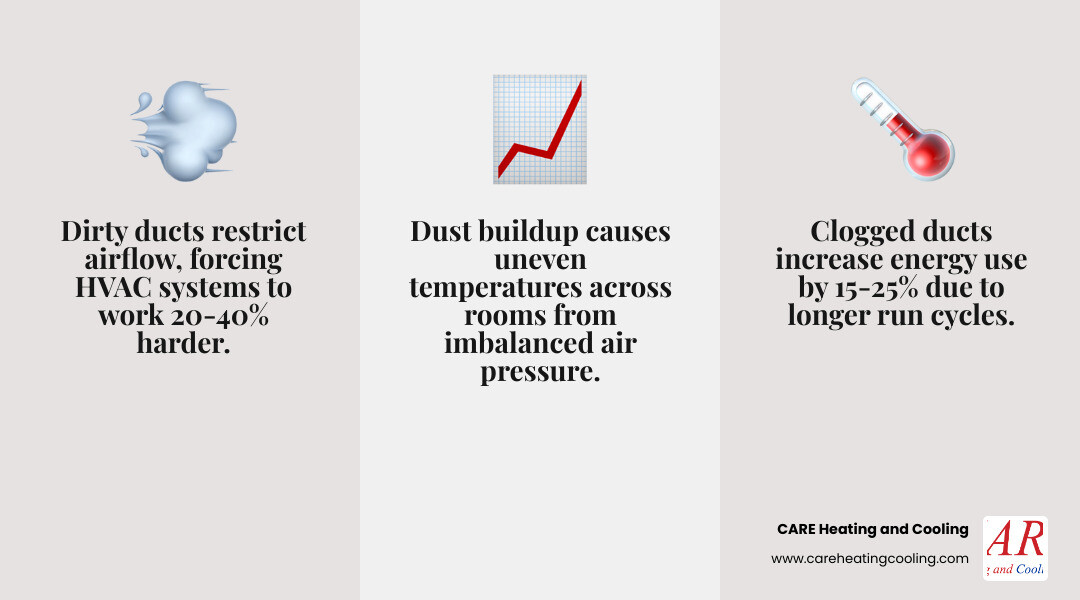
Most homeowners don’t see their ducts. They’re hidden in walls, ceilings, and crawlspaces — easy to ignore. But that out-of-sight network is one of the biggest factors in how well your heating and cooling system actually performs. According to the U.S. Department of Energy, up to 20% of energy can be lost through poorly maintained ductwork alone, and a system working against dirty ducts can use 15–25% more energy than a clean one.
In this guide, we’ll walk you through exactly what happens inside your ductwork, how to spot the warning signs, and what you can do to protect your system’s performance and your family’s comfort.
Understanding the Air Distribution Network in Your Home
To understand how dirty ducts affect your HVAC efficiency, we first have to look at what these hidden pathways actually do. Your ductwork is essentially the “circulatory system” of your home. It consists of two main parts: supply vents and return registers.
The process begins when your HVAC unit pulls air from your rooms through the return registers. This air passes through a filter and over the heat exchanger (to be warmed) or the cooling coils (to be chilled). Once the air reaches the desired temperature, the blower motor pushes it through the supply vents and back into your living spaces.
When this cycle is uninterrupted, your home stays at a consistent, comfortable temperature. However, as we move into April 2026, many homeowners in the Columbus area are finding that years of neglected maintenance have turned these “highways of comfort” into obstacle courses. Dust, pet hair, and even construction debris from past renovations settle on the floor of the ducts.
Having your Air Vents Cleaned ensures that this cycle remains fluid. Without a clear path, the blower motor has to use significantly more force to move the same volume of air, leading to a drop in overall energy efficiency.
“Why is my energy bill so high?” How Dirty Ducts Affect Your HVAC Efficiency
If you’ve noticed your monthly costs creeping up despite keeping your thermostat at the same setting, your ducts might be the “quiet thieves” in your home. How dirty ducts affect your HVAC efficiency is primarily a matter of physics—specifically, static pressure and airflow restriction.
Think of it like trying to breathe through a straw that has a few cotton balls stuck inside. You can still get air, but you have to suck much harder to get the volume you need. In your home, thick layers of dust act like those cotton balls. This buildup increases the “static pressure” within the system.
When the internal resistance of the ductwork rises, the system’s performance takes a hit. Research indicates that unclean ducts can reduce HVAC efficiency by up to 30%. In cities like Columbus, where we rely heavily on our systems during humid summers and freezing winters, that 30% loss translates directly into wasted money. If you are noticing these spikes, looking into Duct Cleaning Columbus is often the first step toward restoring your system’s original performance levels.
“Why are some rooms colder than others?” How Dirty Ducts Affect Your HVAC Efficiency
Have you ever walked from a perfectly chilled living room into a bedroom that feels like a sauna? This “stuffy room” syndrome is a classic example of how dirty ducts affect your HVAC efficiency.
Debris doesn’t always settle evenly. It often piles up at bends, elbows, or near the registers farthest from the main unit. This creates a “bottleneck effect.” The air pressure becomes imbalanced; while the rooms closest to the air handler might get plenty of conditioned air, the rooms at the end of the line suffer from a 20% or greater airflow loss.
When some rooms stay stubborn and won’t reach the right temperature, homeowners often go to the thermostat and crank it up or down. This doesn’t fix the blockage; it just forces the HVAC system to run a marathon when it should have only been a sprint. For those in our local area, checking a Duct Cleaning Westerville Guide can help identify if these hot and cold spots are due to internal clogs or mechanical issues.
“Can I lower my monthly utility costs?” How Dirty Ducts Affect Your HVAC Efficiency
The financial impact of dirty ductwork is significant. Statistics show that dirty ductwork can increase energy consumption by 20% to 40%. When the pathways are restricted, the HVAC system must engage in longer “runtime cycles.” Instead of cooling your home in 15 minutes, it might take 25 minutes to achieve the same result because the air isn’t moving fast enough.
This extra runtime is exactly what shows up on your utility bill. A typical system with dirty ducts uses 15–25% more energy than a clean system. By opting for Hvac/Delaware Oh/Air Duct Cleaning, you are essentially removing the “weighted vest” your HVAC system has been wearing.
Clean, well-maintained equipment can cut overall energy consumption by 20% to 50% compared to a neglected system. When the air flows freely, the thermostat is satisfied sooner, the system shuts off on time, and your bank account stays a little fuller.
Warning Signs Your Ductwork Needs Professional Attention
Since you can’t easily see inside your walls, you have to look for the “breadcrumbs” that dirty ducts leave behind. As we conduct inspections in April 2026, we frequently see these common red flags:
- The “Dust Ring” Phenomenon: If you see dark filtration lines or actual dust bunnies clinging to the outside of your vent covers, it’s a sign that the interior is overloaded.
- Musty Odors: When the HVAC kicks on, do you smell something “off”? Dust is organic matter (mostly dead skin cells and pet dander), which can hold moisture and lead to mold growth or bacterial odors.
- Spiking Allergies: If family members are sneezing more often or experiencing itchy eyes only when they are inside the house, your ducts may be recirculating pollen and dust mites.
- Visible Debris: If you pop off a vent cover and see a “carpet” of dust inside the boot, it’s time for a professional look.
Following an Air Duct Cleaning Local Tips Guide can help you perform a basic DIY audit of your vents before calling in the pros.
The Impact of Contaminants on System Longevity and Health
The danger of dirty ducts goes beyond just a high bill; it can actually kill your HVAC system prematurely. When we talk about how dirty ducts affect your HVAC efficiency, we also have to talk about mechanical strain.
| Component | Impact of Dirty Ducts | Long-Term Result |
|---|---|---|
| Blower Motor | Must spin faster/longer to push air through debris | Motor burnout / premature failure |
| Heat Exchanger | Reduced airflow causes it to retain too much heat | Cracks in the exchanger (safety hazard) |
| Evaporator Coils | Dust bypasses filters and coats the coils | System freeze-ups and poor cooling |
| Air Filters | Clog much faster due to recirculating internal dust | Restricted airflow and system “choking” |
When the blower motor has to work overtime, it generates more heat and experiences more friction. A system designed to last 15–20 years might give out in just 10 or 12 years if it’s constantly fighting restricted airflow. In some cases, the strain is so great that you might need a Duct Repair Westerville to fix sections that have become disconnected or damaged due to the pressure imbalances.
Beyond the machine, your health is at stake. The EPA ranks indoor air pollution as one of the top five environmental health risks. Since Americans spend about 90% of their time indoors, breathing in recirculated pet dander, mold spores, and dust mites can lead to chronic respiratory issues.
How to Maintain Peak Efficiency in Your HVAC System
Maintaining a high-efficiency home isn’t a one-time event; it’s a habit. To ensure you aren’t wondering how dirty ducts affect your HVAC efficiency next year, follow these professional maintenance steps:
- Change Your Filters Regularly: This is the single most important thing a homeowner can do. Check them monthly and replace them every 1–3 months. High-efficiency filters can trap the dust before it ever enters the ductwork.
- Schedule Professional Cleaning: The National Air Duct Cleaners Association (NADCA) recommends a professional cleaning every 3 to 5 years. However, if you have pets, smokers, or have recently done a home renovation, you may need it every 2 to 3 years.
- Seal the Leaks: Efficiency isn’t just about cleanliness; it’s about containment. Air Duct Sealing Westerville prevents conditioned air from escaping into your attic or crawlspace. The Department of Energy notes that the average home loses 20–30% of its air through leaks.
- Consult the Experts: Work with reputable Ductwork Contractors Westerville to ensure your duct system is properly sized and installed. Sometimes “dirt” isn’t the only problem—poorly designed ducts can be just as inefficient.
The EPA suggests considering duct cleaning specifically if there is substantial visible mold, a vermin infestation, or if the ducts are clogged with excessive amounts of dust and debris that are actually being released into the home.
Frequently Asked Questions about Duct Maintenance
How often should I have my air ducts professionally cleaned?
For most homes in the Columbus area, every 3 to 5 years is the standard. However, you should move that timeline up if you have shedding pets, family members with asthma or allergies, or if you’ve recently completed a dusty remodeling project.
Can dirty ducts cause my HVAC system to break down early?
Yes. By forcing the blower motor and other components to work harder and run longer cycles, dirty ducts cause excessive wear and tear. This can shorten the lifespan of your furnace or air conditioner by several years and lead to frequent, expensive repairs.
Does cleaning my air ducts really lower my energy bills?
Absolutely. While cleaning the ducts alone is helpful, the biggest savings come when a professional cleans the entire “air path,” including the cooling coils and the blower fan. Removing the resistance to airflow allows the system to reach the thermostat’s target temperature faster, reducing the amount of electricity or gas used.
Conclusion
At the end of the day, your home should be a place of comfort, not a source of rising bills and dusty air. Understanding how dirty ducts affect your HVAC efficiency is the first step toward taking control of your home’s health and your monthly budget.
At CARE Heating and Cooling, we take pride in being a different kind of HVAC company. As a family-owned business serving the greater Columbus area—from Hilliard and Dublin to Westerville and Gahanna—we’ve built our reputation on trust. We are honored to have received the BBB Torch Award for Ethics because we believe in doing the right thing for our neighbors.
Our technicians are paid to fix your system, not to hit sales quotas for new units. Whether you need a simple inspection or comprehensive Service/Duct Cleaning, we are here to ensure your HVAC system isn’t choking on dust. Let us help you breathe easier and keep your system running at peak performance for years to come.