
Why Knowing How to Tell if Your Home Humidity Is Wrong Can Save Your Health and Home
Knowing how to tell if your home humidity is wrong is simpler than most people think — your home is already giving you clues.
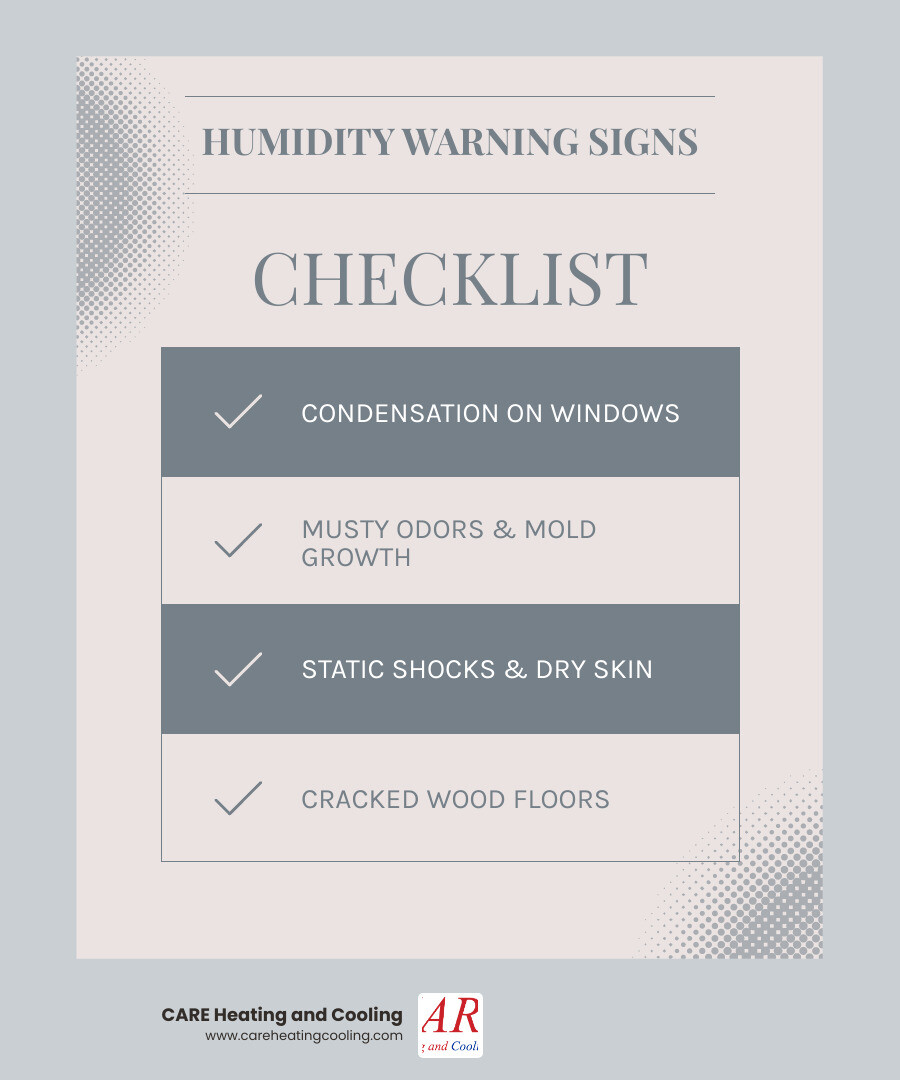
Here are the most common signs to look for:
- High humidity: condensation on windows, musty smells, mold spots, sticky or clammy air, peeling paint, swollen doors or wood floors
- Low humidity: dry or itchy skin, chapped lips, scratchy throat, static electricity shocks, cracking wood furniture or floors
- The ideal range: indoor humidity should stay between 30% and 50% (EPA recommendation)
Most homeowners don’t think much about the moisture level in their air — until something goes wrong. But humidity that’s too high or too low affects more than just comfort. It can quietly damage your home’s structure, disrupt your sleep, worsen allergies, and strain your HVAC system. According to the EPA, indoor humidity above 60% creates the right conditions for mold and mildew to take hold, sometimes within just 24 to 48 hours on damp surfaces. On the flip side, air that’s too dry dries out your sinuses, cracks wood floors, and even causes static shocks that can affect electronics.
The good news is that your home will show clear warning signs before things get serious — you just need to know what to look for.
The Ideal Balance: What Should Your Indoor Humidity Be?
Achieving the perfect moisture balance in your home is a bit like being Goldilocks—you don’t want it too wet, and you certainly don’t want it too dry. In the trade, we refer to this as “Relative Humidity” (RH). This is simply a measure of how much water vapor is in the air compared to the maximum amount that air could hold at that specific temperature.
For most homes in the Columbus area, the “sweet spot” is between 30% and 50%. Once you start creeping over 50%, you enter the “high humidity” zone. If you drop below 30%, you’re dealing with “low humidity” or dry air.
To help you visualize the stakes, we’ve put together a quick comparison of how these extremes affect your life:
| Feature | Low Humidity (<30%) | Ideal Range (30-50%) | High Humidity (>50%) |
|---|---|---|---|
| Personal Comfort | Dry skin, itchy eyes, “static” hair | Maximum comfort, easy breathing | Sticky, sweaty, “heavy” air |
| Health Impacts | Sinus irritation, increased viruses | Reduced allergens and pathogens | Mold spores, dust mites, asthma |
| Home Structure | Wood shrinkage, floor gaps | Stable wood and paint | Warped wood, peeling wallpaper |
| Energy Usage | Feels colder (higher heat bills) | Optimized HVAC efficiency | Feels warmer (higher AC bills) |
Maintaining proper Humidity Control isn’t just about avoiding a bad hair day. It’s about protecting the investment you’ve made in your home. When humidity hits 70% or higher adjacent to a surface, serious structural damage can occur. Conversely, when it’s too low, the air acts like a sponge, sucking moisture out of your furniture, your hardwood floors, and even your body.
How to Tell if Your Home Humidity is Wrong: Signs of High Moisture
Living in Central Ohio, we are no strangers to muggy summers. But when that “mugginess” follows you inside, it’s a major red flag. If you’re wondering how to tell if your home humidity is wrong on the high side, start by looking at your windows.
Foggy Windows and Condensation
If you see droplets of water or a “fog” on the inside of your window glass, your home is likely too humid. This happens because warm, moist indoor air hits the cooler surface of the glass and turns back into liquid. While it might seem harmless, that water eventually drips down into your window frames, leading to rot and mold.
The “Musty” Sniff Test
Have you ever walked into a basement or a spare room and noticed a smell that reminds you of a damp towel left in a gym bag? That musty odor is often the first sign of mold or mildew growth. High humidity over 60% can encourage mold to grow within 24 to 48 hours. If you’re noticing these smells in specific areas, you might be dealing with Humidity Problems With Ductless Ac or poor ventilation in that specific zone.
Physical Cues and Sleep Disruption
High humidity makes it harder for your body to cool itself through evaporation. This is why a 75-degree room can feel like 85 degrees when it’s humid. Research from the National Sleep Foundation even shows that high humidity increases wakefulness and reduces the quality of REM sleep. If you find yourself tossing and turning in “sticky” sheets, your air is likely the culprit.
For those dealing with chronic dampness, especially in basements or crawl spaces, Whole Home Dehumidifiers For Iaq can be a game-changer. They pull gallons of water out of the air automatically, keeping your home’s “envelope” dry and stable.
Recognizing the Symptoms of Low Humidity and Dry Air
In the winter months around Westerville and Worthington, the problem usually flips. Cold air can’t hold much moisture, and when we crank up our furnaces, that air becomes even drier.
The “Zap” Factor
If you’re getting a static shock every time you touch a doorknob or pet the cat, your humidity has likely plummeted below 30%. Low humidity increases static electricity, which isn’t just annoying—it can actually damage sensitive electronic equipment.
Health and Respiratory Irritation
Do you wake up with a scratchy throat, a bloody nose, or chapped lips? Dry Indoor Winter Air sucks the moisture out of your mucous membranes. This makes you more susceptible to colds and respiratory infections because your body’s natural defenses are dried out.
Wood Shrinkage and Gaps
Wood is a natural material that breathes. When the air is too dry, it pulls moisture out of your hardwood floors and furniture. You might notice:
- Gaps appearing between floorboards.
- Wooden doors that no longer latch properly because they’ve shrunk.
- Musical instruments (like pianos or guitars) going out of tune or developing cracks.
Addressing Humidity In Winter often requires a more robust solution than just a small tabletop humidifier. Many of our neighbors find that Hvac/Columbus Oh/Whole Home Humidifiers provide the most consistent relief by injecting moisture directly into the ductwork so every room stays comfortable.
Practical Methods for Measuring Your Home’s Air Quality
While “feeling” the air is a good start, we prefer data. If you really want to know how to tell if your home humidity is wrong, you need a way to measure it.
The most accurate DIY tool is a digital hygrometer. These are inexpensive devices (often under $20) that look like a small thermometer but display the humidity percentage. For the best results, place them in living rooms or bedrooms, about three feet off the ground. Avoid placing them near a kitchen, bathroom, or direct sunlight, as these will give you “false” spikes.
If you’re looking for a deeper dive into Improving Iaq Whole Home Humidifiers, monitoring these levels over a week can help a technician determine exactly what size system your home needs.
How to tell if your home humidity is wrong using the ice cube test
Don’t have a hygrometer? No problem. You can perform a simple “Ice Cube Test”:
- Take a glass and fill it with water and 3-4 ice cubes.
- Place it on a table in a room (not the kitchen).
- Wait about four minutes.
- Check the results: If moisture forms on the outside of the glass, your humidity is likely okay or high. If no moisture forms at all, your air is definitely too dry.
Using a wet and dry bulb thermometer
For the science enthusiasts, you can use two thermometers to calculate humidity. Wrap the bulb of one thermometer in a wet cloth (the “wet bulb”) and leave the other as is (“dry bulb”). Run a fan over both. The wet bulb will be cooler because of evaporation. By comparing the temperature difference between the two using a “psychrometric chart,” you can find your exact relative humidity. If the temperatures are nearly the same, your humidity is very high (evaporation has stopped).
Solutions for Maintaining Perfect Humidity Year-Round
Once you’ve identified a problem, it’s time to fix it. At CARE Heating and Cooling, we believe in finding the most efficient, ethical solution for your specific home.
Battling High Humidity
- The 20-Minute Rule: Running a bathroom exhaust fan for 20 minutes after a shower removes up to 80% of the moisture that would otherwise seep into your drywall.
- ENERGY STAR Dehumidifiers: If you use a portable unit, look for the ENERGY STAR label. These models are 15% more efficient than standard ones, saving you money on your electric bill.
- AC Maintenance: Your air conditioner is actually a giant dehumidifier. If it’s not draining properly or the coils are dirty, it won’t remove moisture effectively.
- Air Sealing: Homes with upgraded insulation and sealed air leaks can reduce humidity problems by up to 40%.
Fixing Dry Air
For those in the Columbus area, the most effective way to handle winter dryness is a whole-home system. However, you must Keep Whole Home Humidifiers In Condition by changing the water panel annually. A poorly maintained humidifier can become a breeding ground for the very mold you’re trying to avoid.
Using Whole Home Humidifiers Indoor Comfort technology ensures that you aren’t just treating one room while the rest of the house remains a desert.
Frequently Asked Questions
How to tell if your home humidity is wrong without a tool?
Look for physical and visual cues. If you have “hat hair” from static electricity or your skin feels tight and itchy, it’s too dry. If your skin feels clammy, your wooden doors are sticking in their frames, or you see “sweat” on your pipes, it’s too humid.
What causes high humidity in a modern home?
It might surprise you, but a family of four releases roughly two gallons of water vapor into the air every single day just through breathing, cooking, and showering! Other causes include:
- Cooking: Boiling water can increase local humidity by up to 30%.
- Oversized AC Units: If your AC is too big, it cools the room so fast that it shuts off before it has a chance to pull moisture out of the air (this is called short-cycling).
- Poor Ventilation: Modern homes are built so “tight” for energy efficiency that they can trap moisture inside.
How do seasonal changes affect indoor air?
In Columbus, April 2026 is seeing the typical swing from late-winter dryness to spring rain. As temperatures fluctuate, your HVAC system has to work harder to balance these changes. Spring is the perfect time to evaluate How Whole Home Humidifiers Improve Iaq or to switch your focus toward dehumidification as we head into the summer.
Conclusion
Understanding how to tell if your home humidity is wrong is the first step toward a healthier, more comfortable home. Whether you’re dealing with the “Columbus clammies” in the summer or the “Westerville winter itch,” there is always a solution that fits your home and your budget.
At CARE Heating and Cooling, we take pride in our “fix-not-sell” philosophy. As a BBB Torch Award for Ethics winner, our technicians are trained to evaluate your home’s unique air quality needs and provide honest recommendations. We aren’t here to push a new unit if a simple repair or a smart maintenance plan will do the trick.
If you’re tired of foggy windows or static shocks, let us help you find the perfect balance. Contact us today for Professional Humidity Control Solutions and experience the comfort you deserve.