
Why Whole Home Humidity Control Improves Comfort More Than You Think
How whole home humidity control improves comfort comes down to one simple idea: temperature alone doesn’t determine how your home feels. Humidity does too. When moisture levels in your Columbus home drift too high or too low, you feel it — sticky summer air that makes 75°F feel like 86°F, or dry winter air that leaves your skin cracked and your throat scratchy before you’ve even had your morning coffee.
Here’s a quick look at how whole-home humidity control improves comfort:
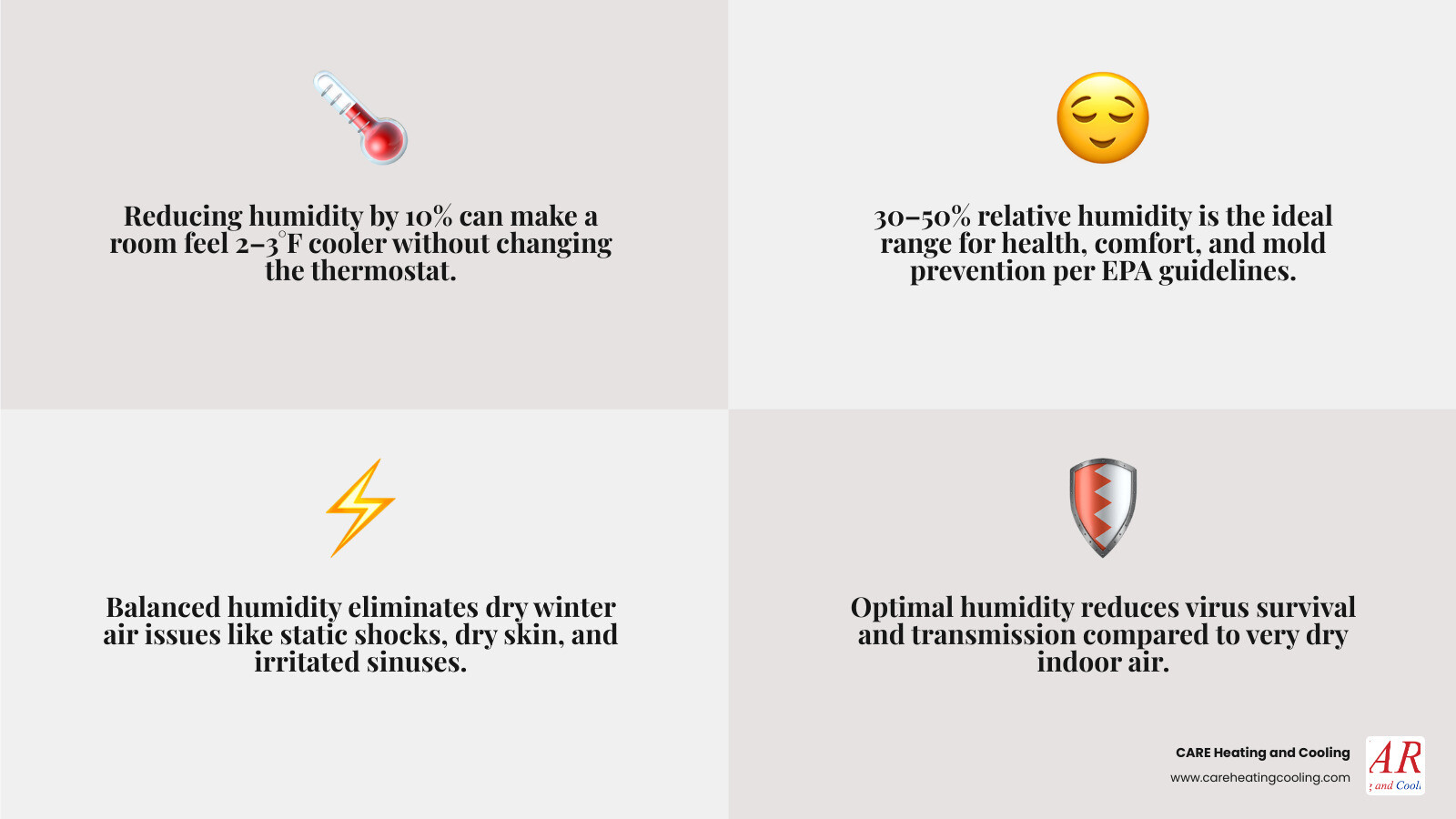
- Balances perceived temperature — reducing humidity by just 10% can make a room feel 2–3°F cooler without touching the thermostat
- Eliminates dry air discomfort — no more static shocks, dry skin, or irritated sinuses in winter
- Prevents muggy, clammy air — maintains indoor relative humidity below 60% even on the most humid Ohio days
- Improves sleep quality — moist air keeps nasal passages lubricated and reduces snoring
- Protects your home — wood floors, furniture, and structural materials stay stable year-round
- Reduces illness risk — viruses survive longer in dry air; balanced humidity helps limit their spread
- Saves energy — humidified air feels warmer in winter, letting you lower the thermostat 3–5°F without losing comfort
The sweet spot for indoor relative humidity is 30–50%, according to guidance from the EPA and the Mayo Clinic. Most Columbus homeowners find that staying in this range eliminates the most common comfort complaints — from rooms that never feel quite right to allergy symptoms that flare up for no obvious reason.
Standard air conditioning handles temperature well, but it only removes moisture as a side effect of cooling. When it’s not actively running — like during mild spring or fall days — humidity can quietly climb, and comfort quietly disappears. A whole-home humidity control system works alongside your HVAC to manage moisture independently, automatically, and consistently throughout every room.
Understanding Whole-Home Systems vs. Portable Units
When homeowners in Hilliard or Dublin realize their air is too dry or too damp, the first instinct is often to head to a big-box store for a portable unit. While these can provide temporary relief for a single small bedroom, they pale in comparison to a comprehensive Humidity Control strategy.
A whole-home system is integrated directly into your central HVAC ductwork. Instead of treating one corner of one room, it treats every cubic inch of air that circulates through your home. This level of system integration ensures that the air in your upstairs master suite is just as comfortable as the air in your basement living area.
How whole home humidity control improves comfort compared to portable units
The differences between portable units and whole-home systems are night and day. Portable units require constant attention—you have to manually refill water tanks in the winter or dump heavy buckets of condensate in the summer. They are often noisy, taking up floor space and creating “hot spots” of moisture near the machine while leaving the rest of the room untouched.
In contrast, whole-home systems offer:
- Consistent Coverage: By using your home’s existing ductwork, moisture is distributed evenly, eliminating the “clammy” or “parched” zones common with portables.
- Noise Reduction: Because the equipment is located in your utility room or basement alongside your furnace, you won’t hear the hum or gurgle of a unit in your bedroom.
- Water Line Integration: Whole-home humidifiers connect directly to your plumbing, meaning you never have to carry a water pitcher again.
- Set-it-and-Forget-it Technology: Modern systems use digital sensors to monitor the air and adjust output automatically.
Choosing between humidification and dehumidification
Depending on the time of year in Central Ohio, your home likely needs both. During our humid summers, Whole Home Dehumidifiers for IAQ are essential. They focus on “latent cooling”—removing the moisture that makes you feel sticky—allowing your AC to focus on “sensible cooling” (lowering the actual temperature).
In the winter, the opposite is true. As we heat our homes, the air loses moisture, leading to the “desert-like” conditions of dry indoor winter air. This is where How Whole Home Humidifiers Improve IAQ comes into play, adding just the right amount of water vapor to keep your skin hydrated and your family healthy.
The Science of Seasonal Comfort and Energy Efficiency
The way we perceive temperature is heavily influenced by the amount of water vapor in the air. This is why a 75°F day in the desert feels pleasant, while a 75°F day in Columbus during a July rainstorm feels oppressive.
| Condition | Winter (Low Humidity) | Summer (High Humidity) |
|---|---|---|
| Perceived Temp | Feels colder than the thermostat says | Feels hotter than the thermostat says |
| Body Response | Rapid moisture evaporation from skin | Sweat cannot evaporate; body stays hot |
| HVAC Impact | Need to raise heat to feel warm | Need to lower AC to feel “dry” |
| Home Effect | Wood shrinks, static increases | Mold risk, musty odors, wood swells |
How whole home humidity control improves comfort by regulating perceived temperature
At a common indoor temperature of 75°F, your perceived comfort can vary by as much as 11°F based on humidity alone. In the summer, high humidity prevents your sweat from evaporating, which is your body’s natural cooling mechanism. By using a dehumidifier to lower the relative humidity by 10%, you can make the room feel 2–3°F cooler. This allows you to set your thermostat higher, reducing the strain on your air conditioner and lowering your utility bills.
In the winter, Humidity in Winter management is just as vital. Moist air holds heat better than dry air. When your home is properly humidified, you can often set your thermostat 3–5°F lower while maintaining the same level of warmth. This small adjustment can lead to significant energy savings over a long Ohio winter.
Maximizing efficiency with advanced IAQ technology
To get the most out of your Humidity Control system, we often recommend integrating advanced technology like the Humiditrol Whole Home Dehumidification System. This system works in tandem with your AC to manage moisture even when the cooling demand is low.
Using variable-speed fans and smart thermostats allows for more precise control. For example, reducing the HVAC blower speed to approximately 350 CFM per ton allows air to stay in contact with the cooling coils longer, which significantly improves dehumidification. These are the kinds of Tips for Improving Indoor Air Quality that our technicians focus on to ensure your system is running at peak efficiency in April 2026.
Protecting Your Health and Home Structure
Beyond just “feeling good,” balanced humidity is a matter of health and property preservation. Your home is a collection of organic materials—wood, paper, fabric—that all react to the moisture in the air.
Signs your Columbus home has imbalanced humidity
If you live in Westerville, Marysville, or Upper Arlington, keep an eye out for these warning signs that your IAQ (Indoor Air Quality) is out of balance:
- Window Condensation: Fog or water droplets on the glass indicate high indoor moisture.
- Peeling Wallpaper or Paint: Excessive humidity weakens adhesives.
- Musty Odors: A “basement smell” usually means mold or mildew is beginning to grow.
- Static Electricity: If you get a shock every time you touch a doorknob, your air is too dry.
- Cracked Wood: Gaps in hardwood floors or cracks in furniture joints are classic signs of low humidity.
If you notice these issues, it may be time to look into Westerville Whole Home Dehumidifiers or humidification solutions to restore balance.
Long-term preservation of household assets
High-quality equipment like the Healthy Climate Whole Home Power Humidifier does more than just soothe dry skin; it protects your investment. Musical instruments, particularly pianos and guitars, can go out of tune or even crack when the air is too dry.
Similarly, excessive moisture can lead to structural issues. High humidity (above 60%) can cause wood doors to swell and stick, and it provides the perfect environment for pests and mold. In fact, mold can begin colonizing at just 55% relative humidity. Utilizing Columbus Whole Home Dehumidifiers ensures your home’s structural integrity remains intact by keeping moisture levels within the safe 30-50% range.
Professional Installation and System Maintenance
At CARE Heating and Cooling, we believe in doing things the right way. A humidity control system is only as good as its installation. We perform detailed load calculations to ensure your system is properly sized for your specific square footage and home airtightness.
Integrating humidity control with existing HVAC
Whether you have a traditional furnace and AC or you are dealing with Humidity Problems with Ductless AC, there is a solution. For homes with central ductwork, we can install Healthy Climate Whole Home Dehumidifiers or Healthy Climate Whole Home Bypass Humidifiers that work seamlessly with your existing air handler.
Proper airflow optimization is key. An oversized AC unit that “short-cycles” (turns on and off too quickly) won’t run long enough to remove moisture, leaving your home feeling clammy even if it’s cool. Our technicians are trained to identify these balance issues and correct them, ensuring your equipment works together as a single, cohesive comfort system.
Maintaining your system for 2026 performance standards
To keep your system running efficiently, regular maintenance is required. According to our Indoor Air Quality Guide 2025, you should:
- Change Water Panels: Humidifier pads (water panels) should be replaced at least once a year to prevent mineral buildup.
- Clear Drain Lines: Dehumidifier drain lines should be checked for clogs to prevent water damage.
- Calibrate Sensors: We ensure your humidistat is reading accurately so the system only runs when necessary.
- Seasonal Adjustments: In very cold weather (below 10°F), you may need to lower your humidity target to 25-30% to prevent window condensation.
Frequently Asked Questions about Humidity Control
What is the ideal indoor relative humidity for a home?
For most homes in the Columbus area, the “sweet spot” is between 30% and 50%. Staying within this range optimizes your health by keeping respiratory passages hydrated while remaining low enough to prevent mold growth and dust mite infestations. In the peak of summer, keeping it closer to 45-50% feels great; in the dead of winter, 30-35% is usually ideal to protect your windows from frost and condensation.
Can a whole-home dehumidifier work with my current AC?
Absolutely. In fact, they make a perfect pair. While your AC provides “sensible” cooling (lowering the temperature), a system like the Humiditrol Whole Home Dehumidification System handles the “latent” cooling (removing moisture). This allows the AC to run more efficiently and prevents the “muggy” feeling that occurs when an AC unit satisfies the temperature setting but leaves the air damp.
How often do whole-home humidifiers need maintenance?
Whole-home humidifiers are relatively low-maintenance, but they aren’t “no-maintenance.” You should have a professional inspection once a year, typically during your fall furnace tune-up. The most important task is replacing the water panel or steam canister, which collects minerals from your water. We also check the solenoid valve and drain line to ensure there are no leaks or blockages that could impact performance.
Conclusion
Achieving the perfect home environment is about more than just a number on the thermostat. It’s about the balance of moisture that allows your body to rest, your family to stay healthy, and your home to remain in peak condition.
At CARE Heating and Cooling, we understand that every home in Central Ohio is unique. Our technicians are paid to provide the best possible fix for your specific needs, not to push unnecessary equipment. Whether you are in Worthington, Powell, or Gahanna, we are here to help you navigate the complexities of Humidity Control with honesty and expertise. If your home feels a little too sticky this summer or a little too dry this winter, give us a call—we’ll help you find your comfort sweet spot.