
Which Humidifier Type Works Best for Your Home — Quick Answer
Which humidifier type works best for your home depends on your space, household, and how much maintenance you want to take on. Here’s a fast breakdown:
| Humidifier Type | Best For | Key Consideration |
|---|---|---|
| Whole-home (HVAC) | Entire house, low maintenance | Requires professional installation |
| Evaporative cool mist | Most rooms, families with kids | Regular wick/filter replacement |
| Ultrasonic cool mist | Bedrooms, light sleepers | Use distilled water to avoid white dust |
| Warm mist / steam | Small rooms, cold climates | Not recommended around children |
| Console evaporative | Large single spaces (up to 1,000 sq ft) | Frequent refilling needed |
For most Columbus-area homeowners, a whole-home HVAC-integrated humidifier is the most effective and lowest-maintenance solution — it covers your entire home automatically and keeps humidity in the ideal 30–50% range recommended by the EPA and Energy Star.
Dry indoor air is one of those problems that sneaks up on you. One day you notice more static shocks, then your skin feels tight, then you wake up with a scratchy throat — and suddenly your wood floors are showing hairline cracks. By the time most homeowners start researching humidifiers, their home has already been running too dry for weeks.
The truth is, not every humidifier is built the same. A small ultrasonic unit on your nightstand is a very different tool from a whole-home system tied into your HVAC. Choosing the wrong type means you could end up with a unit that’s too loud, too small, too risky around kids, or one that creates its own set of problems — like mold, bacteria, or a fine white dust coating your furniture.
In April 2026, there are more options than ever, which makes it both easier and harder to choose. This guide cuts through the noise so you can make a confident, informed decision.
Understanding the Main Humidifier Categories for 2026
When we talk about humidifiers, we are generally looking at two main delivery methods: cool mist and warm mist. Within those categories, the technology used to get moisture into your air varies significantly. Understanding these differences is the first step in deciding which humidifier type works best for your home.
Most Dry Indoor Winter Air issues stem from the fact that cold air simply cannot hold as much moisture as warm air. When your furnace kicks on, it heats that dry air, making it feel even thirstier. To combat this, portable units use one of three main technologies:
- Evaporative Wicks: These use a fan to blow air through a moistened wick or filter. They are self-regulating because the air can only absorb so much moisture based on current humidity levels.
- Ultrasonic Vibrations: These use a metal diaphragm vibrating at an ultrasonic frequency to create tiny water droplets that exit the unit as a fine mist.
- Steam Vaporizers: These use a heating element to boil water, releasing pure steam into the room.
Portable vs. Console Units
If you only need to treat a single room, a tabletop portable model is often the go-to. These are designed for personal spaces or small bedrooms, typically covering up to 250 square feet. However, if you have a large open-concept living area, you might look at a console unit. Consoles are larger, floor-standing models that can cover up to 1,000 square feet. The trade-off is the refill frequency; while a small tabletop unit might need a refill every 8 hours, a console has a much larger tank but can be heavy and cumbersome to move to a sink.
The Role of Ultrasonic Technology
Ultrasonic humidifiers have become incredibly popular by April 2026 because they are whisper-quiet. Since there is no loud fan, they are perfect for light sleepers. However, they come with a unique byproduct: “white dust.” Because ultrasonic technology breaks down everything in the water—including minerals like calcium—those minerals are propelled into the air and eventually settle on your furniture as a fine white powder. Using distilled water or mineral filtration cartridges is often necessary to keep your indoor air quality high.
Comparing Cool Mist vs. Warm Mist for Family Safety
The debate between cool mist and warm mist often comes down to who lives in your home. If you have toddlers or curious pets, safety is the primary concern.
Why Cool Mist is Preferred for Children
The American Academy of Pediatrics strongly recommends cool-mist humidifiers for children’s rooms. Warm-mist units and steam vaporizers contain boiling water and heating elements that pose a significant burn risk if a child knocks the unit over or gets too close to the steam vent.
Furthermore, cool mist is often more effective at shrinking nasal swelling during a cold. While many of us grew up with the idea that “steam is better for congestion,” the FDA notes that warm mist can actually cause nasal passages to swell further in some cases. Maintaining a steady Humidity In Winter with cool mist provides the relief without the risk.
When to Choose Warm Mist
Warm-mist humidifiers do have their place, particularly in smaller rooms during the height of a Columbus winter. Because they boil the water, they naturally kill most bacteria and mold before the moisture enters your air. They also provide a very slight warming effect to the room, which can be cozy when temperatures drop below zero. They are generally quieter than evaporative cool-mist models because they don’t require a powerful fan.
Why a Whole-Home System is Often the Best Humidifier Type for Your Home
While portable units are great for targeted relief, they often struggle to maintain consistent levels throughout an entire house. This is where whole-home systems shine. Integrated directly into your HVAC ductwork, these systems treat every square inch of your home—up to 4,000 square feet—using your furnace’s blower to distribute moisture.
Choosing a Whole Home Humidifiers Indoor Comfort solution means you never have to carry water tanks across the house or worry about a unit running dry in the middle of the night. These systems connect directly to your home’s water line. For those looking for high-performance moisture delivery, the Healthy Climate Whole Home Power Humidifier is an excellent choice for larger homes.
Bypass vs. Fan-Powered Systems
There are two primary ways these systems work:
- Bypass Humidifiers: These rely on the pressure difference between your supply and return air ducts. Air is “bypassed” through the humidifier’s moisture panel and back into the system. Units like Healthy Climate Whole Home Bypass Humidifiers are incredibly reliable and energy-efficient.
- Fan-Powered Humidifiers: These have their own internal fan to pull air across the moisture panel. This allows them to operate even when the furnace isn’t pushing air at high speeds, providing more moisture more quickly.
Smart Thermostat Integration
One of the biggest advantages of modern whole-home systems is their ability to talk to your thermostat. Improving Iaq Whole Home Humidifiers can be paired with smart controls that use outdoor sensors to adjust indoor humidity automatically. This prevents “window sweating” or frost buildup on your glass when the temperature outside drops suddenly—a feature known as “Window Protect.”
Sizing, Water Quality, and Maintenance Essentials
Selecting the right size is critical. An undersized humidifier won’t solve your dry skin issues, while an oversized one can lead to mold and condensation.
| Humidifier Type | Maintenance Frequency | Water Quality Requirement | Best Room Size |
|---|---|---|---|
| Portable Ultrasonic | Daily/Weekly | Distilled Recommended | Small Bedrooms |
| Portable Evaporative | Weekly/Monthly | Tap Water OK | Midsized Rooms |
| Whole-Home Bypass | Once per Season | Tap Water OK | Entire Home |
| Whole-Home Steam | Once per Season | Tap Water OK | Large Homes |
When calculating size, don’t just look at square footage—consider your ceiling height. If you have 10-foot ceilings instead of the standard 8-foot, you need to increase your capacity by about 20% to account for the extra air volume. Proper upkeep is also vital to Keep Whole Home Humidifiers In Condition, which usually involves a simple annual pad replacement for whole-home units.
Preventing Mold and Bacteria
Standing water is an invitation for microbial growth. If you use portable units, you must commit to “humidifier parenting.” This means rinsing the tank daily and performing a deep disinfection with hydrogen peroxide or a weak bleach solution once a week. Failure to do this can lead to “humidifier lung,” a respiratory condition caused by breathing in contaminated mist.
Managing White Dust and Mineral Buildup
If you live in an area with hard water, minerals will be your biggest challenge. In ultrasonic models, this creates the dreaded white dust. In evaporative models, minerals clog the wick, reducing efficiency and requiring more frequent replacements. If you can’t use distilled water, look for demineralization cartridges or stick with evaporative systems that trap minerals in the filter rather than blasting them into the air.
Health and Home Benefits of Balanced Moisture
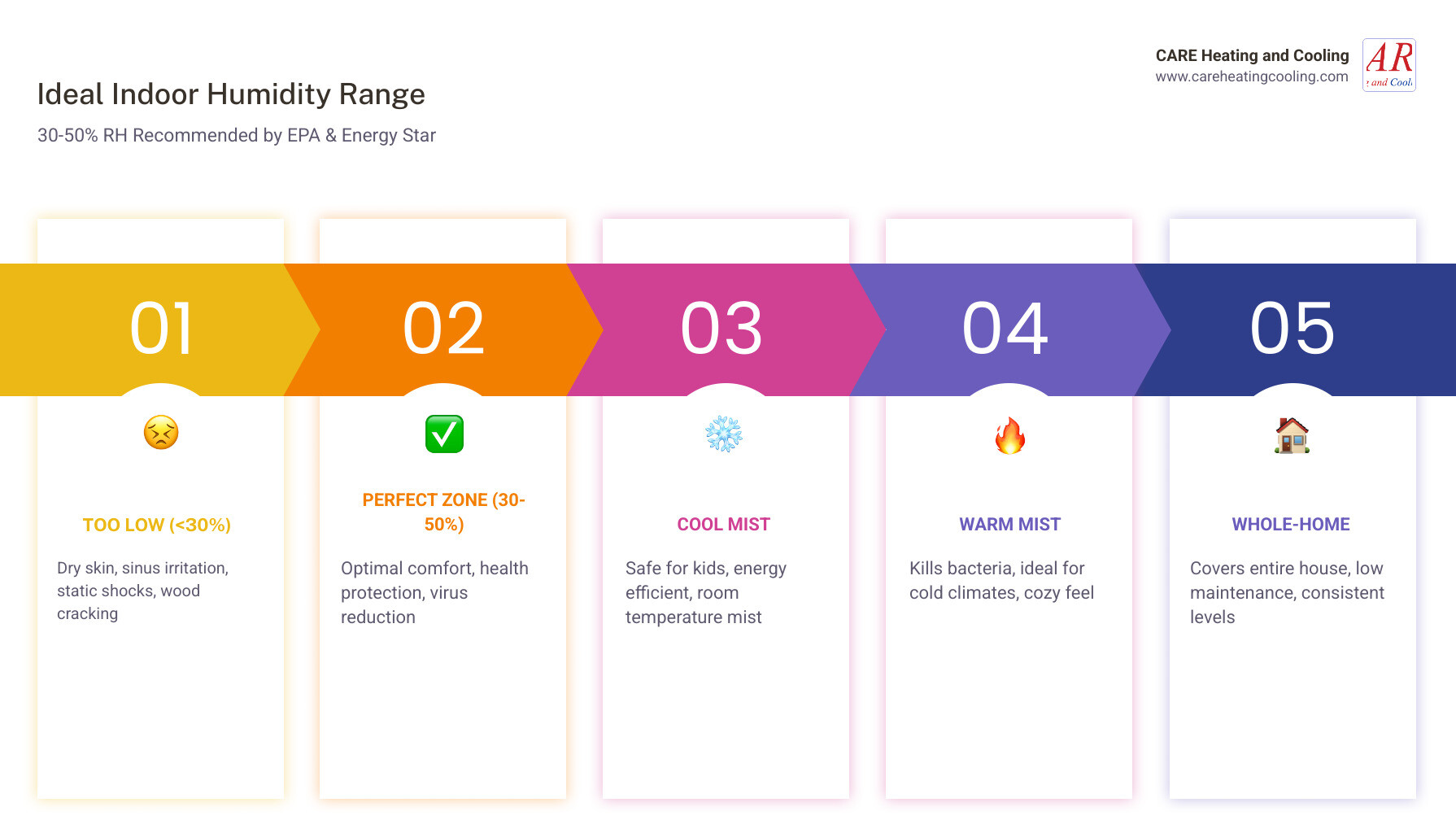
Maintaining the ideal humidity range of 30–50% (or 40–50% during flu season) isn’t just about comfort—it’s about health and property protection.
Respiratory Relief and Allergy Management
Dry air saps the moisture from your mucus membranes, which are your body’s first line of defense against viruses. When these membranes dry out, you are more susceptible to colds, the flu, and even COVID-19. Proper moisture helps thin mucus, eases asthma triggers, and can even reduce snoring by keeping your throat from becoming parched and irritated. How Whole Home Humidifiers Improve Iaq is a major factor in keeping your family healthy throughout the winter months.
Protecting Your Home’s Infrastructure
Your home is likely full of organic materials like wood and leather that react to humidity. When the air is too dry, wood floors can shrink and crack, and musical instruments like guitars or pianos can fall out of tune or suffer structural damage. Balanced moisture also eliminates that annoying static electricity that causes shocks every time you touch a doorknob or pet the cat.
Frequently Asked Questions about Home Humidification
Which humidifier type works best for your home if you have allergies?
For allergy sufferers, evaporative models are often superior to ultrasonic ones. Because the moisture is evaporated off a wick, minerals and larger particulates stay trapped in the filter rather than being aerosolized. This prevents “white dust” from irritating sensitive lungs. Additionally, whole-home systems are excellent because they don’t have standing water tanks that can grow mold if forgotten for a few days.
How do I know which humidifier type works best for your home’s size?
If you are looking for a Westerville Oh/Whole Home Humidifiers solution, a single unit integrated into your HVAC can cover up to 4,000 square feet. For portable units, measure your room’s length and width. A small room (up to 250 sq ft) needs a tabletop unit; a large or open-plan room (500–1,000 sq ft) requires a console model. Always size up if you have high ceilings or leave interior doors open.
Is a whole-home humidifier better than a portable one?
In almost every long-term scenario, yes. Whole-home humidifiers offer consistent moisture levels in every room, operate silently, and require maintenance only once or twice a year. Portable units are “point-of-use” solutions that require daily attention and only treat the immediate area around the device.
Conclusion
Choosing which humidifier type works best for your home shouldn’t be a stressful process. Whether you need a small ultrasonic unit for a nursery or a robust whole-home system to protect your hardwood floors and health, the goal is the same: a comfortable, healthy indoor environment.
At CARE Heating and Cooling, we believe in providing honest, ethical service to our neighbors in Bexley, Dublin, Hilliard, and throughout the Columbus area. Our technicians are paid to fix and optimize your home’s comfort systems, not to push high-pressure sales. If you’re tired of dry air and want a permanent solution that works for your entire house, we’re here to help.
Ready to breathe easier? Explore our options for Columbus Oh/Whole Home Humidifiers and discover why a professionally installed system is the ultimate “set it and forget it” comfort upgrade for your home.