
Why Knowing How Often Should You Change Your HVAC Air Filter Can Save Your System
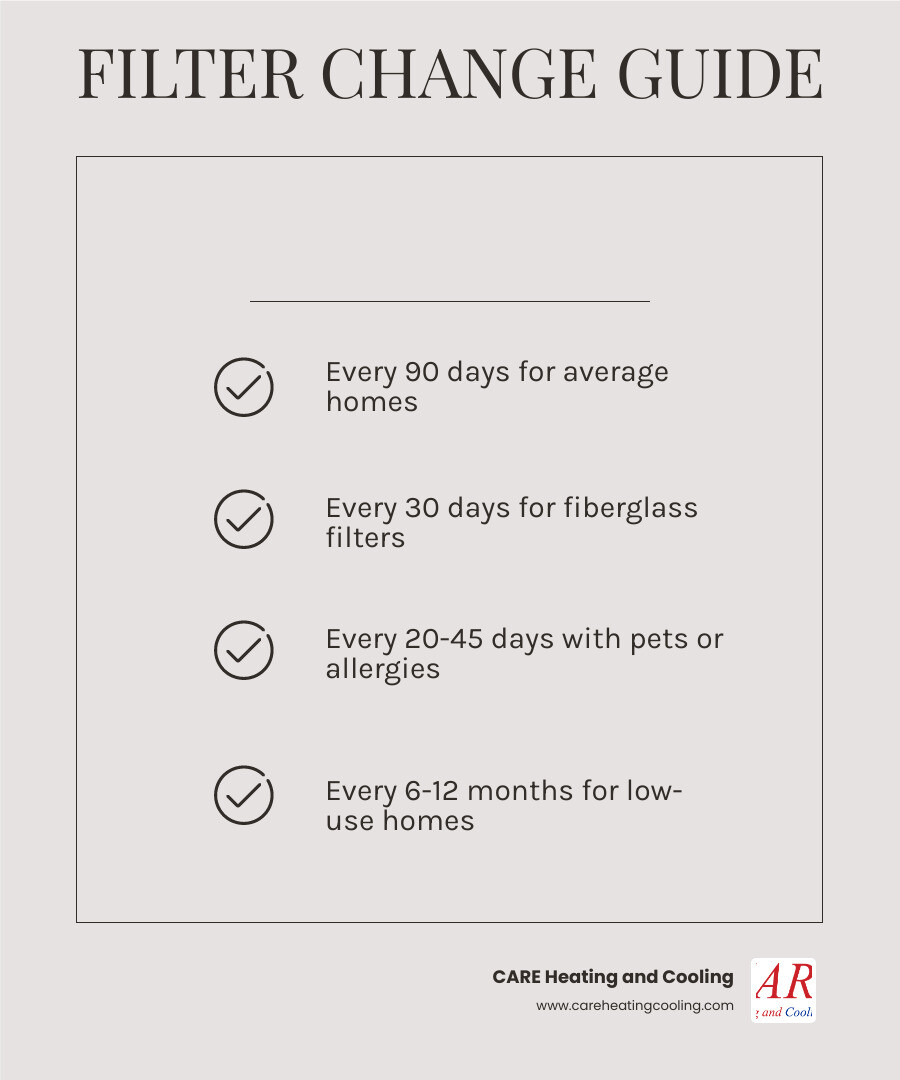
How often should you change your HVAC air filter depends on several factors, but here’s a quick-reference guide to get you started:
| Household Situation | Recommended Change Frequency |
|---|---|
| Single occupant, no pets | Every 6-12 months |
| Average home, no pets | Every 90 days |
| One pet | Every 60 days |
| Multiple pets or allergy sufferers | Every 20-45 days |
| Fiberglass filter (any home) | Every 30 days |
| Vacation or rarely used home | Every 6-12 months |
Most homeowners never think about their air filter — until something goes wrong. It’s tucked away out of sight, so it stays out of mind. But that small panel of fiberglass or pleated media is quietly doing one of the most important jobs in your home: keeping your HVAC system breathing freely and your indoor air clean.
When that filter gets clogged, your system has to work harder to push air through. That extra strain shows up as higher energy bills, uneven temperatures, and — if left long enough — serious mechanical damage. According to the U.S. Department of Energy, simply replacing a dirty, clogged filter can improve your system’s efficiency by 5 to 15%. That’s a meaningful difference for something that takes less than five minutes to fix.
At CARE Heating and Cooling, we believe the best HVAC advice is honest advice. So let’s walk through exactly what determines your filter schedule — and how to know when it’s time to swap it out.
How Often Should You Change Your HVAC Air Filter?
In home maintenance, the 90-day mark is often cited as the gold standard. However, as we move through April 2026, we’ve learned that a “one-size-fits-all” approach doesn’t really work for the diverse homes in the Columbus area. While a 90-day baseline is a great starting point for a standard residential household, the actual timing depends heavily on the specific air handler you have and the environment inside your home.
Whether you live in a brand-new, tightly sealed home in New Albany or a charming historic property in Clintonville, your system’s longevity is directly tied to how well it can “breathe.” Manufacturers provide general guidelines, but these are often based on ideal laboratory conditions. In the real world, factors like how often you run your fan and the quality of the filter itself dictate the schedule. When To Change Your Furnace Filter is a question of balancing air quality with equipment safety.
How Often Should You Change Your HVAC Air Filter Based on Material?
The material of your filter is the biggest technical factor in its lifespan. Not all filters are created equal; some are designed to be “rock catchers” that protect the equipment from large debris, while others are high-tech screens that trap microscopic allergens.
- Fiberglass Filters: These are the thin, blue or white filters you can almost see through. They are incredibly affordable but have very little surface area. Because they clog quickly, they generally need to be changed every 30 days or less.
- Pleated Media Filters: Made of folded polyester or cotton paper, these have much more surface area to trap dust. A standard 1-inch pleated filter usually lasts up to 90 days in an average home.
- High-Capacity 4-inch to 5-inch Filters: These thick filters, like the Lennox Healthy Climate CarbonClean 16, are designed to last much longer. Because they have a massive amount of surface area, they can often go 6 to 12 months before needing a replacement.
| Filter Thickness | Typical Material | Recommended Interval |
|---|---|---|
| 1-inch | Fiberglass | 30 Days |
| 1-inch | Pleated | 60–90 Days |
| 4-inch | Pleated Media | 6–9 Months |
| 5-inch | High-Efficiency | 9–12 Months |
Residential vs. Commercial Replacement Schedules
While we primarily serve homeowners, it’s helpful to understand that commercial buildings operate on a completely different scale. In a residential setting, occupancy is low and the air volume is manageable. In commercial spaces—like offices in downtown Columbus or retail spots in Gahanna—the high occupancy and constant foot traffic mean the HVAC system moves massive volumes of air.
Commercial systems often require monthly inspections and changes because of higher industrial dust loads and the sheer number of people shedding skin cells and hair. For your home, you don’t need a commercial-grade schedule, but if you run a home business with frequent clients or have a large family, you might find your needs leaning toward that more frequent commercial-style interval.
Key Factors That Impact Your Replacement Schedule
Your home is a living environment, and everything from the size of your floor plan to what’s happening outside your front door changes the math on how often should you change your hvac air filter.
If you live in a large home in Dublin or Powell, your HVAC system has to circulate a much higher volume of air to keep every room comfortable. More air moving through the filter means more dust is deposited there every hour. Conversely, a small condo in Westerville might see its filter last the full 90 days because the total air volume is lower.
Environmental factors are just as important. If you live near a new construction site in a growing area like Sunbury or Marysville, the amount of airborne dust and debris is significantly higher. This fine grit can clog a filter in a matter of weeks, leading to immediate airflow restriction. Keeping that filter clean ensures you get that 5–15% efficiency boost, keeping your system running as smoothly as the day it was installed.

How Often Should You Change Your HVAC Air Filter with Pets and Allergies?
For our neighbors with furry friends, the schedule accelerates quickly. Pet dander and fur are “heavy” contaminants compared to household dust. One cat or dog can easily cut a filter’s lifespan by a third. If you have multiple pets, we recommend checking that filter every 20 to 30 days.
Allergies and asthma are another major consideration. If members of your family suffer from seasonal allergies or respiratory issues, the filter isn’t just protecting the machine—it’s protecting them. Allergies Another Reason To Change Your Furnace Filter because a dirty filter can actually become a source of pollutants, releasing trapped spores back into the air. In these cases, 20-45 day intervals for high-quality pleated filters are ideal to keep pollen counts low indoors.
Seasonal Usage and the Columbus Climate
In Central Ohio, our HVAC systems are rarely at rest. During the peak summer cooling months in July and the freezing winter nights in January, your system is cycling almost constantly. This heavy usage means the filter is trapping dust 24/7.
We also have to account for regional environmental shifts. Agricultural dust during harvest season in surrounding areas like Ostrander or Plain City can impact indoor air quality. Additionally, if you prefer to keep your thermostat fan in the “ON” mode rather than “AUTO” to keep air moving and filtered, you are effectively running the air through the filter much more often, necessitating more frequent changes.
Signs Your Filter Needs Immediate Attention
Sometimes the calendar isn’t the best guide. Your HVAC system will often tell you when it’s “choking.” One of the most common signs is a noticeable increase in dust on your furniture shortly after cleaning. If the filter is full, it can’t trap any more particles, and they simply circulate back into your living space.
You might also notice longer cooling or heating cycles. If your AC is running for an hour to drop the temperature just one degree, it might be struggling to pull enough air through a clogged filter. In extreme cases, you may even notice a musty odor or a slight “burning” smell as the blower motor overworks and heats up.
How to Visually Inspect Your Filter
The most reliable way to check your filter is the “Light Test.” It’s simple, fast, and foolproof.
- Turn off your system: Always turn the HVAC off at the thermostat before removing the filter to prevent loose dust from being sucked into the unit.
- Remove the filter: Take it out of the slot and hold it up to a bright light source (a lamp or even the sun).
- Check for light: If you can see light passing through the material, it still has some life left. If the light is blocked by a thick layer of grey debris, it’s time for a change.
When you slide the new filter in, pay close attention to the arrow printed on the frame. This arrow indicates the direction of airflow. It should always point toward the HVAC unit (the furnace or air handler) and away from the return duct.
Understanding MERV Ratings and Filter Benefits
When shopping for filters, you’ll see a MERV (Minimum Efficiency Reporting Value) rating, usually ranging from 1 to 16 for residential use. A higher MERV rating means the filter can trap smaller particles.
- MERV 1-4: Basic filtration, mostly to protect the furnace from large dust bunnies.
- MERV 8-11: The “sweet spot” for most Columbus homes. It traps most allergens without putting too much strain on the motor.
- MERV 13-16: High-efficiency filters that can trap bacteria and smoke particles.
While it’s tempting to buy the highest MERV rating available, you have to be careful. A filter that is too “thick” for your system to handle creates high static pressure. This makes the blower motor work much harder, which can lead to premature failure. We often recommend Healthy Climate Replacement Air Filters because they are designed to balance high-efficiency particle trapping with proper airflow.
The Consequences of Neglect
What happens if you ignore that dirty filter? It isn’t just about dust. A clogged filter restricts airflow so much that the evaporator coil in your AC can actually freeze over, turning into a block of ice even in the middle of a Columbus summer. In the winter, restricted airflow can cause the heat exchanger to overheat, which can lead to cracks—a serious safety hazard.
Neglecting your filter leads to increased energy bills and, eventually, a total system failure that could have been avoided with a simple, inexpensive part.
Frequently Asked Questions about HVAC Filters
Is it safe to run my HVAC without a filter?
No, you should never run your system without a filter for more than a few minutes (perhaps while you run to the store to get a replacement). Without a filter, dust, pet hair, and debris go directly into the internal components. This can coat the sensitive coils and the blower motor, leading to expensive repairs or total system failure. It is much cheaper to buy a filter than to clean a clogged evaporator coil.
How do I know which direction the filter should face?
Look for the arrow on the side of the filter frame. That arrow represents the direction the air is moving. Since the return duct brings air to the furnace to be heated or cooled, the arrow should point toward the furnace or air handler unit. If you install it backward, the filter won’t be as efficient and could even collapse under the pressure of the airflow.
Do thicker filters always last longer?
Generally, yes. A 4-inch or 5-inch deep-pleated filter has significantly more surface area than a standard 1-inch filter. Think of it like a long, winding road versus a short one; there’s just more room for the dust to settle before the “road” gets blocked. However, your system must be specifically designed or modified with a special housing to hold these thicker filters.
Conclusion
Taking care of your HVAC system doesn’t have to be complicated. By staying on top of how often should you change your hvac air filter, you are taking the single most effective step toward a comfortable, efficient home. Whether you’re in Hilliard, Pickerington, or right here in Columbus, a clean filter is the key to lower bills and better air.
At CARE Heating and Cooling, we’ve built our reputation on being ethical and trustworthy. We were honored with the BBB Torch Award for Ethics because we do things differently—our technicians are paid to fix your system, not to push a high-pressure sale for a new one. If you’re Having Problems Remembering To Replace Your Furnace Filter, we have plenty of tips to help you stay on track.
Ready to ensure your home stays a haven of comfort all year long? Schedule your professional air conditioning service in Columbus today and let our expert team give your system the CARE it deserves.